


What is the story about?
Author’s
note: A full transcript of the video is available at this link.
Here is a written account of my conclusions about the game for those who prefer to use the video only for play breakdowns.
- Each team had a garbage time possession at the end of the 2nd quarter without sufficient time in the half to realistically score. The whole game went into garbage time when Illinois took a 21-10 lead with 2:29 remaining. This left both teams with 10 meaningful offensive possessions.
- Oregon lost this game because of the lack of production in their passing game. Unable to put up more than 10 points all Illinois needed were a handful of super explosive plays leading to touchdowns, which the Ducks’ defense surrendered.
- For the first time this season Oregon was able to establish efficiency when running the ball, but a poor game plan meant they did not exploit this to its greatest potential, resulting in the overall poor performance.
- Though less culpable for the outcome, the Ducks’ defense has issues to address after allowing Illinois to rush the ball more effectively than in the first half of their season.

- Halfway through the season Oregon’s offense found an offensive line combination that allowed them run the ball efficiently, though reliably explosive rushing is still beyond their capabilities. Using OL #70 Koloi Kelli as an extra blocker has had mixed results at best and I think TE #18 Harrison should see the field in his place. He was available in this game, but only appeared on one drive.

- The gains in the rushing offense were not properly leveraged in the passing game. The game plan was conservative (perhaps understandably given WR availability). The team took deep shots and ran trick plays but at inopportune times (1st or 2nd and 10 instead of 2nd or 3rd and short), and failed to play to QB #8 Raiola’s strengths (0 called RPOs on my tally sheet). Raiola himself struggled having to deal with pressure and tended to check the ball down even when he had time and better options were available.
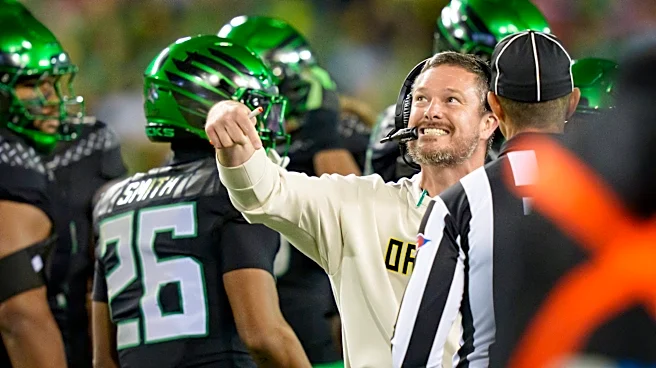
- Even more so than the previous two weeks, I think much of the poor performance by the offense can be attributed to poor play calling and game plan design (and head coach Dan Lanning apparently agreed with me). The offense can improve during the remainder of this season if the new play caller(s) play more to their personnel’s strengths, but there are more fundamental issues that can only be addressed in the off season and will probably involve further staff turnover.
- In addition to 4 of the top five receivers on the depth chart (1 confirmed injury, 1 confirmed disciplinary issue, two unknown) unavailable for this game, freshman OL #79 Immanuel Ihenacho was also out this game. This means we will need to wait at least one more week for the experiment with him at left tackle hythloday and I have both advocated for.
- The offensive line was the same as it was at the end of the Nebraska game, i.e., from left to right: #59 OL Fox Crader, #77 Tommy Tofi, OL #72 Iapani Laloulu, OL #55 Douglas Utu, and OL #78 Gernorris Wilson.
- The only substitutions on the line were when the Ducks broke out a unique short yardage I-formation that took both tackles off the field, replaced them with reserve guards, and also used OLB #10 Uiagalelei as a TE and OLB #44 Tatum Tuioti as a fullback. The note I have in my tally sheet for this is simply “Mr. Horse.”

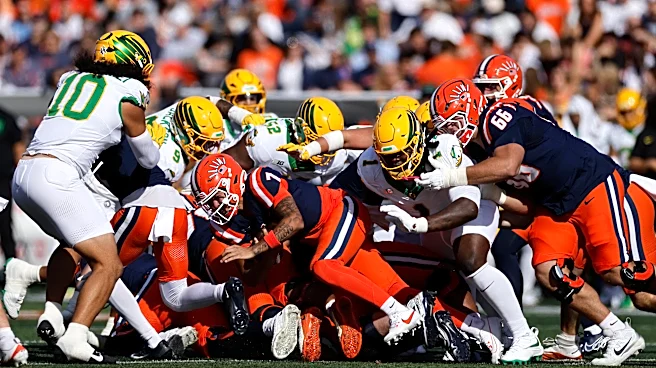
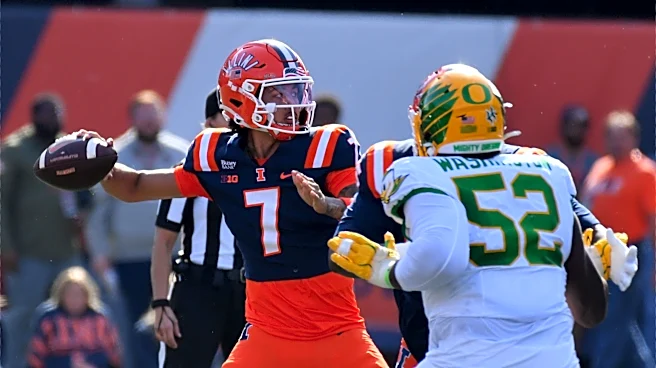
- The Ducks’ defense allowed Illinois to rush the ball more productively than they did in the first part of their season. When the Illini emphasized the run more in the second half (opening the 3rd quarter by using their running QB #2 Boyd) it let them control possession and limit the opportunity for an Oregon comeback. The effect of using their more efficient run game compounded as the second half continued with fatigue taking a toll on the Ducks’ defense.
- Part of this may be explained by the Illini getting some OL back from injury, but on film the defensive issues were outside contain, dealing with a mobile quarterback, and run discipline from the safety position. These issues can be addressed, but they are also vital to address going forward.
- Oregon did an excellent job containing Illinois’ two very capabable wide receivers, the only 2 explosive pass plays were circus catches and the other passing touchdown came on a specifically engineered red zone play.
- The defense cannot be primarily blamed for this loss when holding Illinois to only 21 points, but they did not play to their own high standards and cannot afford to repeat the same errors defending the run going forward.
- In addition to starting boundary safety DB #21 Aaron Flowers, Oregon spent most of the game without starting CB #2 Na’eem Offord. As best I could tell he might have been shaken up tackling a jumping receiver after a catch in the 1st quarter as he rotated on and off the field for a time but I didn’t notice him in the second half at all. In his absence starting nickel DB #4 Brandon Finney moved back out to corner and was replaced with DB #5 Davon Benjamin, who graded out solidly in relief.
- 0:00 – Introduction
- 1:06 – Oregon’s mis-timed shot plays
- 3:32 – The efficiency run game
- 8:09 – “Turtling” in play calling 1
- 10:55 – Raiola checking down
- 13:52- “Turtling” in play calling 2
- 16:49 – Summary of the Offense
- 18:58 – Pass defense 1
- 21:16 – Pass defense 2
- 24:57 – Rush defense success
- 28:19 – Giving up chunk runs 1
- 32:27 – Giving up chunk runs 2
- 35:19- Summary of the Defense
- 36:24- Conclusion