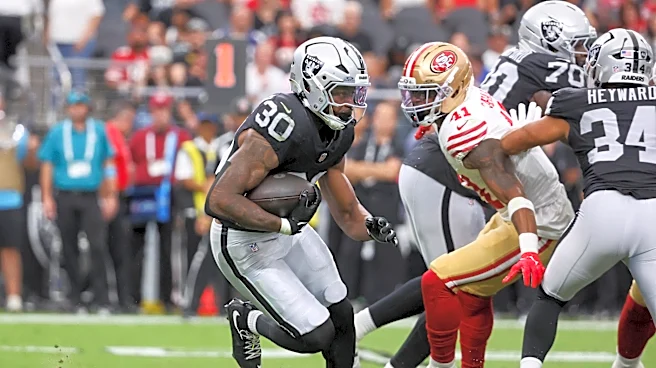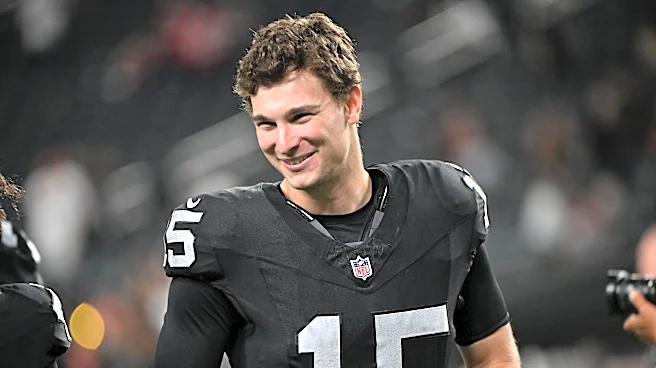



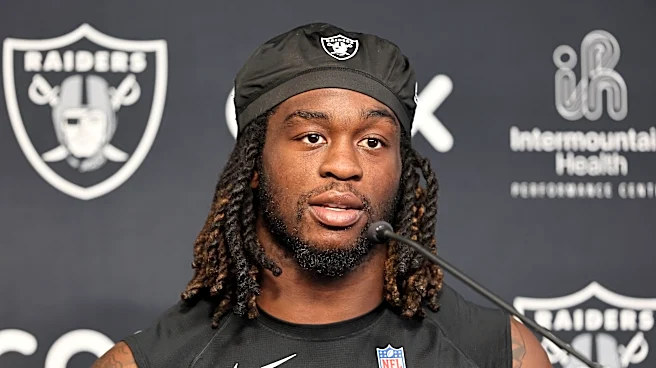
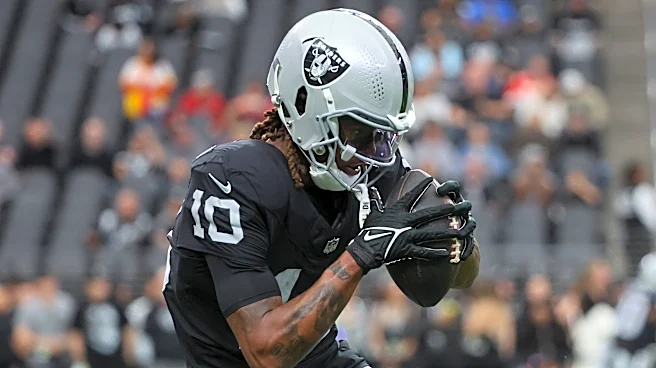
Ashton Jeanty’s ankle ailment was certainly a cause for concern.
The Las Vegas Raiders’ workhorse running back went down with the ankle injury back on August 23 during practice where he dove for a low pass and landed awkwardly. The ensuing silence and players and coaches kneeling was concerning, as was Jeanty unable to put weight on his right foot.
But, in a turn of fortuitous events for the Silver & Black, it appears Jeanty avoided a serious injury.
The team not placing Jeanty on injured reserve with
a designated to return qualifier during cutdown day this past Sunday — when all 32 NFL teams needed to be at the mandated 53-man roster limit — portends to good things. (Not so much for 2026 Draft third-round pick Keyron Crawford who landed on season-ending injured reserve after suffering a serious ankle injury of his own in the third quarter of the preseason finale against the San Francisco 49ers last Thursday.)
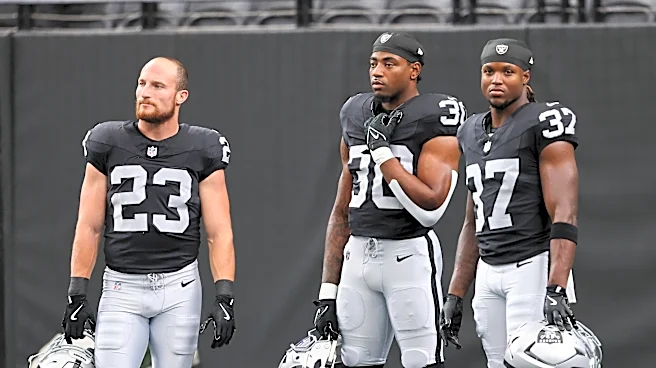
And Las Vegas rolling with a trio of tailbacks on the initial 53 (Jeanty, ravishing rookie Mike Washington Jr., and Dylan Laube) adds more fuel to the positivity fire regarding the starting running back.
“He’s still on the mend and we’re still working to get him back. We got another week to assess how he’s going to look going into this first game, but we’re counting on him,” Raiders head coach Klint Kubiak said regarding Jeanty.
The injury scare produced a really good question for Las Vegas: Is Kubiak’s offense plug-and-play for any running back?
The answer: A resounding no.
While Kubiak’s ground game is philosophically based on the Shanahan-Kubiak (his father Gary, who himself is a disciple of the elder Shanahan, Mike as both a player and coach) wide-zone system — famous for turning mid- to late-round and even undrafted free agents into solid contributors — the scheme does require a highly specific skillset both mental and physical.
Versatility Vortex
Here’s the biggest rub when it comes to running backs in a Klint Kubiak offense: Alignment.
Tailbacks don’t just line up in your standard I-formation behind the quarterback and fullback. Kubiak’s system heavily utilizes pre-snap motion, split-back sets, and formations shifts that call for running backs to line up as a perimeter receiver or even in the slot, before motion or shift calls them back to the traditional tailback spots in the backfield or keeps them out the outside/slot to run routes.
Kubiak deploys running backs this way to create mismatches and to force defenses to show their hand with coverages, blitzes, etc.
But that aspect above is what looms large as a play caller simply can’t put any tailback out wide or in the slot if they’re not effective route runners and receivers. They are high-volume targets in Kubiak’s system where running backs often finish in the top five in terms of targets and receptions.
Jeanty, Washington, Laube, and practice-squad additions Dare Ogunbowale (veteran) Roman Hemby (undrafted free agent) bring the skillsets to be to do so in Kubiak’s Raiders backfield. Laube even showcased the slippery nature he provides as a receiving running back during the preseason — showcasing more confidence than he did the prior two coaching regimes.
Then there’s all-important pass protection ability.
In obvious passing downs, running backs in Kubiak’s offense need to handle the complexity of blocking. That means using the same snap-decision making running with the ball while protecting the quarterback as NFL defenses these days send a dizzying array of defensive fronts, blitzes (both simulated and actual), and the tailbacks must hold up physically against incoming defenders be they edge rushers, linebackers, or defensive backs. While Jeanty and Laube are “smaller” at 5-foot-8, 208 pounds and 5-foot-9 and 204 pounds, respectively, both have shown the ability to pass protect. And at 6-foot-2 and 228 pounds, Washington should be able to hang, as well.
Run Requisites
The Kubiak scheme very much relies on the one-cut decisiveness that’s been a staple alongside the zone blocking concepts that make it work. Thus, the core tenets of the outside/wide zone where running back’s can’t afford to dance or hesitate in the backfield are present. We’ve seen this in fleeting moments when Jeanty got carries in preseason action and most notably Washington’s decisiveness when the rookie plants and turns on the jets.
In fact, we’ve seen the rookie exhibit the Three Bs — bang, bend, bounce — where he slices through the primary crease vertically, cuts back against the grain on backside lane, or even bounces it outside to the edge to out-run defenders.
Kubiak, however, isn’t an obtuse coach or play caller. Putting his players in the best possible position during his tenure as the offensive coordinator for the Seattle Seahawks Super Bowl run last season resulted in him incorporating more gap and power schemes into his repertoire. And we’re seeing exactly that in Las Vegas.
Washington arrived to the Silver & Black from a heavy gap system deployed in Arkansas and instead of plugging the talented tailback into the zone system, Kubiak has called toss and perimeter plays to help create space, give Washington ample time to mentally get in-tune, and force him to let blocks develop.
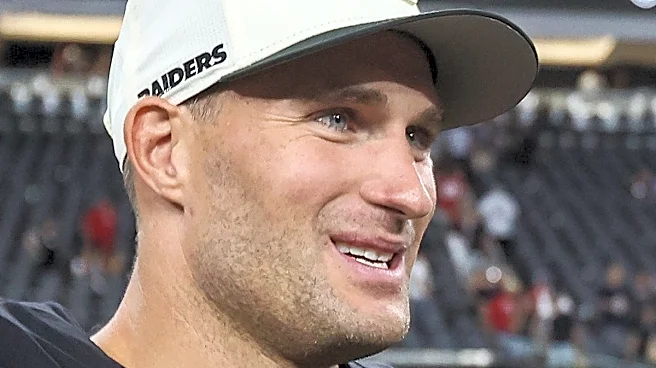
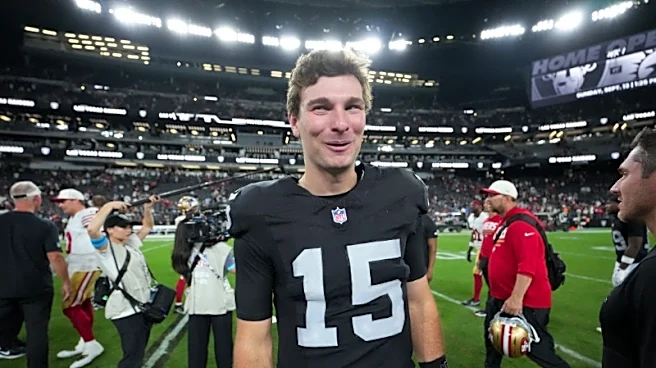
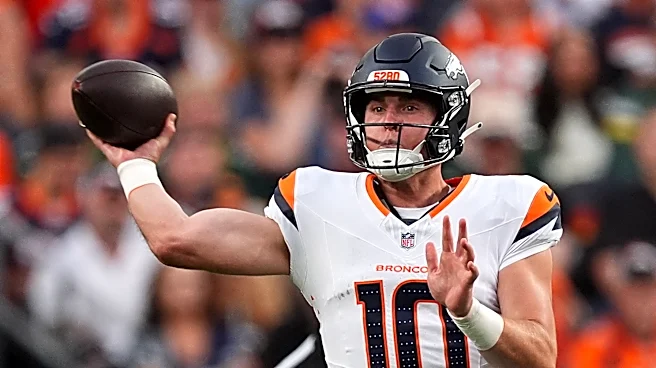
A consistent and effective ground game is instrumental in the play-action concepts Kubiak plans to deploy with veteran quarterback Kirk Cousins (and prized No. 1 overall pick Fernando Mendoza) success. Being able to run the ball for yards and aggressively sell a run to freeze defenders — facilitating to intermediate and deep shots downfield via the air attack — will be something to eye this season. It’ll take every part of the offense — offensive line, quarterback, running backs, wide receivers, and tight ends — to work in unison to make it click.
And in those particular play action instances, you’ll get to see exactly the responsibility placed on the running back. Whether they remain in the backfield as a blocker, or an outlet target sneaking out of the backfield, or running specific routes as a receiving option, it’s a lot to handle.
Which harkens on Kubiak’s system not being a plug-and-play type for running backs.