


It’s that time of the year again when you fine folks get to listen to my rather long-winded nerd-out sessions talking about scheme topics. For the 6th(?!) year, I, as UW Dawg Pound’s resident Film Study nerd, will attempt to peel back the layers of the game to help hardcore Husky fans like myself understand the game a little bit better as they’re taking it in on Fall Saturdays. For the last four preseasons I’ve spent time diving into the off-season’s developments in an attempt to figure out what
schematic, philosophical, or any other X’s & O’s types of changes we should be on the look out for from the staff in the upcoming season. This year, with relatively minimal turnover in the starting line up and at the staff level, our focus shifts away from learning new schemes and towards the leaps we could make as our young roster finally has a chance to take the next step.
Let’s dive in.
Evolution of Fisch’s Offense – Demond Year 3

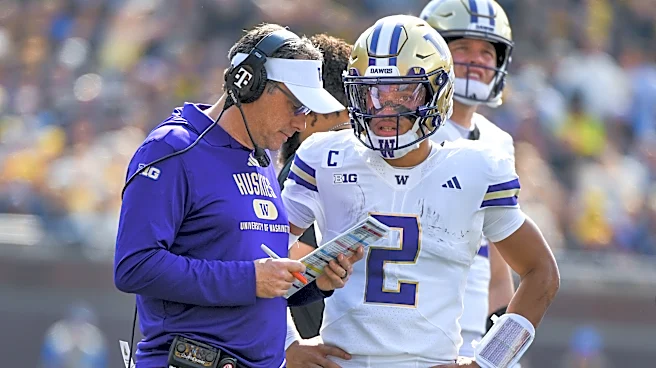
It’s year 3 for both Jedd Fisch and Demond Williams on Montlake, and expectations are high for the duo. Fisch has always pointed to Demond as the “face of the franchise” and the QB who would lead the Huskies to victory. With numerous spot appearances and a couple of promising starts in 2024, UW fans had reasonably high expectations of the then-sophomore heading into 2025. His accuracy through the air and dynamic athleticism on the ground continued once given the starting responsibilities during the 2025 campaign, to the tune of 3000+ passing yards, 600+ rushing yards, 31 TDs, and nearly 70% completions.
That type of production from a second year player handling starting duties for the first full season is very impressive, but finding ways to take the next step, and pushing the ceiling, is always a challenge with QBs like Demond. In my limited experience, the biggest leap in production for QBs, particularly athletic ones, comes once they understand the basics of operating the offense. They know where the first read and safety valve options are, and the game’s slowed down enough for them to make smart decisions that prevent negative plays and turnovers. They also know that if a play starts to go sideways, they can improvise with their athleticism. Usually, between the limited negative plays, taking the safe completions, and a little bit of running, you can find enough success to beat comparable or lesser teams. However, that’s not what gets you a win over a superior opponent.
If you go back and look at a game log of Demond’s production from the 2025 season, you can see this trend play out. His highest production games came against similarly talented or lesser opponents, and his lowest production games came against the best teams on the schedule, even though he maintained relatively high completion percentage. In short, he’s been fairly successful because he was risk averse, but now he needs to add back in the right amount of risk taking to elevate his game to the next level.
Changing that mindset in a measured and responsible way is hard enough on its own, but in 2026 Demond will have to do that without the help of Jonah Coleman or Denzel Boston. One way I think Fisch will help with this is with the continued expansion of the QB run game package. Last offseason, Jedd Fisch said on the record that they had reworked their scheme to take advantage of Demond’s unique skill set, and it was evident in several games last year how effective some of those changes could be. Concepts such as:
QB Zone

Counter Bash

Zone Slice Option

Leaning even harder into the QB run game and option game does a few things for Fisch and Demond.
- It adds diversity, and hopefully explosiveness, to a run game that is still searching for a lead back but should be running behind a good line.
- It capitalizes on Demond’s potentially game altering athleticism.
- It adds more looks that we can take advantage of with the play action passing game.
- It takes the pressure off Demond to manufacture explosive plays through the air.
Another schematic shift I’m expecting is a renewed focus on the mid-field passing game. I spent quite a bit of time last offseason speculating how Fisch would tailor the passing attack to suit Demond’s strengths and cover up his weaknesses, and what we ended up seeing was an offense that emphasize the perimeter and downfield portions of the field. I’ve speculated that this was to provide Demond with cleaner passing lanes and clearer reads. However, with leading returning WR Dezmen Roebuck moving into the slot and a restocked TE room led by 3rd year contributor Decker DeGraaf, Demond’s best receiving weapons seem to be concentrated in the middle of the field.
Slot receivers and TEs have been highly productive when featured in Fisch’s past offenses, so keep an eye on if the play calling this season shifts back towards the middle of the field, or if Fisch continues to give call easy access passing concepts to protect Demond.
Defense According to Walters

In last year’s version of this article, I spent a lot of time focusing on how Ryan Walters’ defensive background, primarily influenced by man-heavy, pressure-oriented, Odd defenses, could represent a major departure from the defenses we had seen on Montlake dating back to the Jimmy Lake days. However, after a year under Walters, it’s become clear that his excellence as a defensive coordinator is rooted more in his ability to adapt the scheme to his players’ strengths rather than the scheme itself.
While Odd fronts were utilized at times in 2025, the Husky defense still played most of their snaps in the more familiar Even fronts. In coverage, while we had NFL-caliber CBs in Ephesians Prysock and Tacario Davis, we got more milage out of zone coverages that better allowed our revamped LB corps and younger DBs to contribute as key playmakers. Now, with a talented 2026 recruiting class on campus, and another offseason to rep the full defensive playbook, the question heading into 2026 is how we’ll take the next step under Walters.
One option would be to build off of the foundation established last season and supplement with the new talent. The defense’s near-perfect bowl performance against Boise State gives us the best example of what that could look like. Aside from the Even fronts and zone coverages that I’ve already mentioned, Walters by that point in the season had really fine tuned how to best deploy our personnel in specific packages and situations. Here’s a couple excerpts that game’s Film Study article that capture what I mean.

This play is a great example of how Walters took his core defensive principles and restructured the scheme to feature the zone coverage that was key to our defensive success. Finally, this play is a great example of how Walters tries to incorporate disguises and player versatility within the scheme to create plays rather than relying on pure talent to win (whole is greater than the sum of the parts).
Setting up the play, Boise’s in a 3rd & medium near mid field, and we’d been playing stingy against their run game, so it’s likely a passing situation. Walters wanted to throw something at Boise’s QB that would throw him off, but he didn’t want to get to put us in a field-flipping, big play situation when a short gain might get them off the field, so he elected to go with a Zone Blitz. Before the savvier readers get after me, technically this isn’t a blitz because we are only rushing four, but let’s just go with it because we’re bringing an atypical rusher (the CB) into the mix on the rush.

Taking a look at my rough diagram above, the pressure design is leaning heavily on disguise, angles, and alignment to do the heavy lifting in place of raw talent or numbers (again, looking to use the scheme to create opportunities). We’re lined up in a Even front double mug look (4 DL/EDGE on the line plus ILBs in the A-gaps in the middle) to feign a blitz which usually gets offenses into their more predictable and conservative protection calls. However, instead of rushing the six most obvious rushers on the LOS, we’re bringing Dylan Robinson (CB, #6) from the corner while dropping an EDGE and both LBs into coverage to just rush four. The idea is we’re using the element of surprise to catch the protection off-guard and hopefully Robinson is an unblocked rusher while being able to keep seven defenders in coverage like we do in standard coverages.

With the pressure design figured out to suit the situation, the coverage needs to match the rush. Walters really likes his 1-high coverage shells because they allow one of the safeties to get involved in the run fit. However, our LBs are much better in zone coverage than man, so Walters goes with a Cover 3 call.
Again referencing my rough diagram above, we’re running a disguised version of Cover 3 Cloud. At the snap, McLaughlin (safety, #12) is playing deeper safety in a “tilted” alignment with Rylon Dillard-Allen (safety, #18). It’s a muddled look that might indicate a 2-high safety shell or a 1-high safety shell, so there’s not a whole lot for the QB to go off of. This tilted alignment leaves RDA close enough to the box where he can still get involved against the run but deep enough where he an also quickly get into deep coverage. In Cover 3 Cloud, both safeties stay deep, taking 1/3 of the field each, and one CB (Prysock, CB, #7) bails to take the last 1/3. This allows the other CB to play underneath zone in the flat, or in this case allows Robinson to blitz without worrying about coverage responsibilities.
This leaves four defenders left to play the four underneath zones. With Durfee (EDGE, #5) as the typical rusher that is forced to play coverage, Walters gives him the least strenuous zone responsibility playing field side hook/curl zone with Rashawn Clark (DB, #2) and the LBs playing the other zones.
Another schematic wrinkle that Walters could (and probably should) build on is our 3-deep coverage looks that played a prominent role in another big play from the LA Bowl.

By adding in more zone coverages and restructuring how we play our deep coverages with more safety help, Walters took a lot off our CBs’ plate. Instead of having to play a lot of man coverage, which is a really tough assignment no matter who you’re playing, or deep third coverage, where you again have to worry about getting beat over the top instead of trying to play the ball, we had the CBs play underneath more. With safety help over the top, our CBs were able to focus on the offense rather than just the individual receivers. They could play up at the line against screens and runs (Robinson was great in this role) and read the QB to play the ball in the air (more picks).

The biggest difference in the coverage on this play is our deep coverage. Instead of Cover 3 Cloud (2 safeties & 1 CB playing deep) we’re running our 3-safety look (McLaughlin, RDA, and Clark) with all three playing deep coverage. This allows both of our CBs to squat in the flats and attack the ball knowing that a route getting past them will get deep help from the safeties.
Boise runs a Verts concept trying to attack downfield. I suspect that because we run our 3-safety look with Clark (who also plays slot corner for us) as the third safety, Boise’s QB didn’t know how to account for him. It’s reasonable to think that because RDA is playing from a center field position deeper than McLaughin or Clark, the QB assumed that it was a 1-high shell. If the typical 1-high shell coverages are Cover 1 or Cover 3, then the QB is looking for his first vertical route that clears the CBs and chuck it over the top.
Playing to his more constrained role underneath, and knowing that letting the WR get behind him isn’t the end of the world, Bryant squats underneath and undercuts the bracketed route. This puts him in perfect position to make a play on the ball, high pointing it from his position between the QB and WR.
Of course, I don’t expect a good coach like Walters to just run out the exact same defensive scheme this season. Just like he tailored the defense to the 2025 roster, I expect him to do the same for the 2026 roster while keeping the best parts from last year. This season we have a much deeper and more talented DL group. That DL group is also quite a bit bigger than last year’s group. That could present Walters with the option to go with 2, 3, or 4-man DL fronts depending on how he thinks he can best deploy our even more talented and versatile LB corps. Walters also needs to consider weaving Emmanuel Karnley and a now full-time starter in Dylan Robinson into the coverage equation. Does the pair provide enough upside in man coverage to deviate from the proven zone coverage schemes from last year? Has Robinson developed into a versatile enough CB where we can get other DB weapons like Alex McLaughlin or Gavin Day into the mix near the line of scrimmage? Has RDA gotten comfortable playing deep center field safety to unlock Walters’ Cover 1 looks?
Walters has plenty of options consider when crafting the defense we’ll see Labor Day weekend, but be sure to keep an eye on which of the more unique schematic concepts he found success with last year carry forward into 2026.