


Chasing starting pitching on the free agent market is often a fool’s errand. The combination of injury risk and performance variance at the position removes any ability to add certainty to your rotation. Guys with top-end potential cost an absurd amount and typically come with high risk. Seemingly safe options to fill out the back of your rotation fall apart just about as frequently, and you should be able to create that sort of arm internally anyway. To the Mets’ credit, they seem able to do this.
Your best move is typically not to play.
Converting relievers into starters has emerged—or re-emerged, depending on your historical perspective—as a viable alternative path to adding starting pitch depth in the last half decade. Reynaldo Lopez, Michael King, Seth Lugo, and of course Clay Holmes have all been notable success stories in recent years. This has expanded from a niche dice roll to a league-wide trend, to the point where a pitcher like Adrián Morejón seemed likely to be one of the most sought after pitchers on this year’s market—at least until he indicated a preference for remaining a reliever.
When analyzing the Clay Holmes signing two years ago, we took a pass at defining what sort of reliever is a good conversion candidate. With Holmes now gone and the Mets seemingly gearing up for another dip into the free agent starter market, now is a good time to update that analysis and see if there are any under-the-radar finds worth pursuing.
So back to the core question: What are the actual differences between starters and relievers? After contemplating this question deeply and discussing with several well-respected baseball minds, I’d define four key dimensions that define the difference:
- Arsenal Depth: Starting pitchers, even in an era where they see fewer batters and pitch fewer innings than ever before, typically face batters multiple times. They also, in general, cannot sustain max-effort, top of the line stuff quality over their full outings. This necessitates a broader, more varied pitch mix, typically featuring options with both armside and gloveside movement. Without getting into the nitty gritty of pitch-interactions, we can quantify this with a metric I call pitch mix entropy (PME)—see below for an explanation.
- Arsenal Quality: Relievers typically have better raw stuff. In part this is because they’re airing it out for an inning at a time and don’t have to conserve energy. In part it’s a selection bias, because you can survive with one or two really good pitches as a reliever but not as a starter. Stuff quality also drops when going from the bullpen to the rotation for the aforementioned reasons. Conversion candidates, therefore, will likely have good enough stuff to sustain their arsenal even when accounting for the conversion penalty.
- Location: Though less critical than the previous two factors, throwing strikes is more important to surviving as a starter than a reliever, due both to the underlying role / responsibilities (you need to throw more pitches and more innings) and the previously mentioned stuff penalty (you can get away with fewer strikes if you’re throwing nastier stuff).
- Physical Capability: This is the hardest criteria to quantify but is nonetheless critical. Some guys simply can’t hold up to a starter’s workload, or have too checkered an injury past to make the conversion worth it. I am a firm member of the “predicting health outcomes is impossible” camp, particularly with only public information, but we can leverage some common sense to rule out select pitchers as we work through the data.
Pitch Mix Entropy was defined as the Shannon Entropy of a single player’s pitches, a metric that ranges from 0-1. As a simple example, a pitcher with a more varied arsenal like Seth Lugo will have a higher value, while someone like Kenley Jansen who throws a limited arsenal will have a lower value. A better metric would incorporate the diversity of movement profiles as well, something Baseball Prospectus’s Surprise Factor metric does in a slightly different way.
Putting aside the Physical Capability aspect of things, we can quantify the differences between starters and relievers across these three metrics:

*One-tailed T-test between 2026 qualified players
Arsenal Depth and Arsenal Quality both match our expectations; starters have deeper arsenals, relievers have nastier stuff. Location, as quantified by Zone%, is a bit trickier. The surface level difference is minimal and the statistical difference is not significant. A confounding factor here is that pitchers can succeed in different ways – a low control, high stuff profile can work as either a starter or a reliever. Other metrics such as Location+ show similar results. Maybe you fall in the “control is fake” camp, and this evidence perhaps supports that. In either case, there is certainly a limit to how bad your control can be before you run into problems (we all remember later career Óliver Pérez).
If you’re more a visual person, here’s what this looks like for starters…

…and for relievers:

Highlighted circles represent those players at least two standard deviations away from the mean Stuff+ and PME in any direction. Names omitted from some highlighted relievers for readability purposes.
Unsurprisingly, there are a lot more arms up and to the left in relief, guys who throw one or maybe two nasty pitches and nothing else. By contrast, there are a fair number more starters on the right hand side of the plot, those who survive on varied arsenals despite pedestrian stuff. Command, as previously discussed, is a bit all over the place, but does offer some useful context; guys with terrible command and weak stuff (i.e., Austin Voth) are bad. Those with nasty stuff and terrible command (i.e., Josh Hader) can be good, but may also struggle (i.e., Jefry Yan).
So we have a theoretical framework to parse the differences between starters and relievers, now let’s apply it. The best conversion candidates are likely those that:
- Have sufficiently differentiated arsenals in some direction – perhaps not as stringent as our plots above, but something noticeable
- Have above average stuff to survive the conversion penalty – at least one standard deviation better than mean Stuff+
- Have viable arsenal depth – at worst one standard deviation worse than mean starter PME
- Have viable command – at worst one standard deviation worse than starter Zone%

Some of these players are clearly too old (e.g., Aroldis Chapman) or too injury prone (e.g., Mason Montgomery) to give this a go. But there are some hits as well. There’s Adrián Morejón at the top of the list. AJ Smith-Shawver, who has at times looked like a potentially decent starter, also appears. Ditto Chase Dollander. The Rays already traded for Casey Legumina and deployed him as a starter a couple times as well.
Then there are some new names. Justin Martinez just signed an extension with the Diamondbacks and looks like the closer of the future, but he’s young enough and started recently enough that he seems ripe for conversion. Louis Varland was a failed starter in Minnesota before figuring it out in the bullpen in Toronto, and I have to wonder if it would work as a starter. Jhoan Duran hasn’t started a game since 2021 and has been so good in relief that you probably don’t mess with it, but theoretically he’s an interesting option.
The two most interesting guys to me here are Drew Sommers and Yoendrys Gomez. Sommers was awesome last year for the Tigers and has never started before, but he seems like someone where this could work. Gomez wasn’t quite as good in relief but has started more recently. I’d be kicking the tires on both of them via trade this offseason if I’m the Mets.
But what if you think stuff is control is fake? We can remove that threshold to open the aperture a bit, and some more names come through:

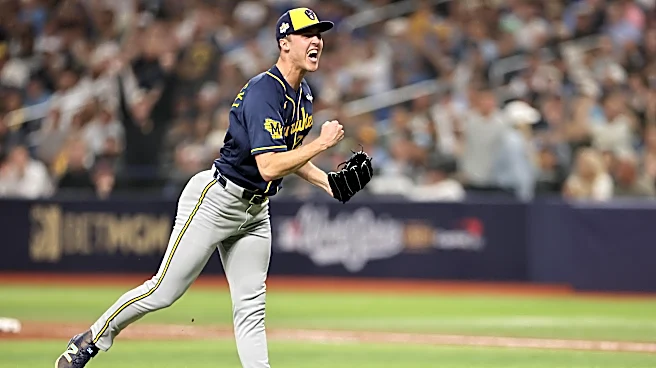
This doesn’t add a ton of names but does unveil Aaron Ashby, perhaps the best candidate for this beyond Morejon. Coming off his insane postseason run, Ashby still seems intent on starting, and frankly the Brewers should probably let him. Will the control hold up in the rotation? Great question, but the breadth and quality of the stuff are good enough to be worth finding out.
Edgardo Henriquez is another fascinating name here, but not one that I think will be relevant for us; the Dodgers have too many starters to make experimenting with a shut down reliever worth it, and he’s not likely to be available via trade. William Kempner is an interesting one that might be attainable. There’s nasty stuff and he started in his senior year at Gonzaga back in 2022. He’s worth checking in with the Marlins on.
There is one caveat to our analysis that we’ve left out; pitchers can add to their arsenal when moving to the rotation. Clay Holmes himself is a prime example of this. In 2024 with the the Yankees he had well below average PME, throwing two pitches (sinker and slider) exclusively. One year later with the Mets, Holmes was throwing five pitches and running an above average PME.
So it may be worth looking at arms who don’t have presently broad arsenals. We’ll still have a threshold—three standard deviations below mean PME—to ween out the extreme narrow arsenal guys, but that leaves a number of additional candidates. Note that previously highlighted players are omitted for readability:

Parsing this is harder than our previous two views. Unless you’re an actual professional coach, determining which of these relievers can add a pitch—and which pitches they should add—is likely beyond your capabilities. A decent proxy would be looking at recent starters such as Dax Fulton who seems like a prime candidate to step back into the Marlins’ rotation next season. Alex McFarlane is another NL East name who the Phillies could leverage as a starter in 2027. All of Blade Tidwell, Seth Johnson, Antwone Kelly, and Erik Tolman had some degree of recognition as prospects and started in the minors, but have struggled significantly with health or effectiveness.
There are two free agent names in Alex Vesia and Evan Phillips that pop up towards the extremes of this cluster. Both are interesting in a vacuum, but neither has a track record of starting, both are over 30, and in Phillips’ case his arm is held together by duct tape and glue. I would chalk these up as plausible but unlikely conversion candidates.
For completeness, what about those arms that don’t necessarily have high-end stuff but zone the ball well and have a broad arsenal. Here you’re mostly getting former and/or failed starters who have not narrowed their arsenal to function in the bullpen. This is not a group worth digging into, but is a decent sanity check on the analysis:

This is an imperfect framework for a number of reasons. Public facing stuff metrics are poor. Zone% is a rudimentary at best measure of control. A more sophisticated view of pitch mix diversity would be informative. And of course we’re missing the all important ability to determine physical capability of starting.
Nevertheless, we can pick out a number of candidates for whom a conversion might make sense. Most (Sommers, Kempner, Gomez, Fulton, McFarlane) would have to be acquired via trade, and the majority of the free agents that stick out (Phillips, Vesia) are likely not viable options.
Morejón, however, really does stand out as much as the free agent hype suggests. His current arsenal—buffed by pitching in releif—is most similar to Jacob Misiorowski among starters. Hitting him with a nerf similar to other players who have made the conversion puts him in the range of Payton Tolle and Eury Perez. He’s only 27 as well, meaning whoever signs him gets his physical prime. Presuming his medicals hold up, he really does seem like the best conversion candidate yet and someone the Mets should seriously pursue.
All data and filtration results can be found here.