
In my previous article, we tackled the financial moves the Buffalo Bills could leverage this offseason to add a healthy amount of potential salary cap space. If the new league year began today, the Bills would
be around $11 million over the cap — but with the right combination of roster decisions, Buffalo’s front office could find its way to nearly $50 million in available space.
Should general manager Brandon Beane and One Bills Drive do that leg work to allow them to be players in free agency this year, who among Buffalo’s own free agents stay, and who walks for a new deal elsewhere? Of course, the Bills’ next defensive coordinator (TBD) and their preferred scheme (if vastly different) will impact the fates of defensive players discussed below.
Offensive line: reality check
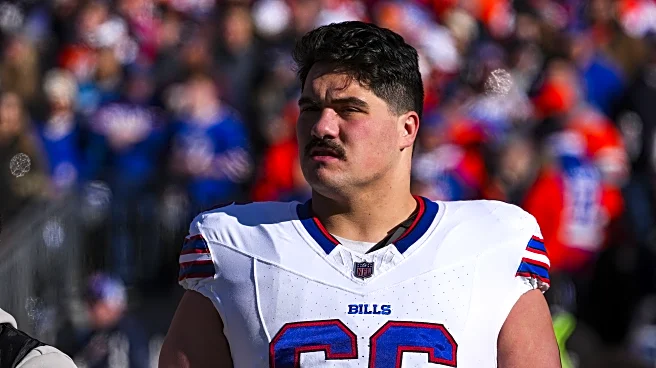
Center Connor McGovern and left guard David Edwards both played extensive, featured snaps in 2025, but their projected market values tell an uncomfortable story. They will probably fall short of their market values, but reality is they are still priced too high for Buffalo. Unless both are willing to take a “home-grown” discount, I don’t see the Bills being able to retain both.
C Connor McGovern – Spotrac Market Value: ~$16.2 million
LG David Edwards – Spotrac Market Value: ~$19.9 million
Paying market value for both offensive linemen would eat up a massive chunk of Buffalo’s newfound cap flexibility (more on this to come). With needs at wide receiver, edge, and the secondary, the Bills simply cannot afford to overspend on interior offensive line continuity. With that being said, if the Bills did spend here, only three teams (the Kansas City Chiefs, Denver Broncos, and Philadelphia Eagles) would spend equally or more on their starting five offensive lineman than Buffalo’s front office.
Verdict: If the Bills keep one, it should be McGovern. Edwards likely prices himself out of One Bills Drive.
Defensive front seven: tough love required
LB Shaq Thompson – Spotrac Market Value: ~$2.7 million
This is a move that actually makes sense. Thompson’s leadership, experience, and cost align perfectly with a transitioning defense. This is the kind of veteran contract Buffalo should prioritize.
DE Joey Bosa – Market Value: ~$13.7 million
Bosa flashed early but faded when the games mattered most. Paying near market value for diminishing postseason impact would be a mistake. The Bills need edge pressure that shows up in January.
DE A.J. Epenesa – Market Value: ~$9.2 million
Good for Epenesa if he gets paid his market value. It just won’t be by the Bills.
DT Larry Ogunjobi – Market Value: ~$5 million
Never truly felt like a fit. This decision may hinge on the new defensive coordinator, but odds are Buffalo moves on.
DT DaQuan Jones – Market Value: ~$1.7 million
At 34, this likely marks the end of his Bills tenure.
… and the complicated one
LB Matt Milano – Market Value: ~$4.5M
Discussed as part of the Salary Cap article as well, Milano’s situation is less emotional than it appears, especially with a new coaching staff coming into the building. His contract voids in February, triggering $11 million in dead cap if untouched.
However, a one-year deal around market value would actually reduce his 2026 cap hit to roughly $10.6 million. That’s a net savings in 2026.
The catch? Milano would have to accept market value, and Buffalo would have to accept the risk that comes with his availability. The remaining prorated money of $4.8 million would push into 2027’s dead cap.
Verdict: A one-year deal at or below market makes sense. Anything more does not. In the end the Bills will still be shelling out $11 million with or without his services this year.
Depth & role players: smart cap matter
QB Mitch Trubisky – Market Value: ~$4.4 million
Continuity matters behind quarterback Josh Allen. Expect something similar to Trubisky’s previous two-year, $5.25 million deal, perhaps with a slight bump.
FB Reggie Gilliam – Market Value: ~$1.5 million
DB Cam Lewis – Market Value: ~$1.5 million
S Damar Hamlin – Market Value: ~$1.5 million
All three are prime candidates for Four-Year Qualifying Contracts (4YQC), allowing Buffalo to retain depth players at a discount. But the 4YQC can only be used on two players, so decisions will have to be made there.
Gilliam makes the most sense to me for his versatility, and his ability and leadership on special teams. But Lewis and Hamlin could return in depth roles if they fit in the presumably new defensive scheme. Real decisions need to be made.
Beyond the primary list, Buffalo has several notable veteran free agents, whose names will naturally spark conversation among Bills fans. That group includes cornerback Tre’Davious White, safety Jordan Poyer, defensive tackle Jordan Phillips, and wide receiver Gabe Davis, all former cornerstones of the roster whose prior departures signaled a shift toward younger cheaper flexibility originally.
White rebuilt himself in Buffalo this past season. He’s not the young CB he once was, but I see him returning for depth at the position. Poyer is probably aging out of rotation, but I would love to see him in the Bills’ locker room in some capacity. His heart and soul shines every week and Buffalo’s secondary was markedly better with him active. Phillips will be 34 this year, so he’s probably gone unless One Bills Drive comes calling. Davis might enter 2026 on PUP, so there is some potential that he could be back at a very team-friendly deal if the new staff would want him.
CB Tre’Davious White – Spotrac Market Value $1.2 million
Veterans like wide receiver Brandin Cooks, safety Darnell Savage Jr. and safety/special teams specialist Sam Franklin represent experienced depth options, but would need to come in at team-friendly prices to make sense with Buffalo’s cap situation. I would love to see Cooks back in Buffalo with an entire offseason to prepare with Allen, but he is turning 33 this year. Franklin may be worth another look, especially for his special teams contributions.
WR Brandin Cooks – Market Value $5.o-6.5 million
Even at kicker, Matt Prater enters free agency as a veteran option. Should the bills choose to reset the position entirely. This obviously only makes sense if there is net salary cap gain from releasing Tyler Bass and signing Matt Prater.