
The Ravens and Steelers are each 6-6 entering Week 14, and the vibes surrounding both franchises aren’t exactly great. Each team lost big in Week 13, and yet this week’s matchup will determine who rises
to first place in the AFC North – and a playoff spot, for the time being.
Ahead of the big game, what should Steeler fans expect from this iteration of their divisional rival?
What to expect from the Ravens’ offense

Rushing YPG: 136.8 (5th)
Passing YPG: 180.5 (28th)
PPG: 24.1 (12th)
RB: Something is off with the Ravens.
Even after correcting from a 1-5 start to 6-6 entering Week 14, Baltimore hasn’t looked like the super team that was promised entering the season. And in their Thanksgiving loss to the Bengals, the Ravens proved their early-season woes still aren’t solely in the rearview mirror.
To be fair, the answer to a lot of the Ravens’ current offensive issues (still the NFL’s 12th-best in scoring) can be at least partly explained due to health.
Baltimore’s offensive powerhouse, quarterback Lamar Jackson, has been a fixture of the injury report through much of the year, missing three games and still looking below 100% when he’s been on the field as of late.
He’s dealt with a bevy of lower-body injuries, and while his speed is still giving defenses issues, he’s been a lot less adventurous and shifty as a runner. In 2024, he averaged 53.8 rushing yards per game; so far this season, his mark sits at 29.3.
Similarly, he’s been sacked three times per game this season, compared to just 1.4 last season.
The injuries seem to have affected his abilities as a passer, as well. Jackson’s completion percentage has dropped noticeably since entering November – he’s fallen well under 60% in every game after being above 70% in all but one of his first five matchups of the year.
He had some rough misses against the Bengals in Week 13. By the second half, it was in problem territory.
But even when Jackson was on target, his receiving core wasn’t always doing him favors. Baltimore’s 29th-ranked passing game bears some resemblances to past Steelers offenses, lacking a high-end WR1 in Zay Flowers, who has playmaking ability but lacks consistency.
Still, Flowers is far and away Baltimore’s top receiving target this season with 767 yards.
Rashod Bateman (197 receiving yards) has had a quiet season for Baltimore despite signing a three-year, $36.75 million extension this summer, while the ghost of DeAndre Hopkins has provided a respectable 257 yards, still having moments that remind you of his elite past.
Outside of Flowers, however, the main names in the passing game have been tight ends Mark Andrews and Isaiah Likely.
Andrews is the more complete of the two and a longtime favorite target of Jackson’s, but he’s lost some explosiveness and reliability in recent seasons. Likely has served as more of the big-play threat as a jumbo wide receiver type.
Baltimore’s passing game uses a lot of condensed bunch formations to take advantage of its receiving tight ends, a staple of offensive coordinator Todd Monken’s scheme. The Ravens are in 12 personnel at the second-highest rate in the league.
Jackson’s passes to his receivers have often focused on the boundaries in the short and deep game, but Andrews and Likely open up the intermediate middle part of the field.
Still, this isn’t an elite group of pass catchers. And Jackson’s offensive line hasn’t done him many favors this season, either.
Andrew Voorhees and Daniel Faalele, Baltimore’s starting guards, have had rough seasons, and the O-line’s performance overall has been subpar in pass protection. And it doesn’t help that Jackson has had more struggles than usual creating under pressure this season. That’s resulted in Baltimore having the fifth-highest sack rate allowed in the league this season at 9.7%, per Next Gen Stats.
It’s been a similar story in the run game, where the Ravens have struggled to create push and sustain blocks up front. They’re still top 10 in rushing yards before contact this season, but I’d pass a lot of that credit to veteran running back Derrick Henry’s vision.
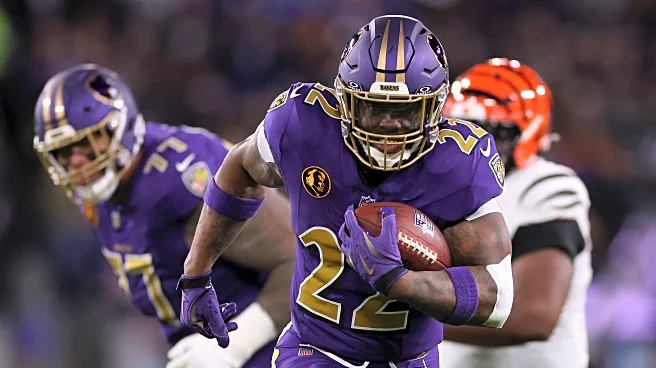
Henry has shown some regression himself this season, with his production dropping in a big way after a historic 2024, but he’s still one of the better running backs in football. If you stay disciplined in your gaps and clog his runway, he can be slowed down, but he somehow still hasn’t lost his chunk play ability as a bigger runner.
His vision, as previously mentioned, is at another level on outside runs.
Helping out in the run is one of the more underrated players in the NFL: fullback Patrick Ricard, who missed the opening stretch of the season but has since logged 126 offensive snaps in six games.
Rewatch that first big run by Derrick Henry. Three-hundred-pound fullbacks are awesome.
The Ravens also have a good change-of-pace back in speedster Keaton Mitchell, who recorded a 19-yard touchdown last week off this nifty fake toss play design:
The Baltimore offense has had a lot of ups and downs recently, with the Cincinnati game being especially extreme – the Ravens had two touchdowns taken off the board: one on a Likely goal-line fumble-turned-touchback, and the other being called back due to a nitpicky offensive pass interference flag on Flowers.
The Ravens are tied for the fourth-most giveaways in the NFL this year, and tied for the second-most fumbles. It’s been sloppy at times.
That bodes well for a Steeler defense that has often depended on takeaways to succeed against opposing offenses this season.
However, the story of the game will be if the Pittsburgh run defense, which surrendered a whopping 249 passing yards against the Bills last week, can hold up against the Henry-Jackson combination that torched them for 299 on the ground the last time the two teams met.
Pittsburgh is expected to be without Derrick Harmon for yet another game, but Lamar Jackson has missed some practice this week and hasn’t been his usual dynamic self.
This has all the makings of another classic ugly offensive battle between two AFC North foes.
What to expect from the Ravens’ defense

Rushing YPG Allowed: 118.4 (18th)
Passing YPG Allowed: 232.0 (25th)
PPG Allowed: 24.4 (21st)
RP: As they have countless times throughout the years, the defenses of the Steelers and their most bitter rival share many commonalities this year. There are a few key differences, of course, but there is a reason that both of these teams are struggling and 6-6 heading into this crucial matchup.
The Ravens even run similar coverage concepts to the Steelers, as indicated in the chart below.
The Ravens’ defense got off to a historically bad start to the season. That was worsened by losing star defensive tackle Nnamdi Madubuike early in the season to a serious neck injury that could be career-threatening. They also lost safety Ar’Darius Washington, and second-year edge rusher Adisa Isaac has been out the entire season as well.
Baltimore’s early secondary struggles prompted the team to trade edge rusher Odafe Oweh to the Chargers for safety Alohi Gilman, which has provided some stability and flexibility for the Ravens on the back end, but has done nothing to help one of the worst pass rushes in all of football.
On the season, the Ravens have just 19 sacks, better than only the Panthers, the injury-riddled 49ers, and the hapless Bengals. Rookie linebacker Mike Green leads the team in sacks (2.5), with each coming after Ravens’ bye in Week 7. The previously mentioned Madubuike (2.0) – who hit IR following Week 2 – is tied with linebackers Kyle Van Noy and Tavius Robinson for the second-most sacks on the team.
Ravens’ opponents have an average time to throw of 2.88 seconds (25th), and Baltimore has generated 141 pressures (19th) on the year. Baltimore’s 25% blitz rate ranks 20th in the league, so they aren’t trying to compensate with exotic blitz packages. Whichever quarterback takes the snaps for the Steelers this week should have plenty of time, by NFL standards, to make their reads.
The secondary, however, has been more of a mixed bag. On the one hand, the Ravens’ coverage is still quite sticky. Collectively, they allow an average of just 3.2 yards of separation on routes, the sixth-lowest figure in the league. They’re also in the top half of the league, barely, in yards after the catch allowed with 1,361 (14th), indicating that they’re still pretty sound at tackling receivers. On the other hand, they’re 10th in passing yards allowed, 20th in passing EPA allowed per play, and they’re exactly middle of the pack (15th) with 18 passing touchdowns allowed.
Nine-year veteran Marlon Humphrey and second-year player Nate Wiggins man the outside for Baltimore, while Gilman and rookie Malaki Starks are the primary safety duo. Star defensive back Kyle Hamilton is the chess piece they move around, but since Gilman entered the fold, Hamilton has seen an increase in plays near the line of scrimmage, where he can be more impactful this season. This could be especially problematic for a Steelers’ passing attack that has lived in the short areas of the field.
Here’s ESPN’s Ben Solak breaking down how this midseason change has looked on the field.
The Ravens have also struggled against the run this year. On average, they’re allowing 1.29 yards before contact (18th) and 3.13 yards after contact (21st) against the run this year. They’re middle of the pack (15th) in allowing explosive runs as well, with 36 runs of 10-plus yards on the year. Of those, only four were runs/scrambles from quarterbacks, meaning the Ravens have been gashed the good old-fashioned way.
Baltimore has also struggled to generate turnovers this year. Only 11 teams have created fewer turnovers than the 14 the Ravens’ defense has secured. They have an even split between fumble recoveries and interceptions with seven apiece. Wiggins leads the team with three interceptions, while the rookie Starks has two. Humphrey and second-year corner T.J. Tampa each have one.
The biggest mystery around the Ravens’ defense right now is how much of their recent turnaround is legit. During a six-game stretch starting on Oct. 12, Baltimore allowed just 14.0 PPG across six games before last week’s poor showing against the Bengals. However, they weren’t exactly facing the most intimidating offenses, with the exception of the Rams. These were Baltimore’s opponents during their defensive resurgence:
- 17 pts to the Rams who lost star WR Puka Nacua early in the game
- 16 pts to the Bears
- 6 pts to the Dolphins
- 19 pts to Vikings
- 16 pts to the Brows
- 10 pts to the Jets
Then, a week ago, the Bengals hung 32 points on them. The Steelers offense has looked more like Baltimore’s recent opponents than the Bengals, however, who have two star wide receivers and had Joe Burrow return at quarterback in that game.
This Ravens defense has its flaws, but will the Steelers be able to get out of their own way to take advantage? They’d better hope so if they want to keep their playoff hopes alive.