

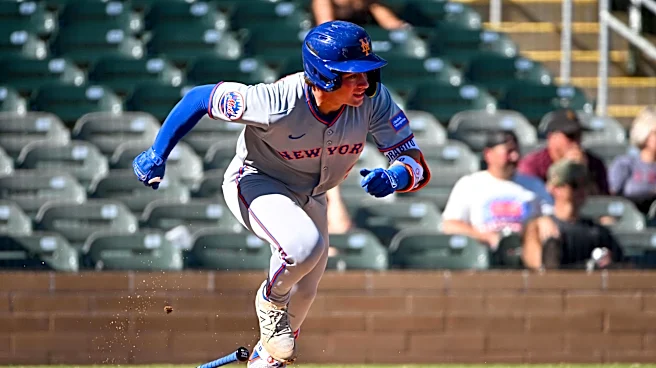
Jacob Reimer
Week: 5 G, 18 AB, .333/.435/.778, 6 H, 2 2B, 0 3B, 2 HR, 4 BB, 4 K, 2/2 SB (Double-A)
2026 Season: 32 G, 113 AB, .221/.346/.416, 25 H, 10 2B, 0 3B, 4 HR, 20 BB, 38 K, 6/8 SB, .292 BABIP (Double-A)
When Jacob Reimer is on, he checks off a lot of offensive boxes: he hits for a solid average, walks a lot, keeps strikeouts to a minimum, and showcases a solid amount of power. When he is off, as he was for virtually all of April, he is a very diminished player. In 20 games in April, he hit .186/.329/.314.
I’m not sure what the correct term would be for it, but I am beginning to think that Reimer is a player who needs to always be optimized in order to be effective. When his upper body and lower body get out of sync, he has trouble with breaking balls and pitches thrown inside. When he is unable to effectively lift the ball, he is grounding into more than his fair share of groundballs. When he is unable to pull the ball, he is hitting for less power than you’d want a corner infielder to be hitting for. When he isn’t feeling confident, he is more passive at the plate.
If Reimer had standout secondary tools, like exceptional speed or sterling defense, it would be easy to look past the occasional prolonged offensive doldrums, because his floor would be higher. But because his speed is minimal and his defensive abilities are negligible, there is more pressure on his bat to come through. Thanks to his strong eye, even when he is struggling offensively at the plate, he isn’t necessarily a black hole and will still draw walks, but when Reimer’s hit tool starts struggling, he really isn’t going to be actively contributing.
Here’s hoping Steve Cohen starts financially supporting my plan to fuse Jacob Reimer and Ryan Clifford into Ryan Reimer sooner rather than later.
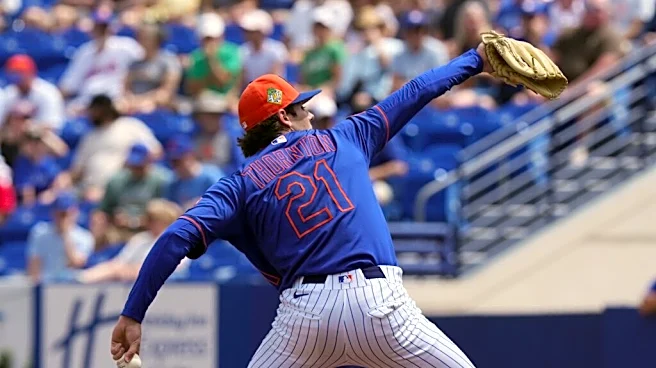
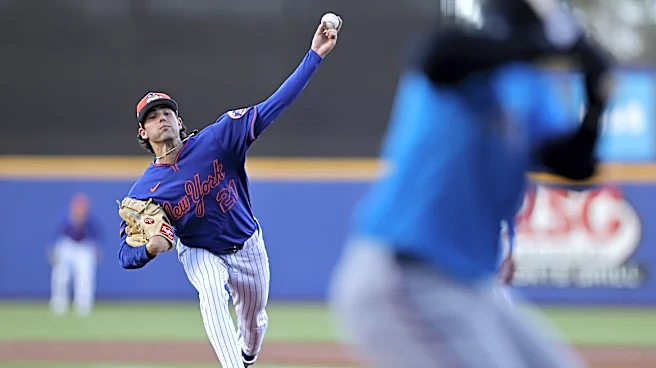
Zach Thornton
Week: 1 G (1 GS), 6.0 IP, 3 H, 0 R, 0 ER, 1 BB, 9 K (Triple-A)
2026 Season: 5 G (5 GS), 25.0 IP, 24 H, 10 R, 10 ER (3.60 ERA), 9 BB, 27 K, .338 BABIP (Double-A) / 2 G (2 GS), 12.0 IP, 8 H, 3 R, 3 ER (2.25 ERA), 3 BB, 13 K, .241 BABIP (Triple-A)
Calling it a magical season might be a bit hyperbolic, but Zach Thornton had a 2025 that really put him on the map as a player- and got him out of the shadow of the former Pirates/Mets reliever Zach Thornton on the search engine hits. Making 14 starts for the High-A Brooklyn Cyclones and the Double-A Binghamton Rumble Ponies, the southpaw posted a combined 1.98 ERA in 72.2 innings, allowing 48 hits, walking 11, and striking out 78. Along with Jonah Tong and Jack Wenninger, he formed a fearsome threesome of pitchers that batters had to navigate past, a dangerous hydra that few hitters were capable of dealing with. Unfortunately for Thornton, an oblique injury in early July ended his season prematurely and suddenly- and just to highlight how strong the pitching was in the system that year, Jonathan Santucci and R.J. Gordon were promoted to Binghamton at roughly the same time, and the Rumble Ponies didn’t even feel the loss of the injury to the left-hander. When all was said and done, we ranked the left-hander the Mets’ 14 prospect coming into the 2026 season.
Thornton returned to the mound with Binghamton in early April, and while he did not pitch poorly at any point, he looked less crisp and more hittable as compared to 2025. In 25.0 innings over 5 starts, the southpaw posted a 3.60 ERA, allowing 10 earned runs, with 24 hits, 9 walks, and 27 strikeouts. Promoted to Triple-A Syracuse after almost exactly a month, Thornton has actually looked a bit better. Through a pair of starts now, the left-hander has allowed three runs over 12.0 innings, scattering 8 hits, walking 3, and striking out 13.
Thornton relies on a five-pitch mix, working with a four-seam fastball, two-seam fastball, changeup, slider, and curveball. In his last start, he threw 33 sliders (41%), 20 two-seam fastballs (25%), 16 curveballs (20%), 7 four-seam fastballs (9%), and 5 changeups(6%); in his other Triple-A start, he threw 28 sliders (33%), 21 two-seam fastballs (25%), 16 curveballs (19%), 16 four-seam fastballs (19%), and 3 changeups (4%). This tracks with past data from the 2025 season, where he used his slider and his fastball almost as much as each other.
Thornton’s four-seam fastball has roughly average velocity for a left-hander, averaging 91 MPH and holding it throughout the ballgame. What stood out to me, looking at the data from his past two ballgames, is that he is getting more induced vertical break on the pitch now as compared to ever before. In his two starts with Syracuse, the pitch averaged 19 inches of IVB, an elite number; in the past, the highest IVB the left-hander had ever recorded was 16 inches, an above-average number to be sure but not elite like 19 is. While this is just a theory, the Triple-A ball may be enhancing the backspin that Thornton creates from his four-seam grip. The spin rate on his fastball is roughly average for a four-seam fastball, but the amount of activated spin that he is getting on the ball is enhancing it. Between his ability to locate the pitch and his ability to induce whiffs, Thornton’s four-seamer is currently sporting a 44% CStr+Whiff% in limited usage. His sinker, interestingly, has a higher spin rate than most sinkers. Most sinkers have spin rates between 2000 RPM and 2200 RPM, allowing the magnus effect to have less of an impact on the pitch, causing it to sink as gravity acts upon the ball. With a higher spin rate, Thornton’s fastball is able to resist the force of gravity longer, giving it late sink. Like his four-seam fastball, he currently has a 42% CStr+Whiff% with his sinker. Because of the lack of premium velocity, when batters make contact with the pitch, they are able to do damage.
His slider has always been his bread-and-butter, and the pitch is showing no ill effects from his return to the mound after a lengthy layup or his promotion to Triple-A. The mid-80s offering has so far averaged 35 inches of vertical drop and 5 inches of horizontal movement, resulting in a 34% CStr+Whiff% rate. When he wants to, he can throw it in the zone, and when he throws it outside of the zone, he can spot it there as well to entice batters. His curveball is much of the same, sitting in the high-70s, featuring 44 inches of vertical movement and 14 inches of horizontal break, with the ability to land in or outside of the zone depending on the situation.
Rounding out his arsenal, the left-hander’s changeup is little more than a change of pace offering at present. Its low spin rate gives the pitch a lot of downward drop, but most of its effectiveness comes from the randomness in terms of when it is thrown, not its nastiness.
There is risk in his profile because, as mentioned, his fastball does not have premium velocity and he is relying more on obstruction, sequencing, and finesse with it to prevent hitters from tattooing the pitch rather than pure brute velocity, but I am feeling bullish on Thornton at present and liking what I am seeing more than I did even last season.
Thornton’s transition to Triple-A so far has been seamless, and he has arguably better now than he was over the course of the last month in Binghamton. I wrote the following paragraph on Sunday afternoon, when I started looking up the data for this Player of the Week write-up: “If these trends continue, and Thornton continues putting up similar numbers over the rest of May, the southpaw might leapfrog Jonah Tong and Jack Wenninger on my preferred pitching prospect depth chart for the Mets to call-up; Tong has had issues acclimating to Triple-A, and while Wenninger has seen plenty of success like Thornton has, I am a bit unsure how his fastball-changeup combo will work at the MLB level as a right-hander with a decidedly middling fastball to set-up his change”. Prophetic words!