





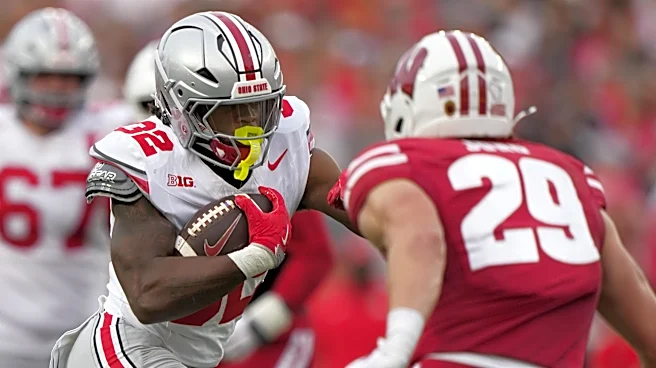


Michigan fans have plenty of reasons to be excited about the backfield entering 2026. Jordan Marshall emerged as one of the Big Ten’s best running backs last season, and now he is joined by five-star freshman Savion Hiter. If Hiter develops as quickly as many hope, Michigan could have one of the nation’s best one-two punches before the year is over.
But entering the season, there are still a handful of backfields around the country with a stronger résumé. Whatever the formula, these five programs
enter 2026 with backfields that should be among the best in college football.
5. Georgia Tech: Justice Haynes and Malachi Hosley
This one may sting a bit for Michigan fans. Justice Haynes arrives in Atlanta after spending the 2025 season at Michigan, where he rushed for 857 yards and 10 touchdowns in just seven games before a foot injury cut his season short. When healthy, Haynes was one of the most explosive backs in the Big Ten, averaging 7.1 yards per carry and eclipsing 100 rushing yards six times.
He’ll be joined by Malachi Hosley, who averaged 7.1 yards per carry of his own last season while rushing for 697 yards and seven touchdowns. Hosley consistently generated explosive plays, producing 19 runs of at least 10 yards despite receiving fewer than 100 carries.
Both backs have already proven they can make the most of their opportunities, and together they give Georgia Tech one of the most dangerous one-two punches in the ACC heading into 2026.
4. Oregon: Dierre Hill Jr. and Jordon Davison
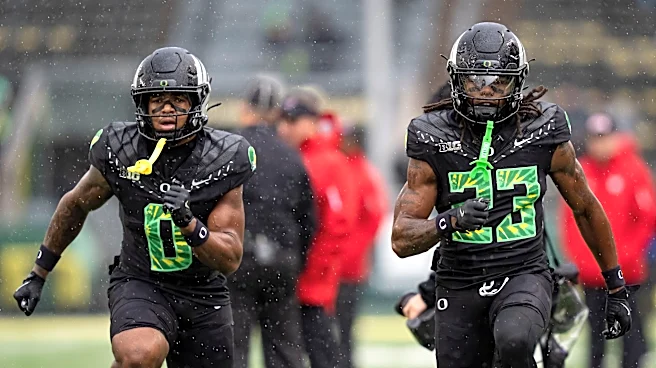
There may not be a younger backfield in the country with a higher ceiling than Oregon’s. Both Dierre Hill Jr. and Jordon Davison flashed star potential in 2025. Davison rushed for 667 yards and 15 touchdowns while quickly becoming one of the Ducks’ most reliable red-zone weapons. Oregon never seemed hesitant to hand him the ball near the goal line, and he rewarded that trust throughout the season.
Hill brings a completely different skillset. He rushed for 656 yards while averaging nearly nine yards per carry. He also caught 16 passes and routinely created explosive plays whenever Oregon found ways to get him into space.
Combined, Hill and Davison accounted for more than 1,300 rushing yards and 20 touchdowns. The numbers are one thing, but both backs also earned Top 12 PFF grades among all FBS running backs by the end of the season.
3. Louisville: Isaac Brown and Keyjuan Brown
If this ranking were based strictly on explosiveness, Louisville might be sitting even higher. Isaac Brown has already established himself as one of the most dangerous playmakers in college football. Despite missing time during the 2025 season, Brown still rushed for 884 yards and seven touchdowns while averaging an absurd 8.8 yards per carry.
Behind him, Keyjuan Brown quietly added 704 yards and six touchdowns while averaging 7.3 yards per carry. Which means the Cardinal’s top two backs combined for nearly 1,600 rushing yards despite Isaac missing time. If Louisville’s backfield stays healthy for a full season, they could easily finish with one of the most productive rushing attacks in college football.
2. Missouri: Ahmad Hardy and Jamal Roberts
This might be a bit controversial to have Missouri this high considering Ahmad Hardy is recovering from a gunshot wound and that Missouri is reportedly “a long way from knowing” if he will be able to return to football this season. However, if Hardy is able to return to the field this fall, I would place this tandem at No. 1 overall.
Hardy was one of the best running backs in college last season. After transferring from Louisiana-Monroe, he immediately became the centerpiece of Missouri’s offense. He rushed for 1,649 yards and 16 touchdowns while averaging nearly 127 rushing yards per game. He finished among the national leaders in rushing and has already established himself as one of the SEC’s premier offensive players.
The Tigers also benefited from having one of the nation’s better complementary backs. Jamal Roberts rushed for 753 yards and six touchdowns while averaging 6.1 yards per carry. He frequently entered games and maintained the same level of efficiency when Hardy was off the field, making life extremely difficult for opposing defenses. He’s also produced several impressive performances of his own, including a 143-yard outing against Kansas that featured a 63-yard touchdown run.
Hardy and Roberts combined for more than 2,400 rushing yards and 22 touchdowns in 2025. Both averaged more than six yards per carry. Both have already proven they can thrive against quality competition.
1. Texas: Raleek Brown and Hollywood Smothers
Few programs did more to upgrade their running back room this offseason than Texas. Raleek Brown finally put together the type of season many expected when he arrived in college as one of the nation’s premier recruits. The Arizona State transfer rushed for 1,141 yards, averaged more than six yards per carry and added nearly 250 receiving yards.
Meanwhile, Hollywood Smothers arrives in Austin after a productive season at NC State where he rushed for 939 yards and six touchdowns while averaging 5.9 yards per carry. He also hauled in 37 receptions, giving the Longhorns another weapon who can contribute in multiple ways. That versatility should fit naturally within Steve Sarkisian’s offense.