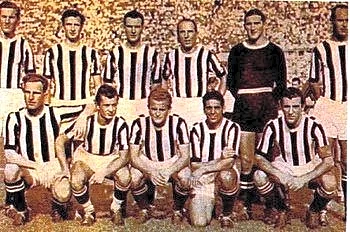





By October 2, 1949, Juventus had spent fifteen long years waiting to reclaim the summit of Italian football. The decade had belonged to the tragic brilliance of Il Grande Torino, while rival AC Milan was aggressively assembling its post-war powerhouse around the newly arrived Swedish trio of Gunnar Gren, Gunnar Nordahl, and Nils Liedholm. Heading into Matchday 4 at San Siro, the early table sat on a razor’s edge: English manager Jesse Carver’s Juventus held a slim one-point lead over Milan following
three straight wins, with the Rossoneri right behind after two wins and a draw.
Carver’s tactical setup relied on an English-style W-M system (3-2-2-3) — a departure from the traditional Italian Metodo (2-3-2-3) that placed Carlo Parola at the center of everything. Positioned as the central stopper ahead of goalkeeper Giovanni Viola, Parola was tasked with locking down Nordahl and cutting off the supply lines from Milan’s midfield. Flanked by Alberto Bertuccelli and Sergio Manente, Carver’s backline provided the launchpad for a lethal front five featuring John Hansen, Karl Aage Præst, Giampiero Boniperti, Ermes Muccinelli, and Argentine star Rinaldo Martino.

According to contemporary reports, the match at San Siro was intense and hard-fought. Milan pressed aggressively throughout the first half, but Juve held firm, coming closest to opening the scoring when striker John Hansen struck the woodwork. The breakthrough arrived in the 51st minute when Martino took advantage of an opening on the right after a quick one-two from Boniperti, calmly cushioning the ball before placing it past Milan’s keeper.
As Milan threw everything forward in a desperate bid to equalize, Gazzetta dello Sport noted that Parola commanded the defense “with absolute mastery,” locking down Nordahl while Viola turned away every late threat. On the counter, Hansen hit the post a second time, but the lone goal proved enough to seal a crucial 1-0 victory.
Writing in Il Calcio Illustrato, Renzo De Vecchi observed that Martino’s goal “had the magical power to energize Juventus, restoring their defensive composure and confidence, while sending the Rossoneri into a state of nervous panic.” Meanwhile, Emilio De Martino declared in Gazzetta dello Sport that Juventus had proven themselves “the most complete, mature, and tactically sound team” in the country.
That victory at San Siro became the springboard for a historic mid-century campaign. Juventus went undefeated through their first 17 matches, opening up a seven-point lead by mid-season. Though the Bianconeri stumbled down the stretch — losing four of their final 21 fixtures — their dominant early start carried them across the line, ending a 15-year drought to claim the 1949–50 Scudetto by seven points over Milan.
Looking back at the team sheets reveals an extraordinary collection of mid-century icons. While Milan’s Gre-No-Li trio would go on to win the title in 1951, Parola’s masterclass on this afternoon showcased why he remains a towering figure in Italian football history. His ability to transition seamlessly between defensive shutdown duties and offensive build-up play — stepping up into midfield to act as an auxiliary playmaker — helped inspire Italian football to adopt the libero, a role that would come to define the nation’s game over the next forty years. Parola would make 334 appearances for the club as both a player and later manager, though his physical image remains immortalized as the airborne bicycle kick on Panini trading cards.
Alongside Parola, the victory marked an early milestone for a 21-year-old Giampiero Boniperti. The young forward was already stepping into his role as the heart of the squad, initiating a career that yielded 178 goals, five Scudetti as a player, and decades of leadership as club president.
October 2, 1949, was more than a hard-fought away win. It was the afternoon a reinvented Juventus proved they possessed the tactical discipline, mental fortitude, and star power to reclaim their throne atop Serie A.