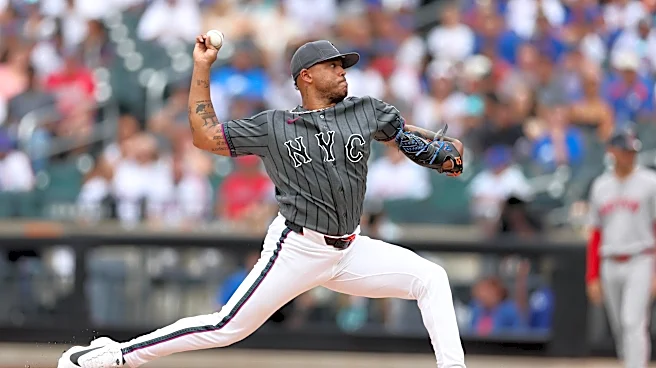







When the Mets traded for Freddy Peralta before the 2026 season, they sold the move to fans as a solution for the pitching collapse that had plagued them last year. The team would finally have an ace to bring it all together. With Peralta’s ERA at 4.66, FIP at 4.39, and WHIP at 1.44, that hasn’t been the case.
When Peralta first arrived at spring training, players weren’t the only Mets newcomers. Having overhauled their coaching staff, the Mets also had a new pitching coach in Justin Willard, and he had a very
clear goal in mind for the entire pitching staff: throw the first pitch in the strike zone. His style was also very different from what Peralta had worked with in Brewers pitching coach Chris Hook. Where Hook has been described by his pitchers as more hands off, only stepping in once he thought it was needed, Willard has been described—in the same article as above—as “very direct” and almost militaristic in his programs. Both coaches describe a mentality of strong communication to relate to their pitchers, but with different outcomes in mind. Hook’s goal is to help the pitcher get to their individual goal, whereas Willard is trying to understand the pitcher’s mindset and hear their concerns, but his stated goal for them does not seem to change as a result of these conversations.
To emphasize, neither style is wrong, but they are different, and making a shift to a new organizational mentality and goal-setting methodology can require quite a bit of adjustment. Peralta spent his entire career before this season with one organization and its pitching coach’s philosophy. Stepping into a new system, under a new coach, with a pre-defined goal is a big change for a player to absorb mid-career. In addition, some of the mechanical differences that have been discussed all season started on Opening Day. His arm angle lowered meaningfully, his release point changed, and his pitch mix shifted, although he continues to rely on his fastball most of the time. His first-pitch strike rate in 2026 has dropped from 2025.
While the Mets organization has cited mechanical flaws for Peralta’s troubles, Peralta himself has stated in interviews that he feels physically fine and that his stuff is also fine. Looking at the Statcast information for each start in 2025 and 2026 tells its own story. While his arm angle has been drifting slightly downwards since late June 2025, it had dropped from averaging 36.67 degrees in his last start of 2025 to 33.14 degrees by Opening Day of this year. As a result, his average release height had also dropped from his last game of 2025, at 5.34 feet, to 5.23 feet on Opening Day 2026. Jay Jaffe of FanGraphs noted on June 23 that it could have actually helped Peralta’s fastball deceive hitters more, even as he struggled with his breaking pitches.
Peralta’s pitch mix might be the reason for his overall velocity decrease, but his pitch combinations are not doing him any favors. While he has incorporated more changeups, reduced his slider usage, and slightly increased the number of sweepers, he still throws his fastball the majority of the time (around 53%). His tunneling has not been as good as it was in 2025. The fastball-slider combination continues to work well for him, but the curveball, slider, and sweeper are increasingly ending up in similar locations, in the lower-middle part of the zone, more visible earlier out of his hand. They do not fool hitters like they once did. Despite all the changes, he has not made as many first-pitch strikes as he did in 2025. In 2025, his first-pitch strike rate was 63.3%. In 2026 so far, it is 59.7%. League-wide across pitchers, the average is 61.2%.
After an incredibly rough start on June 20, Peralta started making some changes that are definitively his own. He started putting his hands over his head before throwing, a position he stated that he found more comfortable. He started calling some of his own pitches, incorporating more sweepers and sliders, according to Will Sammon at the Athletic. Beyond these changes, his average arm angle has started to increase again, from 31.57 degrees on June 20, to 34.61 degrees on July 1, to 37.55 degrees on July 11. His release height is moving with it. His fastball velocity is back up, from an average around 93.8 prior to his start on June 25, to about 95.1 MPH since June 25, higher even than in 2025.
The results have been mixed so far, although some of it may be bad luck combined with some inept Mets defense. His command has not bounced back and actually has gotten worse. He has demonstrated visible frustration in games lately. While he still struggles to go deep into games, it’s really no different than last year, still averaging around 5.1 innings per start. However, he is mechanically starting to look more like Freddy Peralta of previous years, at least by the numbers. The Mets are pleased by what they see. It does call into question whether his stuff needed that much alteration to begin with, given such little return.
As the trade deadline approaches, it seems almost guaranteed that Peralta will be traded, barring a better outcome from a qualifying offer. That makes sense, as it seems like this has not been a good fit, whatever the underlying reason. Perhaps he will benefit more from an approach like the Brewers had, or from simply pursuing a different goal than the one Willard set for him. With that in mind, a more useful question for his next club might be not what’s wrong with Freddy Peralta, but rather, how can they help him succeed.