
In honor of the Philadelphia Phillies playing host to the 2026 Major League Baseball All-Star Game at Citizens Bank Park, we here at The Good Phight are launching a yearlong series that focuses on the history of the Phillies and the All-Star Game. Check back regularly for posts about the Phillies participation (or lack thereof) in the Midsummer Classic over its history.
It’s time to move on to the 1950s in our look at all of the one and done All-Stars in Phillies history. The fifties started off strong
for the Phillies with achieving their first pennant in 35 years, but they promptly slid back into mediocrity not long after and eventually back to last place. But hey, if you’ve been following along with the rest of this series so far, mediocrity was an upgrade!
Jim Konstanty, 1950
We’ll start off with a player that was a member of those 1950 pennant winning Whiz Kids, even if by that time he was a bit of an elder statesman. Casimir James Konstanty was a multi-talented athlete. He was named captain of the basketball, baseball, and football teams his senior year at Arcade High School in upstate New York. Konstanty especially excelled at baseball, being named team MVP in both his junior and senior years while playing all over the diamond. All of this helped earn Konstanty a partial scholarship to Syracuse University.
Following his graduation in 1939, Konstanty went into semi-pro ball, eventually converting to pitching full-time in 1940 at the recommendation of his manager, fellow Syracuse alumnus George Minor. Not long after, Konstanty was signed to the Syracuse Chiefs, the Double-A affiliate of the Cincinnati Reds. By 1943, Konstanty was considering quitting baseball and teaching full-time but was convinced to stick around with the possibility of a chance to play for the Reds on the table. Sure enough, Konstanty pitched well enough to earn a spot with the Reds in June of 1944 at the age of 27. He had a modest rookie season, pitching in 20 games with 12 starts and sporting a 2.80 ERA across 112.2 IP.
But Konstanty’s career then went on hold in 1945 when he was drafted into the Navy. He continued pitching for his base team and was discharged in early 1946 but was traded to the Boston Braves soon after opening day. Konstanty appeared in just 10 games with Boston though, as he struggled early and the Braves decided to send him to the Toronto Maple Leafs in Triple-A to make room for a young up-and comer named Warren Spahn. During the offseason after an uneven year at Triple-A, Konstanty went for a ride with his neighbor and local undertaker Andy Skinner. As it turned out, Skinner was also an avid bowler who was able to help Konstanty improve his slider and changeup thanks to his knowledge of spins. This partnership would last the rest of Konstanty’s baseball career.
Konstanty remained with Toronto for the next two years, but his manager Eddie Sawyer opted to move the righty to the bullpen in 1948. Later that season when Sawyer was hired as manager of the Phillies, he convinced the team to acquire Konstanty, and the latter made his return to the Majors with the Phillies on September 14th, 1948. He entered in the eighth with the Phillies down 8-0 to the Cardinals and two men on with no outs. Konstanty escaped that jam by inducing two pop-ups and nabbing the runner on first in a run down. He went on to appear in six games for Philadelphia and allow only one run across 9.2 IP.
Konstanty emerged as a bullpen anchor for the Phillies in 1949, appearing in 53 games and posting a 9-5 record with a 3.25 ERA in 97 innings. He even added a walk-off hit to finish off a sweep of the Cubs on June 16th. Manager Sawyer allowed Konstanty to hit in the ninth following a late Phillies rally to tie the game at 3-3 in the eighth. Konstanty collected a one-out, two strike single just over the second baseman’s head, allowing the winning run to score.
But the soft tossing reliever’s finest work would come in 1950. The now 33-year-old slammed the door on Phillies win after Phillies win, as the team began to surge into the pennant race by May. Konstanty, who was 7-3 with a 3.21 ERA through 36 appearances, was named to the 1950 All-Star roster along with teammates Robin Roberts, Willie “Puddin’ Head” Jones, and Dick Sisler. Roberts started the game for the NL on the mound at Comiskey Park, but Konstanty came on in relief in the sixth and retired all three hitters he faced, including strikeouts of Detroit’s Hoot Evers and Cleveland’s Jim Hegan. The game ultimately went 14 innings before the Cardinals’ Red Schoendienst homered off of Ted Gray to give the NL the winning run.
Konstanty returned to the Phillies and had an incredible second half following another meeting with his old bowler friend. He appeared in 38 games in the second half and owned a 2.02 ERA across an astounding 84.2 innings in relief, including a 22 1/3 inning scoreless streak. He lost the scoreless streak when he allowed a tying home run to the Pirates’ Ralph Kiner in the bottom of the 10thh inning on August 25th. But Konstanty remained in the game to pitch a full nine innings in relief and added an RBI single in the 15th in a 9-7 win.
The Phillies would ride Konstanty and the rest of a fantastic pitching staff to the pennant. Konstanty was a surprise starter for Game 1 of the World Series and completed eight innings while allowing just one run in his first start since 1946. But that one run was all the Yankees needed, as the Phillies bats could only muster two hits off of Vic Raschi. Ultimately, the Yankees finished off the sweep and dispatched the surprising Phillies team. But Konstanty was awarded a consolation prize after the season, as he was named the National League MVP, becoming the first relief pitcher in history to win the award in either league. He was a near unanimous winner, receiving 18 of out of 24 first place votes and 85% of the overall vote. Stan Musial, who finished second, only received one first place vote.
But much like the rest of the Phillies, Konstanty took a step back in 1951 with a 4.05 ERA in 58 games. He would remain in Philadelphia until being acquired off waivers in 1954 by those very Yankees that defeated him in the World Series. Konstanty reached the World Series again with New York in 1955, but this time he did not appear in the series as the Yankees lost in seven games to the Brooklyn Dodgers. Konstanty was later released by the Yankees in 1956 and signed with the Cardinals with whom he appeared in 27 games. St. Louis also released Konstanty after 1956, and he ultimately retired in 1957 after a brief stint with the San Francisco Seals in the Pacific Coast League. He then went into coaching where he mentored a young Steve Carlton in the Cardinals farm system.
Dick Sisler, 1950
Like his teammate Konstanty, Dick Sisler was another of the elder statesman of the Whiz Kids who made it onto the 1950 All-Star roster. But before that, he was born as the son of Major Leaguer George Sisler, a star of the dead ball era and Hall of Famer whose 41-game hitting streak in 1922 was the longest in American League history until it was surpassed by Joe DiMaggio in 1941. Dick was actually born during one of his father’s finest seasons in 1920, when the elder Sisler collected his first of two batting titles with a .407 average and set the then MLB record for hits in a season with 257.
Baseball was a dominant force in the family, much to the chagrin of Frances Sisler, the only daughter of the clan. Some of Dick’s earliest memories include seeing legends like Babe Ruth and Lou Gehrig on the field up close or going for ice cream with Rogers Hornsby. He signed his first professional contract with the St. Louis Cardinals in 1939 despite only being in college for barely over a year. Dick would spend the next four years in the Cardinals’ farm system before enlisting in the Navy in 1942 and serving three years as a physical instructor at Bainbridge Naval Training Center. Sisler got back to baseball in late 1945 by playing winter ball in Havana, Cuba where he became known as “the Babe Ruth of Cuba” and even earned an invite to a house party held by a fan known as Ernest Hemingway.
Despite his own success, Sisler was constantly compared to his father. He remarked to the Wisconsin State Journal on the eve of his MLB debut in 1946 that being George Sisler’s son was a “handicap” and that it was unfair to be compared to his father because “players like him come very seldom and never in one family.” For his part though, Sisler did acknowledge in the same interview how his family name gave him advantages, saying “I don’t suppose I’d have been signed by a big-league club as soon as I was had I not been a Sisler.”
Sisler made his MLB debut on April 16th against the Pirates, going 1-3 with a double. He would continue to start at first for the Cardinals until a hand injury in June forced him out of the lineup. Sisler wouldn’t get his everyday 1B job back, as Stan Musial shifted there from left field and took over the regular starting gig. Sisler would head out to left after his return and was utilized in a platoon. He’d finish his rookie season with an underwhelming .260 average and 3 home runs in 83 games. Sisler would play just 46 games with the Cardinals in 1947 before being traded to the Phillies in 1948.
In Philadelphia, Sisler was able to slide back into being an everyday first baseman, and he thrived with his new team. He finished his first year with the Phillies hitting .274 with 11 home runs in 121 games. However, his starting job once again appeared to be in jeopardy to start 1949, as the Phillies acquired first baseman Eddie Waitkus in a trade with the Cubs. Sisler was once again sent back to the outfield but struggled to find playing time amongst a group that included Richie Ashburn, Del Ennis, and Bill Nicholson.
But that all changed the night of June 14th, 1949, when Waitkus was shot in the chest by a mentally unstable woman in his Chicago hotel room in what became one of the first widely publicized cases of stalking. He would survive and go on to play six more years in the Majors, but Waitkus was lost for the rest of the 1949 season. Sisler would then be tasked with playing first base the rest of the season and finished the year hitting .289 with 7 home runs.
Waitkus was given the starting first base job back in 1950, forcing Sisler once again to fight for time in the outfield. But this time, determined to improve himself as an outfielder in the spring, Sisler won a starting job in left field and went on to have the best season of his career. He was hitting .325 with nine home runs by early July and was named to the NL All-Star team. Sisler didn’t have as much of an impact on the game as his teammates Robin Roberts and Jim Konstanty did, but he did appear as a pinch hitter for Don Newcombe in the top of the sixth and singled off of Bob Lemon before being replaced by pinch runner Pee Wee Reese.
Sisler returned to the Phillies and cooled off some, but the team was surging towards the NL pennant. However, despite having a seven-game lead over the Dodgers in late September, losses in the Phillies rotation led to that lead narrowing to just one game with one game left on the schedule. That game just so happened to be against the Dodgers in Brooklyn. Robin Roberts started on two days’ rest and pitched into the tenth inning of a 1-1 game. In the top of the tenth batting for himself, Roberts singled before Waitkus added a base hit of his own. Richie Ashburn then attempted to bunt the runners over, but Roberts was out at third. Nevertheless, two men were on with one out when Sisler came up to the plate.
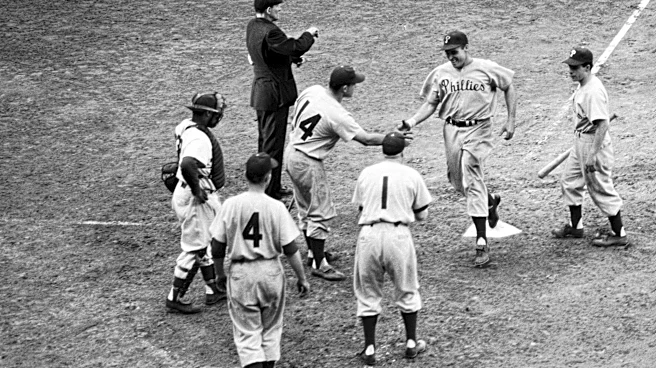
That’s when the son who couldn’t escape his father’s shadow finally emerged with a legendary moment of his own. Sisler blasted a three-run homer to left off of Newcombe, the man he pinch hit for in the All-Star game, to give the Phillies a 4-1 lead and ultimately their first National League pennant since 1915. It was arguably the most impactful home run in Phillies history until perhaps being matched when Bryce Harper accomplished a similar pennant-clinching feat in 2022. Alas, just like Harper’s Phillies in 2022, Sisler’s Phillies in 1950 were not able to finish the job in the World Series. But at least Sisler got a shout out from his old friend Hemingway in The Old Man and the Sea, a novella the famed writer began working on just three months after Sisler’s famous home run.
Sisler had a decent year in 1951, but the Phillies were not able to recapture the magic of the previous season and finished under .500. He was then traded to the Reds following the season before being traded to the Cardinals merely one month into the 1952 season. All in all, Sisler hit .256 with 13 home runs in 130 games split between the two teams in 1952. But in 1953, he once again lost his starting job at first base, this time to 24-year-old phenom Steve Bilko. Sisler would appear in only 32 games with the Cardinals in 1953 before being sent to the Columbus Red Birds in Triple-A. He’d bounce around the minors for six more years before retiring from playing in 1960, never again to play a game in the Majors. Sisler did make it back to the Majors as a coach however, becoming the Reds hitting coach in 1961 and taking over as interim manager in 1962 when manager Fred Hutchinson was diagnosed with terminal lung cancer. Sisler was officially named manager in 1965, joining his father once again as the first father-son manager combination in MLB history.
Jack Sanford, 1957
Sometimes all you need is a chip on your shoulder to succeed. People underestimated Jack Sanford for much of his life, starting in high school when he wasn’t even the number one pitcher on his team. When the Boston Braves expressed interest in signing the Massachusetts native out of high school, his own manager, who was also a scout for the Braves, advised them against it, declaring that Sanford wasn’t much of a prospect.
But that didn’t deter Nancy Sanford, Jack’s sister who played on a local softball team. She encouraged him to go try out for the Red Sox and made sure to pack him a bag and see him on to the trolley to ensure he would go. The Red Sox declined to sign Sanford, believing he was too small, but a scout for the Phillies that was in attendance had his interest piqued. The Phillies then moved to sign Sanford in 1947, but they did not offer him a bonus in the deal like they did with pitchers Curt Simmons and Robin Roberts in the same signing class.
Sanford then experienced a growth spurt his first few seasons in the minors to bring him to just around six feet tall and 190 pounds. He performed well enough to earn an invitation to big league camp in 1954, but he was not given a spot on the major league team. Sanford, who had already earned a reputation of having a very short-fused temper, did not take it too well. He was issued a suspension during the 1954 season when pitching for Syracuse when he refused to come out of a game despite his manager trying to take him out.
But that didn’t deter Sanford’s desire to prove everyone wrong, as he continued to work in Triple-A to earn a spot with the Phillies. However, he quickly found out that there’s at least one entity that doesn’t much care what your desires are when he was drafted into the U.S. Army in October 1954. Sanford was trained as a missile tactician but mostly spent his service time playing for the baseball team at Fort Bliss, Texas. That time in the Army seemingly convinced the Phillies to give him a shot at the Majors, as they decided to bring him up for the last month of the 1956 season. Manager Mayo Smith had to look up records to even know who Sanford was but that didn’t deter him from using Sanford as a starter in the second game of a doubleheader against the Cubs on September 16th.
Sanford pitched seven innings in his MLB debut, allowing one run on four hits with four strikeouts despite walking eight batters. Nevertheless, the performance was enough to make his manager ask why the Phillies didn’t claim his services before the Army did and to declare that Sanford will be on the Phillies to begin 1957 no matter what, saying “someone will have to chop off his arm or something to convince me he can’t pitch in the majors.”
Despite finally accomplishing his goal, Sanford still had a roadblock in his way with an injury in his pitching hand he suffered in a fight while in the Army. His hand would occasionally go numb, and at first surgery was recommended but ultimately Sanford was given medication to treat the injury. But throughout the rest of his career his hand would sometimes go numb in cold weather and he was forced to use a hand warmer on the bench.
Smith was true to his word and Sanford made the 1957 Phillies out of training camp. He rewarded his manager’s faith by winning five of his first six starts and sporting a 10-2 record with a 3.20 ERA and a league-best 96 strikeouts by the All-Star break. Sanford was named to the 1957 All-Star team along with teammate Curt Simmons, becoming the only rookie pitcher named to the NL’s squad. Simmons started the game at St, Louis’ Busch Stadium, but Sanford did get to make an appearance in the top of the sixth.
Sanford entered to replace Milwaukee’s Lew Burdette with the AL up 2-0. He got Ted Williams to fly out for the first out but then ran into trouble, allowing a double to the Yankees’ Bill Skowron before a wild pitch with Yogi Berra at the plate moved Skowron to third. Berra promptly singled to left to bring in Skowron, pushing the AL’s lead to 3-0. But Sanford was able to get the Red Sox’ Frank Malzone and the Orioles’ Billy Loes to groundout to escape the inning. The AL would go on to win 6-5 after a pushing their lead to 6-2 heading into the ninth and barely staving off a late NL rally while sixteen suspected ticket scalpers were arrested outside of the stadium.
Sanford returned to the Phillies and continued his strong season, pitching to a 2.98 ERA in his final 18 starts but was saddled with a 9-8 record as the Phillies went 38-36 and sagged out of contention, finishing third in the NL. Sanford led all of baseball in strikeouts by the end of the season and finished with a 19-8 record and a 3.08 ERA in 236.2 innings. He was named NL Rookie of the Year, becoming the first in the history of the Phillies. He received 16 of 24 first place votes and finished ahead of teammate Ed Bouchee who finished in second place with four first place votes. Sanford joked to the Inquirer that he “must’ve been the oldest in history” to win the award, as he was 28 years old in 1957. He was actually the second oldest to that point, as the Boston Braves’ Sam Jethroe won at age 30 in 1950.
1958 was a disappointment for both Sanford and the Phillies, as he pitched to a 4.44 ERA in 186.1 innings. That was enough to convince the Phillies that Sanford would never replicate his rookie season, and they shipped him off to the Giants in the winter for pitcher Ruben Gomez and backup catcher Valmy Thomas. Phillies owner Robert Carpenter later called it the worst trade he ever made, as Sanford went on to have a good career with the Giants, compiling a record of 85-62 and a 3.59 ERA across six full seasons with the Giants before a mid-season trade sent him to the Angels in 1965.
But Sanford’s career as a starter was nearing its end at that point, and he was converted to a reliever in 1966. He was once again traded mind-season in 1967, this time going to the Kansas City Athletics. But he would appear in only 10 games with Kansas City and sported a 6.55 ERA before being released in August. His former manager in Kansas City brought Sanford along to his new job as manager in Cleveland as a pitching coach, but Sanford quit after two seasons to go work at a golf club in Florida where he eventually worked as a director.
Sources
C. Paul Rogers III, Society for American Baseball Research (SABR) Biography for Jim Konstanty
Stan Baumgartner, The Philadelphia Inquirer, September 15th, 1948
Stan Baumgartner, The Philadelphia Inquirer, June 17th, 1949
Art Morrow, The Philadelphia Inquirer, October 5th, 1950
The Philadelphia Inquirer, November 3rd, 1950
Greg Erion, Society for American Baseball research (SABR) Biography for Dick Sisler
Henry J. McCormick, Wisconsin State Journal, April 17th, 1946
Jefferson City Post-Tribune, April 8th, 1948
The Philadelphia Inquirer, June 15th, 1949
Stan Baumgartner, The Philadelphia Inquirer, October 2nd, 1950
Warren Corbett, Society for American Baseball Research (SABR) Biography for Jack Sanford
Art Morrow, The Philadelphia Inquirer, September 17th, 1956
The Philadelphia Inquirer, July 4th, 1957