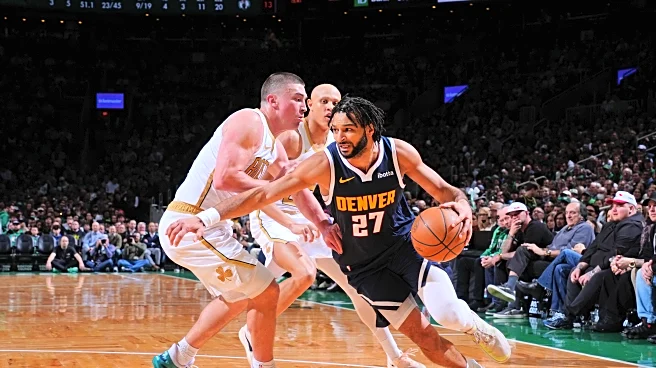



Boston’s loss against Denver wasn’t just about missed shots or late-game execution. It was, above all, a night where defensive choices, communication, and coverage discipline consistently put the Celtics in uncomfortable situations. Jamal Murray became the main stress test — and the Celtics never fully solved it.
The Celtics started the game with Jaylen Brown on Jamal Murray, but things quickly changed. Denver immediately identified Payton Pritchard as the pressure point and repeatedly used his matchup
as the screener, forcing Boston into switches and opening clear driving lanes. That’s the inherent risk of a switch-everything scheme against an offense built on manipulation and timing.
Boston adjusted by putting Derrick White on Murray. White’s ability to navigate screens gives the Celtics a chance to avoid automatic switches and stay more connected. Still, that approach comes with its own downside: when White fights over the screen, Murray can gain just enough space on the catch to operate comfortably.
The Celtics also experimented with keeping Pritchard on Murray while adding help through aggressive stunts. But this only displaced the problem. Those stunts consistently created four-on-three situations, allowing Denver to showcase just how strong they are as a connecting team.
This Nuggets team is very well connected beyond Murray and knows how to punish over-commitment. Here, JB wants to help on the drive, but his and Hauser’s positioning is redundant, giving an exit-screen opportunity for Braun. JB doesn’t see the screen behind him, and that leads to an open corner three.
Searching for another answer, Joe Mazzulla tried something different. Jordan Walsh was put on Murray, while Luka Garza was assigned to Christian Braun, considered a non-shooting threat. The idea was clear: take the ball out of Murray’s hands and shrink the floor elsewhere. Denver immediately countered by involving Braun as a screener, pulling Garza into the action and breaking the coverage.
While one could argue Walsh was too aggressive on Murray in the play above, the possession below shows why you can’t be laid-back against Denver’s pick-and-roll. The Celtics knew Braun would be the screener, as he was defended by Neemias Queta. Still, Murray was allowed to operate with far too much comfort, reading the floor without any real pressure.
Straight away, Joe Mazzulla addressed it directly, asking Jaylen Brown to pick Murray up higher, right after half court.
Another example here of questionable defensive execution. JB goes over the screen, suggesting this isn’t a switch coverage, but Hauser also steps up on Murray. Pritchard then stunts on Murray’s drive as well, leaving Brown open, who swings it to Holmes. The shot is missed, but the defensive shell is broken, and Murray grabs an easy offensive rebound.
Movement or mismatches — these were the two problems the Celtics couldn’t resolve last night. Here again, Murray gets good post position against Simons. This attracts Queta, JB doesn’t get in front of Nnaji and bites on the fake: and-one.
In the final five minutes, the Nuggets kept exploiting the Celtics’ aggressive but imperfect defensive coverage. Here, on a zoom action, they attacked the Celtics’ hedge defense. Pritchard doesn’t fully commit to the roll man, Brown is too high on the weak side, and White is late to protect the rim.
Same play-call a possession later, and the Nuggets again took advantage of the Celtics’ aggressive approach. On the weak side, Pritchard has to deal with two players, which leads to an open mid-range pull-up for Pickett, who looks comfortable taking that shot.
The last one gave Denver a 13-point lead with three minutes to go. The Celtics switched the first screen, but Brown and Walsh stayed connected to their matchups on the ball screen. That gives far too much space to Murray, who can drive and kick to Watson — who was very efficient from the corner in this game.
Boston never truly found a clean solution. Murray’s scoring was somewhat contained, but at a heavy cost: he finished with 17 assists, more than the Celtics’ entire team. Each adjustment solved one problem while creating another.
Murray wasn’t the only issue. Boston’s overall defensive execution simply wasn’t sharp enough, and the Nuggets repeatedly punished small mistakes. On several possessions, the Celtics failed to apply ball pressure — and when they did, they were punished if the execution wasn’t precise.
Against a team as smart and connected as Denver, these lapses are costly — especially when mismatches also need to be hidden. Boston wasn’t able to consistently make up for its defensive issues on the offensive end, and the accumulation of small errors slowly tilted the game out of reach.