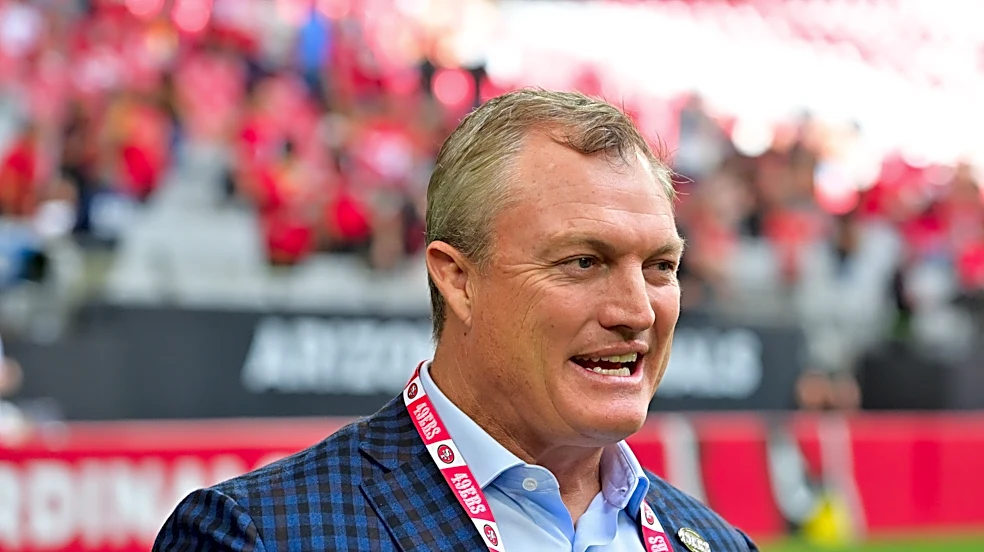




San Francisco 49ers general manager John Lynch joined Chriss Simms on the Unbuttoned podcast to discuss injuries, late-game management, and changes in defensive back play.
Lynch also spoke about how the 49ers’ draft strategy changed and why they needed to add length to the defensive line:
I think first of all, nobody’s perfect in the draft. It’s an inexact science. But you better have a good process. I think Kyle and I having been here for 10 years now, we’ve got a lot of continuity. So sometimes,
the faces change — Raheem Morris in for Robert Saleh.
But we have a really good knowledge of what we like in players. And then, typically, in our schemes, you know. Because we go to great lengths to define each and every position and the characteristics at that position. Now, I’ll tell you, it changed a little bit this year with Raheem.
We were going to be doing more 5-down fronts. And there was probably more of an emphasis this year. You look at some of the guys like [Jaden] Dugger, the linebacker that we took. We knew we had a bunch of little Chihuahuas that would chase you and swarm you. We needed some length, you know, to play those fronts.
And whether we had gone to more of the 5-down fronts or not, we needed some length in there. A guy like Gracen Halton, we just loved his style. He’s an attack-defensive lineman. We loved his film from Oklahoma. I really think why we hit on late-round picks exceptionally well is because we have great synergy with our coaching staff. Scouting, coaching.
It’s still baffling knowing that Halton fell to Day 3 of the NFL Draft. He’s a hair under 6’3″ and sub-300 pounds. I get it. But he tested like a superb athlete in the areas that translate for defensive linemen: Lower-body explosiveness.
He wasn’t an under-the-radar prospect, either. He started on arguably the best defense in the country. Then he went out and had a good Senior Bowl week. Not to mention, he’s only 22.
Lynch talked about why the team hits on late-round picks:
We talk about alignment all of the time. That’s where you use data. Our R&D, our research and development, when they’re in on a player, when scouting is in on a player, when coaching is in on a player, we hit at a real high rate. And a lot of those late round picks, when you have that alignment on a guy, you say, “Alright. We don’t think he’s going until here.” Now we’ve gotta be really skillful and use our experience as to when we do think we can get him. And then sometimes getting lucky, like with Brock Purdy.
The follow-up questions to that would be why there isn’t the same synergy for early-round picks, which department has the lowest hit rate on Day 1 and Day 2. Why not implement more of whatever it is that allows you to find talents like Halton, Dugger, or Malik Mustapha earlier in the draft?