



The Phoenix Suns have numerous decisions ahead of them this upcoming offseason, including multiple restricted free agents, unrestricted free agents, and players with trade value. The following series will examine those decisions as our writing team presents both a point and a counterpoint for each.
Royce O’Neale may or may not be the number one player on the trade block for the Phoenix Suns this offseason. He has a cheap contract, the Suns want to continue getting younger and more athletic, and he has value
to any team he could potentially end up on.
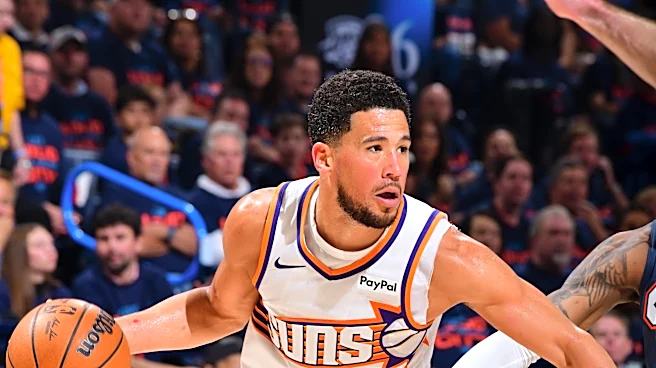
The Suns appear to want to keep the nucleus of Devin Booker, Jalen Green, and Dillon Brooks together. Mark Williams, Jordan Goodwin, and Collin Gillespie are free agents, so even if the Suns wanted to use those players as trade chips, they cannot. The Suns have four young players they drafted the last two seasons who have some value, but nothing other teams around the league should covet. So that leaves O’Neale and Grayson Allen as the Suns with value, under sizeable contracts, that could fetch a decent role player in return.
But even though there are many good reasons to trade O’Neale, there are many reasons that he should remain a Sun as well.
The main reason why O’Neale should not be traded this offseason is his shooting. Last season, O’Neale shot a career high 40.8% from the three-point line and made 2.7 three-pointers per game. Both of those rank in the top 25 of all NBA players. It was not an outlier year either; O’Neale shot above 40% from long range in the 2024-25 as well, and he has continued to improve as a shooter almost every season since he came into the league.
Not only is the shooting percentage real, but his ability to take and make difficult shots is valuable as well. O’Neale is not a movement shooter, but his quick release off the catch or pump-fake side-step dribble three-point shots make him extremely valuable to NBA offenses. So while O’Neale should not start 67 games next season like he did this year, he can be a key contributor and a needed shooter coming off the bench.

O’Neale is not the future at the forward position for Phoenix, and it may be this offseason that Rasheer Fleming gets the nod from Jordan Ott as a more integral rotation player than O’Neale. But with the ups and downs that come from playing young players, the Suns will still need a veteran presence who can stay ready and play under any circumstance. That is where O’Neale provides so much value, even as someone coming off the bench.
We have seen Ryan Dunn struggle to commit fouls on defense over the last two seasons, and Fleming will have his growing pains as the lead defender on the ball as well. Let’s not forget the handful of games that Brooks spent fourth quarters on the bench for his erratic fouling and behavior. Even though he is not a great defender anymore, O’Neale provides the calming presence on both ends that the Suns will need to deal with the growth of the young bucks.
Offensively, it will be difficult for any young player on the roster to replicate O’Neale’s role on offense. He is one of the Suns’ smartest, craftiest, and crucial pieces to their offensive success. He was not a go-to scorer, but he did handle the ball more this season and showed he can keep the Suns’ offense moving. He was a steadying presence that often went overlooked by most of us fans, but with O’Neale starting 67 games and playing in crucial stretches, he showed that Jordan Ott valued him more than we did.
By the way, his 67 starts led the team this season. Which is the next reason that O’Neale should remain a Phoenix Sun: his consistency.
O’Neale played 69 games in his rookie season and has yet to play below 70 games in his career since then. His 78 games were the third most games played this season by a Sun, and you can pencil him in for 70 or more games next season as well. Being in the lineup every day and being a consistent shooter are two extremely valuable skills the Suns need in the rotation. Not only is his play consistent, but so is his demeanor. He keeps his poise when things spiral, which is needed to balance out the chaotic nature of playing alongside the necessary chaotic Dillon Brooks style of basketball.
The weaknesses for O’Neale are easy to see. Is O’Neale the defender he used to be at his peak? No, he is not. He has glaring flaws, especially in rebounding and defending the ball. His value is only going to decline with age; however, holding onto him for one more season could be wise, because he can be used as an expiring contract next season. He has two years left on his 4-year, $42 million contract he signed in 2024, which is not exceptional value, but he still provides the Suns with value at that price tag. The Suns will not be able to easily pick up a 40% three-point shooter off the street to replace O’Neale.
Unless O’Neale is traded away for a star player, the Suns have to keep him because the only other knockdown three-point shooters on the roster are Collin Gillespie and Grayson Allen. Outside of those three players, the Suns do not have the consistent shooting needed to space out opposing defenses. If the Suns truly are set on Devin Booker, Jalen Green, and Dillon Brooks being a three-headed monster next season, they are going to need players like O’Neale who can fill in the gaps. Right now, outside of Allen, O’Neale can fill in those gaps better than anyone else on the Suns roster.
Hopefully, Ryan Dunn or Rasheer Fleming can supplant him soon, but for now, O’Neale is just as integral a piece to the Suns’ next season as any role player on the roster. The Suns won 45 games this season, with O’Neale starting 67 games and only making $10.5 annually. He is the quintessential glue guy, and replacing him will be much tougher than it looks at the surface. So even if you do want him traded, and I won’t tell you you are wrong, it will be difficult for the Suns to replace a guy who was one of the most dependable players on the team last season.