



Major League Baseball was forever changed 50 years ago this month. That was when arbitrator Peter Seitz ruled in favor of pitchers Andy Messersmith and Dave McNally against the league. The two had played 1975 after refusing to sign contracts for their respective teams and the opportunity had finally arrived in full for the MLB Players Association to take down the reserve clause in full following years of pioneering efforts from the likes of Marvin Miller and Curt Flood.
The Seitz Decision killed that
infamous clause and opened up new avenues for players to hit the open market after six or seven years of service time, depending on the circumstance. While the majority of owners griped and bemoaned the end of the spirit of the game (clearly just that and not their outright feudal control of the market), the avenue was open for teams to make big improvements by simply forking over some cold, hard cash. And no one was more prepared to do that than the New York Yankees and still-new owner George Steinbrenner.
Upon purchasing the Yankees from CBS for $8.7 million with his group of partners in 1973, Steinbrenner had told the press, “We plan absentee ownership as far as running the Yankees is concerned … We’re not going to pretend we’re something we’re not. I’ll stick to building ships.”
That promise hardly lasted through the first week of spring training. Indeed, it was soon obvious that Steinbrenner was willing to do just about anything to win, and as free agency became integrated within the sport, he proved to be quite ready to open up the checkbook. The Yankees often had well-paid stars, going back to the days of Babe Ruth making more more money than President Herbert Hoover and Joe DiMaggio becoming MLB’s first $100,000 player. But Steinbrenner’s near-relentless pursuit of top free agents—both the best players and ones who simply happened to be among the best available at the time—inextricably tied the Yankees to the whole process. Even in relative down years, they were always lurking like a tiger, seemingly ready to pounce at whichever opportunity most appealed to them at the time.
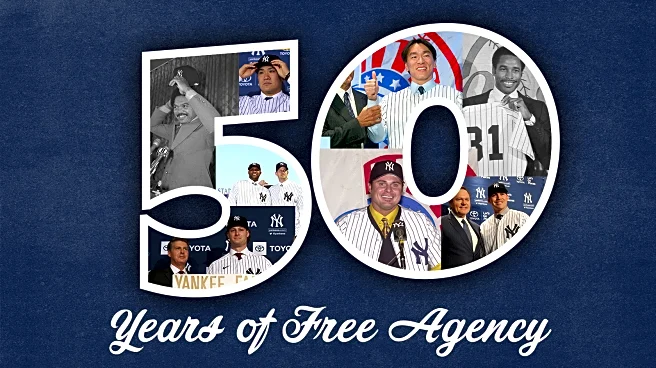
To celebrate the 50th anniversary of free agency as we know it, we’re telling 50 different stories of notable Yankees free agent signings in chronological order, from those that were smash hits to ones that blew up in their faces. They are all parts of Yankees history, for better or for worse, and free agent busts can be more famous than most signings.
As a disclaimer, please know from the jump that we are not necessarily just looking at the smartest moves, the best bargains, or all of the richest contracts. Those are all separate categories. The screening process aimed to capture the Yankees free-agent signings that generated the most buzz at the time. So, for example, while the resurrection of 2011 Bartolo Colón was a smashing success on what was initially a minor-league deal, that will not qualify.
Extensions were also ineligible because those negotiations are naturally different than when the open market is a legitimate presence. If players became free agents and re-signed, however, then that entry would be under consideration. Trading for a big contract isn’t the same as a free-agent signing, so you won’t find the deal for Giancarlo Stanton here, nor the acqusition of Randy Johnson, who was quickly extended. The negotiations are just an entirely separate affair than free agency. Lastly, some players might have had multiple free-agent signings qualify, but to ensure variety, we only have major contract per player.
Enough with the methodology! It’s time to explore the actual stories. Beginning today, we’ll have a historic free agent signing to discuss almost every day until spring training begins, primarily posting on weekdays and skipping holidays. This intro will remain pinned to the front page and update with links to the new articles as they go up.
We hope you enjoy!