





Forget about last year’s playoff exit. Forget about the New York Knicks winning the Finals. Forget about all the Jaylen Brown trade drama.
Boston Celtics basketball is almost back, baby!
The 2026 NBA Summer League is set to kickoff on Thursday, July 9, in Las Vegas, and the Celtics’ last two draft classes are expected to play under assistant coach Amile Jefferson. That includes 2025 draftees Hugo Gonzalez and Amari Williams, as well as rookies Chris Cenac Jr. and Dillon Mitchell.
While Summer League
is never the most meaningful stage for young prospects, it gives rooks a chance to show their stuff for the first time on the professional level, recent draftees an opportunity to show growth, and fringe NBA players a shot at proving their worth to the league.
Sometimes Summer League performances clearly exemplify a young player’s potential on the NBA level. Think Damian Lillard in 2012. Over four games, Lillard displayed immediate signs of superstardom, as he posted 26.5 points per game on solid shooting efficiency while creating for himself and his team at a dominant level. He won the Las Vegas Summer League’s co-MVP award for his play.
Most of the time, the opposite is true. Going back to 2012, does anyone remember who the other co-MVP was? It was the Memphis Grizzlies’ second-round draft pick from the year before, Josh Selby. He put up 24.2 points, 2.4 rebounds and 2.4 steals per game that summer. Selby ended up playing 38 total games in the NBA and averaged 2.2 points per game.
So, regardless of how the young Celtics play this summer, don’t put too much stock into anything, good or bad.
Nevertheless, what can we reasonably hope to see out of the young guns this summer?
Hugo Gonzalez: all-around excellence

Now you might be saying, Ryan, how can you ask what can we “reasonably” hope for, then say “all-around excellence” for Hugo Gonzalez?
Well, if you know, you know.
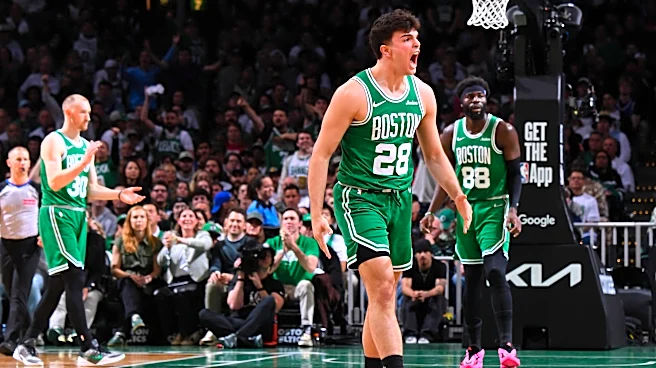
Despite averaging less than 15 minutes and 4 points per game over his rookie season, Gonzalez displayed starter-level potential for the Celtics last year and should be the best player on this year’s Summer League squad.
The 20-year-old, 6’6″ wing has an endless motor, the athleticism to match it, excellent defensive versatility, a solid understanding of the game, and a decent shot to top it all off.
While Gonzalez didn’t get a chance to shine in the playoffs, he should get plenty of opportunities in the Summer League. Last year, he averaged 10.8 points, 4.5 rebounds and 2.8 assists over four games, but shot about 30% from both the field and three-point range.
This year, I wouldn’t be shocked to see him average 15+ points per game as he assumes a larger role as a second-year player, all while maintaining his overwhelming, energetic presence on the defensive end. Gonzalez will likely be asked to serve as more of an offensive creator than ever, given his “veteran” role on the squad, so it will be interesting to see if that aspect of his game developed over his rookie season. Young players often struggle with maintaining efficiency in an expanded offensive role, but I think Gonzalez’s shooting numbers will land closer to last season’s (47.6% from the field and 36.2% from three) than last Summer League’s.
All in all, Gonzalez should be Boston’s best player on the court this summer, serve as a major contributor on offense and defense, and have a chance to show off more of the tantalizing potential he displayed as a rookie.
Amari Williams: recreate his G-League success

Williams, a 6’11” big drafted in the second round last year, didn’t get nearly as much run as Gonzalez in his rookie season. He played in only 22 games at the NBA level (compared to 74 for Gonzalez) and averaged 6.6 minutes per game when he did.
Nevertheless, Williams displayed promising upside during his time in Maine. Over 18 games played in the G-League, he averaged 17.9 points, 10.9 rebounds, 4.8 assists and 1.8 blocks per game. With impressive size and length (including a freaky 7’6″ wingspan), as well as strong court vision and passing from the post, Williams could be the next solid big man to come out of Maine.
This summer, I want to see Williams bring some of that G-League production to Las Vegas. Last year, he averaged only 6.3 points, 5 rebounds and 1.8 assists per game, and was overshadowed by Charles Bassey. While he is likely to start alongside rookie big man Chris Cenac Jr., Williams will be in a prime position to play major minutes in Boston’s frontcourt and serve as an offensive lynchpin in the post due to his playmaking talent.
Williams will have a chance to show that he deserves a bigger role in the Celtics’ frontcourt in 2026-27 but, realistically, he may still be a year or two away from earning one — especially if the Celtics do acquire an additional big in the offseason. However, if he finishes Summer League averaging a double-double in points and rebounds while dishing out 3-4 assists per game, his growth as a player may be difficult for Coach Joe Mazzulla to ignore.
Chris Cenac Jr.: display elite athletic tools, offensive versatility

The Celtics’ latest first-round draft pick is a 19-year-old, 6’10” big man out of the University of Houston, where he averaged 9.5 points, 7.9 rebounds, 0.7 assists, and 1.3 stocks over 24.8 minutes per game.
Like Williams, Cenac is an athletic big who sports an impressive wingspan (7’5″) but, unlike the 24-year-old Williams, he slots in as more of a power forward than a center. That’s due to his ability to shoot from the perimeter (even though he only shot 33% on 3 attempts per game in college), blow by slower big men with a quick first step, and pull up for jumpers in the mid-range. At the same time, he’s a lob and putback threat who demands attention beneath the basket.
With that kind of offensive versatility, one of the most interesting things to keep track of this summer will be how Jefferson utilizes Cenac on the offensive end. Will he be seated in the dunker spot and asked to clean up offensive boards, or be stationed on the perimeter or at the elbow to stretch opposing defenses?
On defense, Cenac has the athletic tools to become a plus defender in the NBA despite an unimpressive 2.6% block percentage during his time in college. He’s got the length and bounciness to deter shots down low, as well as the lateral agility to stick with many perimeter players, resulting in exciting switchability. While he’s still got a ways to go in learning how to best utilize his athleticism defensively, the tools he displayed in college should translate well to the NBA.
Overall, Cenac is still very raw as a prospect, so I don’t expect him to excel in his first go at Summer League. But if he can show A) that he can operate outside of the dunker’s spot, and B) that his athletic tools remain high-quality even amongst NBA talent, I think that’d count as a successful showing.
Dillon Mitchell: cause CHAOS

Mitchell, the 40th overall pick in this year’s NBA draft, is an athletic wrecking ball of a 22-year-old.
The 6’7″ wing has absolutely zero shooting touch, as he shot only 6.7% on 0.4 attempts per game from three-point range and 49.4% on free throws during his time at St. Johns. Regardless, Mitchell is an explosive athlete with outstanding speed, strength, and leaping ability, which he leveraged to score 8.3 points per game on 55.9% shooting from the field, as well as tally an solid 7 rebounds per game as a wing.
The vast majority of his points at St. Johns came in the paint as a result of backdoor cuts and athletic slashes to the basket, as well as in transition. He also displayed a respectable passing game, averaging 3 assists during his final year in college, with many coming off of kickouts to perimeter players after breaking into the paint.
However, his athleticism is best displayed in his defense. Lauded by Celtics’ Vice President of Basketball Operations Mike Zarren as “one of the best perimeter defenders in college basketball”, Mitchell should be able to make an immediate impact on the defensive end of the court in Summer League.
So, Mitchell’s numbers may not be pretty this summer, but if he can use his athleticism to cause chaos defensively and drive into the heart of opposing defenses to generate rim looks and kickouts on offense, he could be a positive contributor despite his lack of shooting.