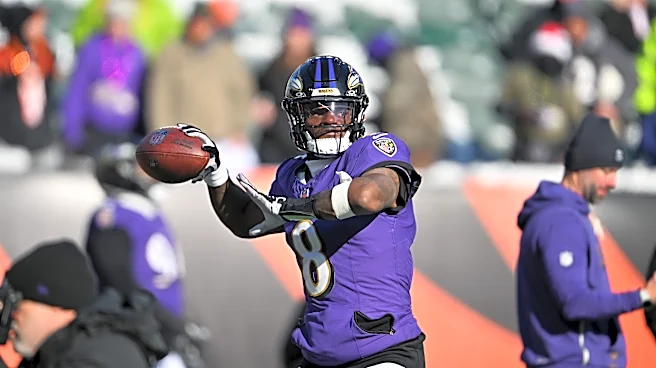



Welcome back to former Raven Femi Ayanbadejo’s four-part series on Lamar Jackson. Part One examined why the narrative surrounding the two-time MVP requires a reset. In Part Two, Femi tests criticism of Jackson’s play against the film and data and resets the remaining goalpost where it belongs: the Super Bowl.
In December 2023, Fox Sports Radio host Monse Bolanos argued that Jackson did not deserve the MVP. “I want my quarterbacks to be quarterbacky,” she said. “To me, Lamar Jackson’s just a great
athlete.”
The backlash was swift. ‘Quarterbacky’ became somewhat of a rallying cry for the Ravens in press conferences and social media posts. Ray Lewis and LeBron James clowned the take. Jackson, as always, did his talking on the field, throwing five touchdowns and recording the third perfect passer rating of his career.
The word exposed a framing that has followed Jackson since before he was drafted: the tendency to strip him of intellectual credit and reduce him to his physical gifts. When another quarterback escapes pressure, it is called creativity or processing. When Jackson does it, the play is often described as instinct, as though elite cognition and elite athleticism cannot occupy the same body.
Jackson is the “and.” Instinct and intellect. Improvisation and structure. Creativity and discipline.
The Common-Denominator Argument
This past June, Emmanuel Acho argued that Baltimore had again changed coordinators while its postseason results remained the same, making Jackson the common denominator.
The phrase sounds conclusive, but it confuses continuity with causation. Jackson is a common denominator, but not the only one. Identifying him as present in every loss does not establish how much responsibility he carries for each one. As the face of the franchise, he takes blame for the team’s shortcomings without a full accounting of his actual responsibility for each.
When it comes to coordinators, Jackson is actually the common denominator of success. In Greg Roman’s first full season as OC, he led the Ravens to the No. 1 seed in the AFC and earned a unanimous MVP. After Todd Monken was hired in 2023, he repeated the feat (with 49 of 50 MVP votes).
Those offenses were not identical. Roman emphasized the zone-read game and a record-setting rushing attack. Monken expanded the route tree, spacing, progression game, and Jackson’s responsibility as a passer, even while Baltimore remained committed to the run. Jackson thrived in both systems – better yet, both systems thrived because of Jackson.
The playoffs require a more exact audit. In his first two losses to the Chargers (2018) and the Titans (2019), Jackson’s late production did not erase slow starts, turnovers, and missed opportunities. His pick-six against the Bills in 2020 was decisive. And though Baltimore’s abandonment of the run is partially to blame for the heartbreaking 2023 AFC Championship loss to the Chiefs, Jackson also pressed, held the ball, and threw a costly end-zone interception. Those are not imaginary failures. They belong in his evaluation.
Other losses require shared attribution. Protection, play selection, penalties, drops, fumbles by teammates, and defensive performance also shape elimination games. “Common denominator” is a starting question, not a completed analysis. The responsible conclusion is that Jackson has contributed materially to several playoff losses without being the sole explanation for Baltimore’s postseason record.
What the Regular-Season Record Shows
Jackson ended the 2025 season tied with Aaron Rodgers for the highest qualifying career passer rating in NFL history at 102.2. In 2024, he produced a 119.6 passer rating from the pocket. He shares the record of four qualifying perfect-passer-rating games with Peyton Manning and Ben Roethlisberger. He is the first quarterback to throw at least 40 touchdown passes with fewer than five interceptions in a season.
In other words, his passing production is not simply the byproduct of scrambling. In Jackson’s 2019 MVP season, 25 of his 36 touchdown passes came from the pocket. Warren Sharp’s charting showed Jackson leading quarterbacks from the start of 2024 in touchdown passes traveling more than 10 yards through the air, while also ranking first in red-zone passing efficiency and EPA per attempt on throws released within 2.5 seconds over the same period.
Film provides the mechanism behind the numbers. Jackson manipulates second-level defenders with his eyes and legs, resets throwing platforms without surrendering vision downfield, and turns simulated pressure into favorable space. Under Monken, he showed greater patience through full-field concepts and more willingness to win from inside the structure. His mobility changes coverage rules, but exploiting the resulting leverage still requires recognition, timing, and accuracy. Athletic stress creates the question. Quarterback play supplies the answer.
That distinction matters when commentators treat the effect of Jackson’s legs as evidence against his passing. A quarterback does not lose intellectual credit because one elite trait creates opportunities for another. Every great player forces defenses to overreact to what he does best.
Durability in Context
Joe Burrow is an exceptional quarterback and belongs in any discussion of the league’s elite. Durability, however, is part of quarterback value. From his 2020 debut through the 2025 regular season, Burrow missed roughly one-third of Cincinnati’s games because of injury. Jackson missed less than 10 percent of Baltimore’s regular-season games because of injury over his career through 2025 and has not undergone surgery.
This comparison does not diminish Burrow. It demonstrates how selectively availability enters quarterback debates. Jackson’s open-field style is regularly presented as a durability liability even though his actual injury history has been less severe than that of several celebrated pocket passers.
Where the Criticism Is Valid
Jackson’s postseason record is 3-5. His postseason passer rating is 84.6, far below his regular-season standard. Across eight playoff games, he has thrown 10 touchdown passes and seven interceptions, taken 29 sacks, and committed additional fumbles. The exact fumble total varies by statistical classification, but the conclusion does not: his elimination-game ball security has been materially worse than his regular-season norm.
The performance is not static. In his four most recent playoff games through the 2024 season, Jackson completed 70 percent of his passes, produced seven passing touchdowns against two interceptions, and posted two of the best postseason performances of his career. That improvement matters. So does the fact that Baltimore did not finish the job.
The fairest critique is specific: Jackson has sometimes pressed when the game turned against Baltimore, held the ball while searching for an explosive answer, and exposed the offense to sacks or turnovers. The coaching staff has compounded that problem by departing from its identity in critical moments. Both can be true. Accountability does not require assigning every failure to one person. It requires identifying what that person controlled.
Jackson does not need to prove that he can play quarterback, win from the pocket, master different systems, or produce historically efficient seasons. The unresolved requirement is narrower and more demanding: carry his regular-season decision-making and ball security through four championship-level postseason performances.
That is a legitimate question. But really, it’s the only one left.