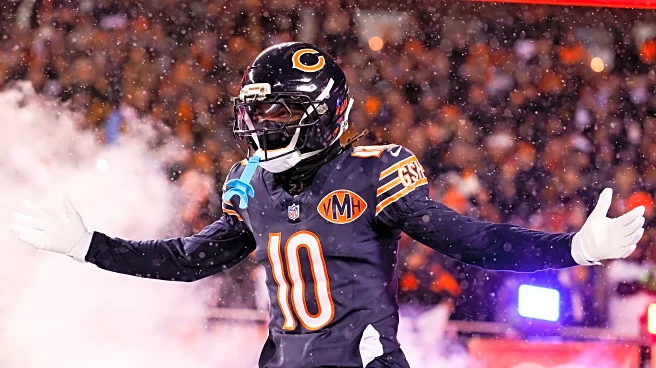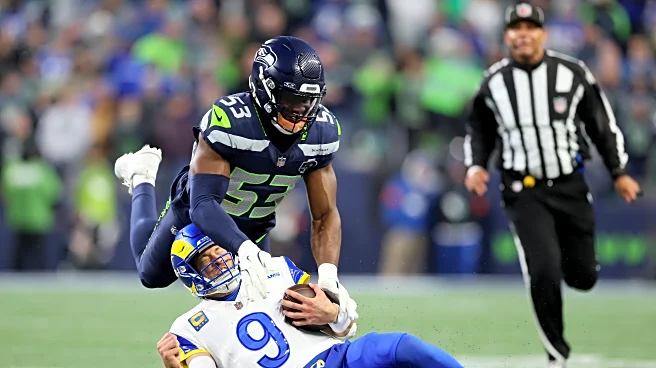



Following the Chicago Bears’ first playoff win in 15 seasons, the season ended in heartbreak with a 20-17 loss at home to the Los Angeles Rams. Although the season didn’t end the way fans were hoping for, there’s plenty of reason for optimism moving forward into the upcoming offseason. For starters, the Bears’ core players are in place. As of now, all 11 offensive starters are set to return, as is the majority of their depth chart. The defensive side of the ball is another story, but after a lackluster
year on that side of the ball, maybe that’s not the worst thing.
Before we dive too far into the Bears’ cap situation and what they could do in March and April, let’s first take a deeper dive into their upcoming free agents. As it stands, Chicago is set to have 25 total free agents, but only 22 for whom the team holds no control rights heading into March. It’s important to note that additional moves will happen in the coming weeks, but for now, we’ll take a look at all 25 free agents and where they stand.
Unrestricted Free Agents (22)
The bulk of any team’s pending free agents will always be of the unrestricted variety. In short, barring a franchise tag (which won’t happen), all players are in line to test the market when the legal negotiation period starts on Monday, March 9th, at noon Eastern. Of the 22 names on this list, only four players are coming off their rookie deals, while 10 players were with the team for one year or less. History has shown that while general manager Ryan Poles isn’t afraid to sign players to an extension, most names who hit the market tend to leave.
Below you’ll see these 22 names broken down by each position and unit. 14 of their 22 unrestricted free agents are on the defensive side of the ball, with a large majority in the secondary. Of the defensive names, seven players started at least one game for the Bears in 2025. Most notably, all four safeties that were under contract for 2025 are set to be free agents.
Offensively, there are a few names worth mentioning, but none that profiled as primary starters for the team down the stretch run. There are a few depth pieces that might be nice to have back, but in total, none of what they are projected to lose are irreplaceable. At least in terms of continuity, that’s an excellent place for the offense to be. All things considered, there shouldn’t be any player too expensive not to retain, but as usual, expect Poles to be selective, especially on the defensive side of the ball, for a unit that needs multiple upgrades.
- S Kevin Byard
- S Jaquan Brisker
- S Jonathan Owens
- S Elijah Hicks
- DB C.J. Gardner-Johnson
- CB Nahshon Wright
- CB Nick McCloud
- CB Jaylon Jones
- LB D’Marco Jackson
- LB Jaylin Reeves-Maybin
- DT Andrew Billings
- DT Chris Williams
- DE Dominique Robinson
- DE Joe Tryon-Shroyinka
- WR/KR Devin Duvernay
- WR Olamide Zaccheaus
- OT Braxton Jones
- iOL Ryan Bates
- iOL Ricky Stromberg
- TE Durham Smythe
- RB Travis Homer
- LS Scott Daly
Restricted Free Agents (2)
In past years, there’s been some anxiety about who the Bears will keep on restricted tenders and who they will allow to test the free-agent market. The best example of this in recent memory was last year with linebacker Jack Sanborn. While many, including me, believed he was worth an original-round tender, the Bears opted not to retain him, and he signed a cheap one-year deal in Dallas. Understanding Dennis Allen’s defense a little better, it made sense why they decided to let him walk, given his lack of speed.
As a refresher, here’s how restricted free agent tenders work (all figures provided by Over The Cap):
1st Round Tender (Projected At: $7.893M)
The most expensive option is for teams that strongly value a player to place a first-round tender on them. This means that if another team were to sign a player to an offer sheet and the player’s current team opts not to match, the pursuing team would give its first-round pick, plus a contract, in order to obtain the player.
2nd Round Tender (Projected At: $5.658M)
Similar to the first-round tender, but in this case, it would cost the pursuing team a second instead of a first.
Right of First Refusal (Projected At: $3.453M)
This is the cheapest and most logical option for teams who value a player but are also willing to risk losing him to a deal they’re not comfortable with. This tender can be used for cap-flush teams that are willing to allow another team to essentially write a new contract for a player they’d like to keep. Or it can be used for a player they would like to keep, but don’t have the financial means to overpay, regardless of the market.
This year, the Bears have only two players in the restricted category. Some of that is due to their lack of effectiveness with undrafted free agents, but sometimes there are just years when there aren’t many restricted free agents. It’s worth noting that neither player would require anything more than a Right of First Refusal tender, but neither is likely to receive it. Despite being credited with only three NFL seasons, Hardy is just 27 years old. He’s not a significant factor on defense, but he’s become a core special-teamer for Richard Hightower’s units. It sounds like the Bears would like to keep Hardy, so something similar to what Josh Blackwell received last year (two years, $5 million with $2.45 million guaranteed) should get it done. For McFadden, his value might be trickier. The team felt comfortable enough with him to give him the start at left guard in a playoff game. That said, he has under 100 offensive snaps over the last few years, so the sample size isn’t very big. A cheaper one-year deal could make some sense for both sides, but in a weak free agent market, another team could offer more than the Bears are comfortable paying. That’s the risk teams take when not tendering a contract, but McFadden’s body of work should not require giving him close to $3.5 million, especially when he wouldn’t be guaranteed a roster spot in September.
- DE Daniel Hardy
- iOL Jordan McFadden
Exclusive Rights Free Agents (1)
The final name on this list is a no-brainer for the decision to be made. Because Benedet was an undrafted free agent and didn’t make the 53-man roster his rookie season on the contract he signed, he’s basically on a year-to-year basis in Chicago until he goes into his fourth year, where he would become an unrestricted free agent. Simply put, all the Bears need to do to secure his services for the season is tender a contract. They have complete control of his rights, so this will end up becoming more procedural than anything else. According to Over The Cap, the cost of his contract will be 1.05 million with no guaranteed money. That’s a low price to pay for quality offensive line depth.
- OL Theo Benedet