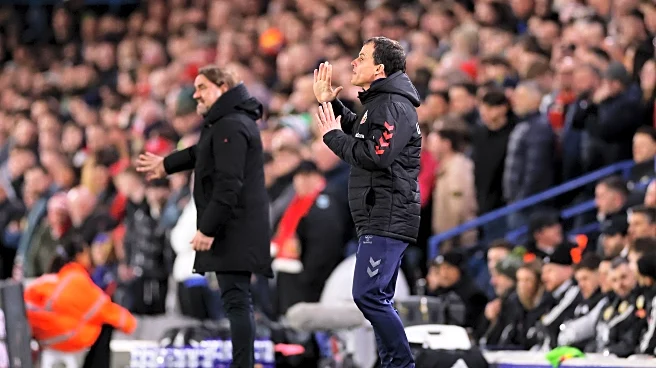

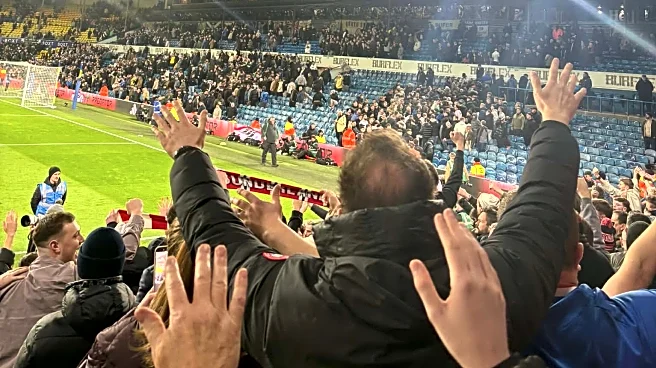
Sunderland travelled south for their final away double-header of the season, with trips to Bournemouth and Leeds in the space of seventy two hours.
On paper it felt like an enormous task for Régis Le Bris to galvanise his players having not taken maximum points on the road since October, but the welcome return of captain Granit Xhaka was a boost ahead of the first game down at the Vitality Stadium.
Despite the initial concerns, the Lads walked away from the south coast with a point before travelling
up to Elland Road and battling to only our third away win of the season against relegation-struggling Leeds.
Reverting to what made Sunderland so successful in the early stages of the season, how did Le Bris tweak his shape to get his side back on track and net that magical forty-point target?
Sunderland Lineups
With fresh injury concerns after a disappointing result against Fulham, Le Bris needed to make several changes to his side to accommodate the missing personnel before considering any game-specific adjustments.
Four changes were made from the loss to Fulham as both Brian Brobbey and Nordi Mukiele missed out due to injury and were replaced by Lutsharel Geertruida and Eliezer Mayenda.
Elsewhere, Xhaka and Chemsdine Talbi returned to the side following returns to full fitness at the expense of Nilson Angulo and the injured Jocelin Ta Bi.

With such a tight turnaround, Le Bris named a changed side on Tuesday night, gradually reintroducing Bertrand Traoré after he picked up a muscle injury during AFCON and with those who were fresh on the treatment table likely to be missing for upwards of a month, he was stretched in his ability to rotate the team further.

Whilst the personnel differed, the away shape and system was very much what we’ve come to expect from a Le Bris but with the inclusion of Xhaka, we saw a more traditional degree of bite in Sunderland’s ability to press at Bournemouth compared to recent weeks.
Enzo Le Fée moved across to the left wing to allow the trio of Xhaka, Noah Sadiki and Habib Diarra all to roam centrally, whilst Le Fée would drift infield and invert with Sadiki when Sunderland retained possession.
The key to utilising Diarra and Sadiki centrally and ahead of Xhaka meant that when Le Fée or Trai Hume inverted infield, they were able to form a ‘box midfield’ and sustain possession and pressure by outnumbering the opposition midfield.
This was combined with the raw distance both players are able to create — not through only their work between the boxes, but also their ability to run the channels and exploit the half-spaces, as we’ll touch on later.
With Xhaka returning to fitness and Robin Roefs picking up a late knock, Melker Ellborg came in to make his debut at Elland Road whilst Luke O’Nien came in to make his first league start of the season at right back, which allowed Geertruida to move into the midfield void vacated by Xhaka.
Xhaka himself was a late fitness doubt and was looking likely to start this one prior to discovering the extent of the challenge he faced courtesy of Tyler Adams’ tackle on Saturday lunchtime.
Both opponents offered different levels of positional rotation, with Andoni Iraola’s Bournemouth matching Sunderland in their shape, whereas Leeds have never looked back since Daniel Farke’s transition to a 3-5-2 system in order to utilise the athleticism of his wing backs and providing a supporting striker for Dominic Calvert-Lewin to prevent the forward from feeling isolated.
Both of Sunderland’s opponents would naturally consider themselves as possession-oriented, therefore we weren’t forced to hold the ball uncomfortably, allowing the Lads to get back to what made them so strong earlier in the season with their discipline on the road.
Opposition Lineups
Iraola made several changes to his Bournemouth side — most notably the rotation in his forward line with Evanilson dropping to the bench in favour of Le Bris’ old favourite Eli Kroupi Jr from his position behind the striker — a player who’s been a revelation since his summer signing from Lorient.
Elsewhere, David Brooks came into midfield and Marcus Tavernier also replaced Amin Adli out wide, whilst January signing Rayan retained his place on the wing following his electric start (four goal contributions in his first five games).

Bournemouth set up in 4-2-3-1 system, but since the introduction of Brazilian Rayan, they’ve opted to move away from the inverted wingers approach and instead utilise traditional wingers, with both Tavernier and Rayan both operating from their strong foot side as they look to utilise their pace to beat full backs on the outside.
With Adli and Justin Kluivert also capable of playing off their strong side, Iraola has switched between inverted and traditional wingers, depending on the game state.

With two wing backs who love to provide attacking threats both via overlaps and underlaps, Bournemouth like to retain two defensive pivots alongside their central defenders to form a compact box midfield and allowing a concerted effort to retain possession.
Despite initially arriving as a more transition-focused coach, Iraola has leant himself more into the possession game this season: with his team averaging 49.9% possession. This places them dead central in the league for this metric — compared to Sunderland, who sit sixteenth with 44.1%.
In total contrast, Sunderland’s second away trip saw them face a Leeds side who don’t change much about the way they operate game by game.
Despite his touchline ban, Farke named an unchanged side to the one that placed Manchester City under heavy pressure at Elland Road on Saturday evening by retaining their 3-5-2 shape, which has turned their entire season around.

Following their change in system, Leeds opted for a less free-flowing yet more compact and aggressive 3-5-2 system which saw their possession numbers plummet but their position in the Premier League skyrocket.
After a sensational run which saw them suffer just three defeats in fourteen games, Leeds were riding the crest of a survival wave and looking to put Sunderland to the sword. In late November, they switched to a system that was less reliant possession they dropped down to 44.8% average possession, placing them just slightly above Sunderland.
With three incredibly aggressive central defenders and the combination of Ethan Ampadu and Anton Stach anchoring their midfield, the central spine of the team can do battle with anyone and therefore often leads to them dominating the midfield battle against teams.
Both wing backs are capable of providing width but are equally as comfortable in dropping into a back five, remaining compact and funnelling opposition players into the crowded centre of the pitch.
A battling point at the Vitality
Within the opening minutes, Sadiki had tested Djordje Petrovic and Sunderland were unlucky not to have a penalty after Enzo Le Fée was bundled over in the box by Alex Jimenez.
With Xhaka resuming normal service in the base of midfield, both Sadiki and Diarra were able to make surging runs down the left and right channels in order to create overloads in the attacking phase. For the opening goal, Sadiki was able to breach the line and draw the attention of Marcus Senesi, who needed to go and engage, leaving space for Diarra to ghost in on the opposite flank.
Following a quick switch of play, Dan Ballard was able to zip the ball into Diarra, whose low driven cross-come-shot was parried into the path of Mayenda for an easy finish — the perfect start.
Looking at both Sadiki and Diarra’s heat maps, we’re able to see just how much more expansive both players were able to be when supporting attacks with Xhaka anchoring the base of midfield for the duration of the game.
As noted above, with Le Fée capable of rotating with Sadiki in between attacking phases, both he and Diarra were able to support attacks in transition but also to provide extra covering runs within the half-spaces in the attack.


Sunderland’s central defensive pairing once again demonstrated their worth as Bournemouth pushed for their equaliser.
Ballard and Omar Alderete combined for 15/19 duels won including an impressive 100% ground duel win rate for Alderete and 4/6 aerial duels won by Ballard. With Evanlison introduced during the second half, Bournemouth went more direct and both defenders were called into action repeatedly throughout the second period.
After such a comfortable display, Sunderland were finally breached via an early delivery from Tavernier — whom Geertruida had done so well to keep quiet by showing the winger inside and preventing many crossing opportunities.
Tavernier’s early ball was perfectly flighted and dropped over an onrushing Roefs’ head, leaving the goalkeeper stranded, and despite hitting Evanilson’s shoulder and rolling down his arm, VAR didn’t look to intervene and the goal stood.

Despite Jarred Gillett’s best efforts to provide Bournemouth with a chase to play ‘next goal wins’, Sunderland battle their way through an initial seven minutes of added time — which then developed into almost thirteen minutes — but were able to stand tall and walk away with a point.
All things considered, our performance was much more encouraging and the underlying data showed a positive trend away from home for the first time in a while in the league.
Under the lights at Elland Road
As the midweek fixtures rolled around, much was made of the ‘famous Elland Road night games’ given their stupendous record which stretched back almost three seasons — including Sunderland’s two previous trips finishing 0-0 and 2-1 last season, which pretty much set the expectations for both clubs as the Championship season reached its climax.
Having lost against Manchester City at the weekend, when a chink in the armour shows a blow normally follows — as Sunderland themselves found out against Fulham at the Stadium of Light — and Tuesday night was no different.
With injury concerns around Roefs, a late fitness test for Xhaka and Sunderland’s ‘curse of the black kit’, the odds looked stacked in favour of Leeds.
However, Le Bris learnt from his previous encounter at Elland Road as well as the gamesmanship displayed by Fulham to totally nullify the Stadium of Light, and drafted in his very own ‘Master of the Dark Arts’ in O’Nien to help out.

The opening half hour saw Sunderland make the game as disrupted as possible to prevent Leeds from building up a head of steam, and by funnelling all of their play centrally and horizontally as opposed to their usual vertical transitions down the wings, the hosts were forced to play at a laboured tempo and the crowd were quick to express their concerns.
By utilising Angulo and Le Fée as wingers, they were able to track back and double up on the Leeds wing backs, forcing them to pass inside and rotate the ball horizontally.

When things got a little slow and the crowd began to apply pressure to Leeds, they resorted to going more direct into Calvert-Lewin — which Ballard and Alderete thrived on.
The latter in particular had another outstanding game after his mid-season lull, providing a match-high eighteen duels won and sixteen clearances in a warrior-like display, which also included five blocks.
Alderete was also key to commanding the area alongside Ballard and even acted as a great outlet in possession with a 50% long ball success rate and 75% pass success overall.

At full back, Hume dug his heels in against an attacking Jayden Bogle, winning 6/9 of his duels, whilst O’Nien showcased his versatility and despite playing against an excellent Gabriel Gudmundsson, still managed to win 5/7 of his own personal duels.
Whilst Sunderland struggled to summon any attacking impetus through Mayenda, given the context of the game, it was never going to be high on the agenda and defensive solidity was going to take priority.
With only three shots in the game and an open play xG of 0.06, it was never going to be an expansive performance, but following Diarra’s goal, the changing game state also played a factor with Sunderland essentially defending their own final third for the best part of thirty minutes.
Sunderland’s immense defensive performance meant that debutant Ellborg enjoyed a relatively quiet evening, having to only make four registered saves — of which two were claims from headers.
Despite a shaky opening period, as was expected for the youngster, he settled into the game well and with Roefs expected to be sidelined for at least the next two games, we’re likely to see Ellborg back between the sticks against Port Vale.
With a ‘goals prevented’ rating of 0.73 xG, the Swede can be proud of his first clean sheet in English football and he also made a smart save from Stach in the first half.
Interestingly, it’s clear the players are used to a left-footed goalkeeper in build-up as it took some time for our defenders to get their bearings in order to creating passing angles in possession, with the goalkeeper often bypassed early on.
This wasn’t due to a lack of confidence but more because they weren’t used to mirroring their starting positions for our patterns of play with a right-footer in goal.

FA Cup fever is back!
With a welcome break from the league for an FA Cup tie on Sunday, Sunderland have a relatively short turnaround before facing Port Vale in the fifth round and looking to prevent another giant-killing before returning to face Brighton at home.
With the magic forty-point target now achieved, our remaining nine games will be a welcome challenge in order to see how far this team can go — with their sights set firmly on a top ten finish come the end of May.
A host of players look set to return in the coming week, with Roefs, Mukiele, Brobbey, Dennis Cirkin and Reinildo all expected to be back in action, Sunderland just have the tricky task of a scrappy pitch and a potential ‘giant killing’ to avoid as they look to reach the quarter-finals of the FA Cup.