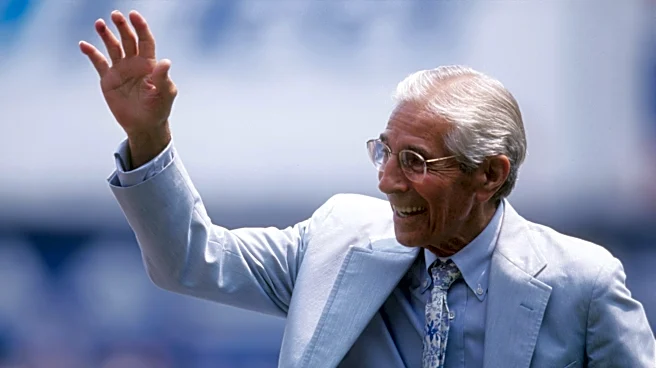



How do you define a legend like Phil Rizzuto? A kid from Brooklyn. A speedy, slick-fielding shortstop. An American League MVP. A seven-time World Series champion. A sailor in the United States Navy. The radio and television voice of the New York Yankees. The namesake for the Staten Island Yankees mascots. All of these descriptions are accurate, but none of them quite capture the Hall of Famer — although that impossibility may, in truth, capture the essence of the legend best.
Fiero Philip Francis
“Phil” Rizzuto Born: September 25, 1917 (Brooklyn, NY) Died: August 13, 2007 (West Orange, NJ) Yankees Tenure: 1941-42, 1946-56 (player); 1957-96 (announcer)
Rizzuto was born on this day, September 25, 1917… probably. His birth certificate, naval records, baseball cards, obituaries, and encyclopedia entries all list this as his date of birth, but after Rizzuto’s death, reporter Murray Chass shared that, while in the hospital back in the 1970s, Rizzuto claimed his actual year of birth was 1916.
No matter the year of his birth, Rizzuto faced a stark challenge trying to break into the sport during his youth. Both the Brooklyn Dodgers and New York Giants refused to give him a shot due to his short stature. The Yankees, however, having seen him go up against the likes of Satchel Paige while playing for a semipro team, signed him as an amateur free agent in 1937, assigning him to their Virginia-based minor league affiliate, the Bassett Furnituremakers. He spent four years in the minors, racking up stories that he would tell for decades, but which were never told the same way twice: the New York native was surprised by the size of the minor league town, put grits in his pocket because he didn’t realize they were food, injured his foot stepping into a gopher hole, and received the nickname “Scooter” due to his speed.
Looking to move on from the aging Frankie Crosetti, the Yankees made Rizzuto their starting shortstop to start the 1941 season in his age-23 season. Across his first two seasons in the Bronx, he posted a .295/.343/.386 slash line, stealing 36 bases and playing great defense. He earned down-ballot MVP votes in each season, losing both times to teammmates (Joe DiMaggio in 1941, Joe Gordon in 1942), made the All-Star team in his second season, and won his first World Series as a rookie.
Like many of his teammates and opponents, Rizzuto put his Major League career on hold after the 1942 season and joined the Navy. Originally stationed in Norfolk, Virginia, to play with the dock teams, the young man was eventually transferred to the Pacific theater, where he led a 20 mm gun crew — taking him away from his new wife Cora, whom he met while at the Norfolk base. Following a stint in Australia to recover from a battle with malaria, Rizzuto briefly served on a cargo ship, then was sent ashore to organize sports competitions and serve as an athletic trainer; not only was this a much better use of his skills as a professional athlete, it was also a relief to Rizzuto, who learned after joining the Navy that he was prone to seasickness.
After the war, Rizzuto returned to the Yankees despite a brief flirtation with the Mexican League, and after sandwiching his second World Series ring between a pair of third-place finishes, Rizzuto and the Yankees embarked on arguably the greatest run in franchise history. Starting in 1949, the Bronx Bombers won five consecutive World Series championships, and the now-veteran shortstop was a big reason why. He finished as the runner-up to Ted Williams for AL MVP in 1949, then won the award the following year with a .324/.418/.439 showing, tallying a league-best 6.8 WAR. In 1951, he made the Giants regret passing on him as a teenager, slashing .320/.393/.440 against them in the Fall Classic to down them in six games.
The Yankees’ World Series streak came to an end in 1954. It was also, perhaps uncoincidentally, the beginning of Rizzuto’s decline. After two seasons of less-than-stellar production from the now-aging star, the Yankees unceremoniously released him in the middle of the 1956 season. That was almost the end of Rizzuto’s relationship with New York, as he was furious at the disrespect shown to him. Teammate Snuffy Stirnweiss, however, encouraged him to take some time away from the team before he did something he would later regret, and that turned out to be one of the greatest pieces of advice in Yankees history; soon afterwards, the Yankees invited him to join Mel Allen and Red Barber in the broadcast booth.
Rizzuto spent four decades in the broadcast booth, and in truth, had he never played for the Bombers, he would have become a Yankee legend just from his time with the microphone. He was not only the voice of the Yankees for multiple generations of Yankees fans, he in many ways set the tone for the YES Network with his ability to blend seriousness and fun: when Michael Kay, Joe Girardi, David Cone, Paul O’Neill, and Meredith Marakovits banter during the game, they follow in the legacy of Scooter.
Due to his less-than-stellar counting stats, Rizzuto became a controversial candidate for the Hall of Fame, failing to achieve baseball immortality through the traditional writers’ vote and only receiving the honor once good friends Yogi Berra, Bill White, and Pee Wee Reese sat on the Veterans’ Committee in 1994. This is fortunate, not only because he deserved the honor, but because otherwise, the world would not have gotten one of the best Hall of Fame speeches.
Major League Baseball may have waited to honor Rizzuto, but the Yankees did not. In 1985, they retired his No. 10 and gave him a plaque in Monument Park. During the ceremony, a holy cow famously knocked Rizzuto to the ground. That cow would get reincarnated, metaphorically speaking, as Scooter the Holy Cow, the first mascot for the Yankees’ former Short Season Single-A affiliate, the Staten Island Yankees.
After his retirement from the broadcast booth following the 1996 season, Rizzuto continued to be a regular presence at Yankee Stadium. When he passed away after a long period of declining health in August 2007, the entire Yankees family felt the loss. Between his playing and broadcasting days, Rizzuto had spent more than 53 years with the organization, making him by far the longest-tenured Yankee in franchise history. To honor him, the 2007 Yankees played the final two months of the season with a black armband and on his No. 10 on their sleeves.
Happy birthday, Scooter! We miss you.
See more of the “Yankees Birthday of the Day” series here.