






The Detroit Tigers have done a nearly miraculous job climbing out of the hole they dug for themselves back in May. A 33-22 run now has them right in the thick of the hunt for the final wild card spot in the American League, and the division is still just 4.5 games out of reach after back-to-back losses to the AL Central-leading Chicago White Sox on Friday and Saturday.
After trading Tarik Skubal and Casey Mize at the trade deadline and not pursuing any relief help, the front office conceded that this
was all quite a long shot, at least too long to pass up the opportunity to restock the organization with team-controlled young talent. Yet the opportunity to get to the postseason and shoot their shot remains intact, and the one player the Tigers acquired at the deadline may prove decisive for their chances, one way or the other.
The Tigers have played .600 ball for the past 11 weeks. That’s not easy to sustain when one considers the injuries they’ve continued to deal with, the lack of a consistently dominant relief arm, and the fact that they dealt away Skubal and Mize along the way. They’ve gotten boosts along the way from rookies like Hao-Yu Lee, Max Clark, Ben Malgeri, and particularly Eduardo Valencia, while the return of Jackson Jobe, who still has development ahead of him at 24 years of age, should continue to stabilize the rotation.
Riley Greene is already rehabbing toward a return from the injured list, while any of Brant Hurter, Kerry Carpenter or Jack Flaherty could provide a boost, at least in terms of depth. But other than Greene, the only player with huge impact potential when and if he returns healthy is right-hander River Ryan. The Tigers might be able to sneak into the postseason without him, but any real chance of a deep run likely relies on their newest arm.
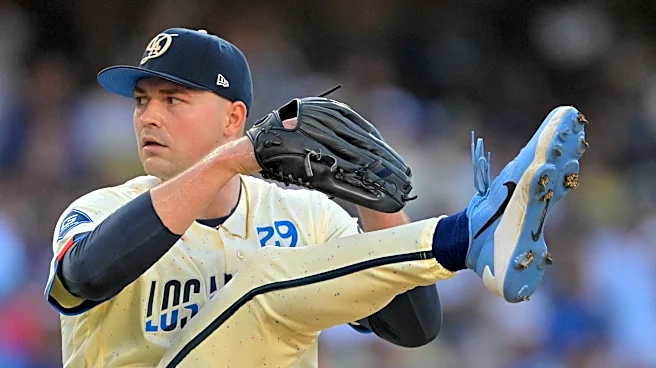
Ryan, who will turn 28 on Monday, has been on the injured list with a right hamstring strain since his last Triple-A start on June 17. His ETA to return has generally been slated for the end of August, but as he’ll probably need a rehab start or two to get tuned up, we should see him back on the mound for the Toledo Mud Hens next week if that’s still the timetable.
Manager A.J. Hinch had a reasonably positive report on that front when he spoke to reporters on Friday. By his account, Ryan is working through a progression of bullpens leading back to a rehab assignment, saying that his velocity looks great and that his recovery has gone even better. Let’s hope so. Still, the subtext in the comments is that there are still live bullpen sessions ahead of him before an actual rehab assignment. That feels like it pushes the timetable just a bit into September.
If Ryan is healthy, he immediately challenges Troy Melton for best stuff on the Tigers pitching staff. Let’s just do a quick comparison between the two.
Ryan averaged 97.7 mph on his fourseam fastball in his limited action this season with 6.6 feet of extension to the plate, with 15.4 inches of induced vertical break.
Melton is averaging 96.3 mph with 6.8 feet of extension to the plate with 15.1 inches of induced vertical break.
Both fourseamers lack the kind of eye-popping riding action that misses bats in the strike zone, but their velocity and extension counterbalance that to a degree. As we’ve seen regularly from Melton, he can get whiffs at the top and above the strike zone, but he has to set hitters up well with his secondary stuff to really get them chasing the heater. The same is true for Ryan. In fact, these are very comparable fourseamers all around. Ryan generally has a tick more gas, but otherwise the two pitches profile very similarly. They even release their fastball at roughly 5.6 feet off the ground, starting it on the same plane to home plate. Melton will mix in a few more sinkers than Ryan does, but they both use the pitch to jam right-handers and help keep hitters off the fourseamer a bit.
The comparisons hold up throughout each pitcher’s breaking stuff as well. Ryan’s 94 mph cutter is a huge weapon for him, just as Melton’s increased cutter velo, up to 92.2 mph average this season, and better command of the pitch have made it a major part of his arsenal in a breakout year for him. Even the vertical and horizontal movement on the two pitches are very similar. Ryan’s is just that little bit harder, giving him an edge, although Melton’s been throwing his harder as the year has unfolded.
Things start to diverge a bit between them in terms of sliders. Ryan averages 91.3 mph with his slider, while Melton averages 86.8 mph. Melton gets a few extra inches of horizontal break, but both pitches feature similar depth. Typically, harder is better with sliders, but because they both have a cutter, again I think this is kind of a wash. Melton’s increased velocity separation between the two pitches arguably gives him a little edge there.
Where Ryan gets an edge back is in terms of curveballs. Melton’s is a solid 78-79 mph knuckle curve with solid depth, whereas Ryan throws his at 83.3 mph with four inches more depth. Ryan’s is much more usable as a bat-missing power curve, while Melton can get whiffs, but it’s more of a change of pace pitch for him.
Finally, their changeups are both 89 mph as well. I’m belaboring the point a bit, but you see the picture here. These two are very comparable pitchers. Ryan just has a bit of extra heat on most of his stuff and a better curveball, while Melton has shown better command and probably deserves a bit of a nod toward his changeup, simply in the fact that he’s more comfortable throwing it regularly.
Other characteristics that distinguish them are that Melton walks fewer hitters and attacks the zone more. Ryan doesn’t give up many homers, certainly less than Melton has in his pro career. Those two things may well be related. Even their deliveries aren’t too dissimilar, with both using a pretty short, explosive arm stroke to their release point.
By now you see the appeal. The Tigers could very well add in a second Troy Melton in a few weeks, possibly even a bit of a turbo-charged version of Melton. This is why River Ryan is such a big piece of the puzzle, both for this season and for assessing how well Scott Harris and Jeff Greenberg did in the Tarik Skubal trade. If River Ryan comes back healthy and puts together a few years of relatively good health, the trade is wildly lopsided in the Tigers’ favor. If the injuries keep cropping up even with Tommy John surgery well behind him? Well, that deal is going to age more poorly, although certainly Zyhir Hope could make it all worthwhile anyway.
More germane to the moment, the River Ryan acquisition could also be the piece that carries them to the postseason. The Tigers dealt away Skubal, and they made no other moves to shore up their bullpen or rotation to give them a fighting chance at reaching the postseason and perhaps going on a run. Getting Hurter and Flaherty back could potentially help them down the stretch drive, but it’s Ryan who can put this pitching staff over the top at a point in the season when plenty of teams’ pitching staffs are starting to run out of gas.
The Tigers are going to have a lot of crucial decisions in the coming weeks. Adding Riley Greene, Flaherty, and Hurter back into the mix are obvious. Less obvious are decisions like whether Matt Vierling or Kerry Carpenter can help them or not, and who to demote or release in their stead. Their biggest decision in August has already been made, however. The Tigers bet big on the risk/reward upside of River Ryan at the deadline, and his presence and performance, or the lack thereof, may well be the deciding factor in whether the Tigers can complete an unlikely run to the postseason or not.