


Under Dan Campbell, the Detroit Lions have made a habit of playing meaningful games in Week 18. This time, however, the stakes are far less inspiring. Detroit enters the season finale with only marginal incentives remaining: the possibility of a more favorable fourth-place schedule in 2026, slight draft positioning improvements, and additional snaps for a few unproven players.
The Lions will head to the chilly confines of Soldier Field with fans stuck in a Twilight Zone–like emptiness and confusion,
closing out the season by shifting focus toward fudging free agency numbers and making mocks drafts as the primary points of intrigue.
Despite several injuries and the subtle benefits that can accompany a loss, Campbell’s team is still expected to compete with their “never say die” attitude, with most remaining starters available. Detroit sits on the brink of a four-game losing streak, is 1–4 in divisional play, and will face a Chicago Bears team motivated to secure the NFC’s No. 2 seed.
This article breaks down three key statistical matchups for Detroit’s final game of the season, as the Lions send the Bears off to the postseason and quickly turn toward a pivotal offseason, starting with coaching staff decisions and followed by roster evaluation. The focus will be on the Lions’ defense against the Bears’ offense, since there isn’t much to admire on the Bears’ defensive side aside from their absurdly unsustainable turnover rate, and the Lions’ offense is currently a factory of sadness that will likely disappoint expectations, especially without Penei Sewell.
Note: Unless otherwise indicated, all statistics are sourced from NFL Pro, TruMedia, FTN Fantasy, or Pro Football Reference.
Early Down Wylin’ Williams
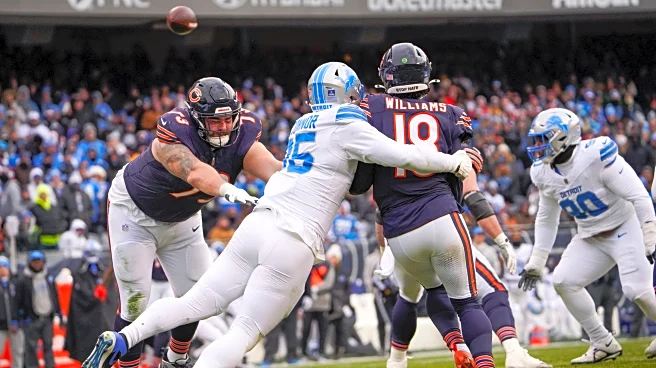
Caleb Williams has had a number of his flaws corrected in Year 2 under Ben Johnson, but his accuracy issues have remained stubborn. He ranks last among qualifying quarterbacks with a 57.9% completion percentage and a -7.2% completion percentage over expectation.
Much of Williams’ struggle comes from his play on early downs. His metrics are buoyed almost entirely by his ability to make magic happen on third down.
On first and second downs, Williams averages:
- 58.1% completion percentage (32nd of 32)
- 48.4 passer rating (28th)
- 7.0 yards per attempt (19th)
- 44.8% success rate (31st)
- Half his interceptions (3)
On third downs, he’s much higher in the rankings across the board:
- 59.0% completion percentage (18th)
- 98.0 passer rating (9th)
- 7.3 yards per attempt (13th)
- 35.4% success rate (17th)
A handful of other useful stats illustrate his early-down struggles: he has a 3.0% sack rate (5th best), despite the highest average time to throw or be sacked (3.15 seconds), and second-best air yards to the sticks (-0.8) behind only Matthew Stafford. On early downs, Williams isn’t processing quickly enough, relying on extending plays and hunting for big gains while still avoiding sacks.
I’ve spent enough of these preview articles this season preaching how the Lions need to show up on third downs—on both sides of the ball—and I won’t waste any more digital ink pretending that’s realistic. One thing is certain: aside from hoping to coral D’Andre Swift and Kyle Monangai, if Detroit’s defense can give Caleb Williams trouble on early downs—leveraging their top-five passing success rate and EPA per dropback—they might improve their chances on late downs and maybe salvage a bit of their winning identity to close out the season.
Famous franchise milestone
A quick, petty stat interjection, because I haven’t seen it mentioned elsewhere this week.
As insignificant as it might be in the grand scheme of things, it’s in the Lions’ and their fans’ best interest if Caleb Williams doesn’t hit 270 passing yards in Week 18. That would make him the first quarterback in Bears franchise history to throw for 4,000 passing yards in a single season.
In the Bears’ 106-year history, 151 players have attempted a pass, 78 quarterbacks have started a game, and not one has reached 4,000 passing yards in a season while with the franchise—even though 237 quarterbacks have done so in NFL history.
Williams is 108 yards shy of Erik Kramer’s franchise single-season record of 3,838 yards set in 1995. That 270-yard mark is a little lofty—even against this iteration of the Lions’ pass defense. Williams is averaging 233.1 passing yards per game, and the Lions are only giving up 218 per game. In the last eight weeks, he’s topped 270 just once, and he threw for only 207 yards against Detroit earlier this season. The Lions have allowed that many yards in only three games this year.
Not much remains in terms of meaningful narratives for the Lions to cling to as the season ends—outside of players finishing strong or rebounding after a rough month—but avoiding this milestone for Caleb Williams at least avoids another unwanted footnote to an already calamitous season.
Where Art Thou, Trickeration?
Based on FTN Fantasy’s tracking of trick plays, last season the Lions led the NFL with eight passing attempts on trick plays, completing all eight for 181 yards (22.6 YPA) and six touchdowns. No other team had more than 87 yards, and the rest of the league combined for just four passing touchdowns on trick plays.
This season, the Lions have three attempts, two completions, 20 passing yards, and one passing touchdown—nothing spectacular to marvel at, but a limited tool they’ve gone to in their toolbox.
Last year, that once-every-other-game edge added an explosive spark, keeping the offense humming or swinging momentum back in Detroit’s favor. This season, the trick plays have largely disappeared—one of many avenues the Lions can no longer lean on to trim small margins and salvage games.
Unsurprisingly, the Bears are leading the NFL with six passing attempts on trick plays this year, resulting in 117 yards (19.5 YPA) and two passing touchdowns. Ben Johnson has injected that extra layer of fun into Chicago’s offense.
As Derrick Barnes and the Lions defense learned against the Giants, they’ll need to stay alert to Johnson’s ability to turn a bouquet of flowers into a dove.