
After the Seattle Seahawks suffered their first loss of the season, they returned to Lumen Field needing to bounce back and, more importantly, avoid letting one setback turn into a losing streak.
On the other side was a Los Angeles Chargers team that had yet to win a game this season. This was, therefore, a game Seattle needed to take care of before heading into a much more difficult stretch of the schedule.
The Seahawks did exactly that. But while the result was positive, the performance left some
warning signs, and that’s where the good and the bad of this win come into play.
The Good
Brian Fleury is getting legitimately creative
Brian Fleury’s creativity is starting to look like more than just an early-season impression. It is becoming a defining characteristic of this offense. Against the Chargers, Seattle once again found different ways to put its playmakers in favorable situations, whether by moving pieces around or using players outside of their more traditional roles.
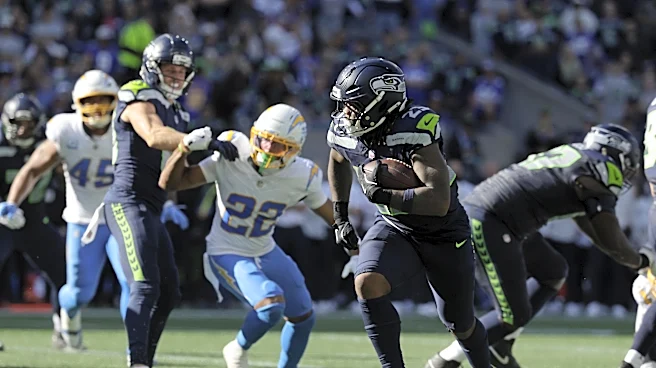
One of the best examples was Rashid Shaheed being placed in the backfield to take advantage of his speed, something the team was missing after the injury to Jadarian Price. The WR finished the game with two carries for 33 yards, including a 28-yard TD. Excellent blocking on this toss run, allowing Shaheed to read the field like a returner and find the space for the TD.
Excellent screen design. Shaheed motions across the formation to keep him as an option, and the ball goes to Wilson, who gets good blocks (especially from Christian Haynes) and then breaks a tackle at the end for the TD.
Good OC play-calling is about keeping the defense guessing. From the same formation and motion, you can call different plays. The design is very similar to what happened on Wilson’s TD, but this time the ball goes to Barner on the screen, who gets good yardage.
Excellent game plan.
Excellent call. Three TEs — actually, one sixth OL and two TEs — and only one WR. Everything points toward a run. The Chargers are committed to it, leaving Tory Horton one-on-one. I believe Horton should have had two options: a slant against off coverage and a fade if the defender played press. Quick pass and TD.
Emanuel Wilson makes the most of his opportunity
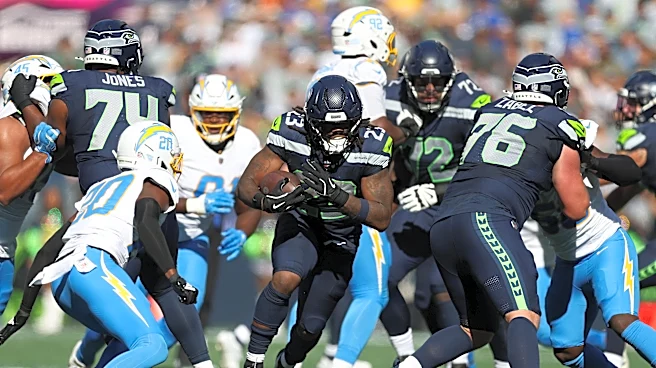
Emanuel Wilson probably had the most complete game of his NFL career: 21 carries for 81 yards and a touchdown, plus three receptions for 39 yards and another touchdown. That’s 120 yards from scrimmage and two touchdowns on an afternoon when Seattle desperately needed production from its backfield.
With Jadarian Price and Zach Charbonnet unavailable, Wilson received a bigger opportunity and made the most of it. I don’t necessarily think he’s the ideal running back for an offense that wants to consistently attack horizontally and outside, but he found ways to produce within what the offense was asking him to do.
This is the kind of snap he needs to have more often. The intended gap on this run is the B-gap, but he recognizes the good block from Grey Zabel, makes the cut inside and gets a solid gain.
Here, he simply puts his head down and runs. He doesn’t look for other options, even though the blocks from Barner and Abe Lucas don’t appear to be developing. Maybe a cut into the A-gap would have been the better option.
Wilson even showed that he could contribute as a blocker…
BOOM!
Drake Thomas answers back
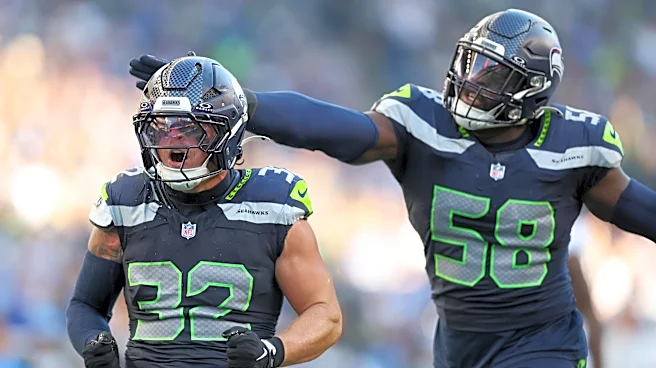
After a game that was below his usual standard against Washington, Drake Thomas showed up in a big way against the Chargers — and he did it immediately.
On the first play of the game, Thomas intercepted Justin Herbert, showing good route recognition and making a play that immediately put Seattle in a favorable position — only for Sam Darnold to throw an interception on the very next snap. Good job recognizing the play-action, dropping into coverage and coming down with a poor throw from the QB. If he doesn’t make the interception, Josh Jobe probably does.
On this play, he diagnoses all of the misdirection on the Chargers’ reverse immediately. He takes a stiff arm, but his quick diagnosis slows the play down just enough for his teammates to finish it. This is how Mike Macdonald’s defense works, as we’ve discussed before.
Drake Thomas isn’t a big linebacker. He tries to compensate for that with a ton of film study. You can frequently see his quick diagnosis on plays like this, anticipating what’s coming and waiting for the RB to make the tackle.
And just because he’s undersized doesn’t mean he can’t be physical. Look at this hit on the fullback. BOOM!
The pass rush finally showed up
Herbert was pressured on 55% of his dropbacks, while Seattle finished the game with four sacks — plus a fifth that was wiped out by a roughing the passer penalty. The Chargers’ offensive line had its issues and lost players during the game, so there is some context here, but Seattle did what it needed to do: it took advantage of the situation.
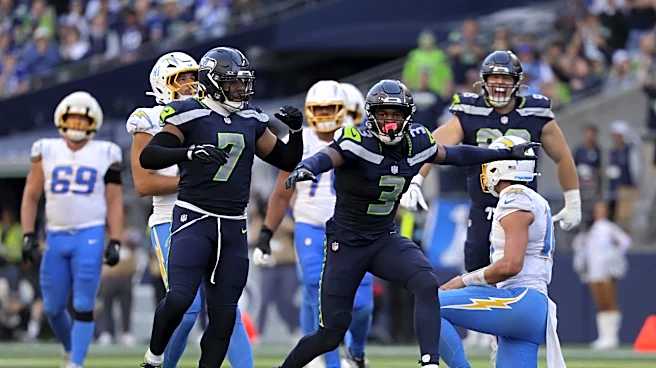
The pressure was consistent, and in the end, it was a pass-rush play that decided the game. Uchenna Nwosu forced the strip-sack on the Chargers’ final drive and ended Los Angeles’ comeback attempt. Excellent work by Julian Love cutting off the passing lane and forcing the QB to hold onto the ball for too long.
Byron Murphy standing up is inevitable. Excellent swipe to get to the QB on one of the quickest sacks of the season.
Ernest Jones, who led the team in tackles and also had an interception, got his sack here. I think he made an adjustment before the snap based on the Chargers’ formation, and this is where the execution comes into play. He appears to attack OL #69 to open up space for the stunt, so the RB ignores him and waits for the looper. Jones gets around the blocker and gets the sack.
Nick Emmanwori doing it with pure athleticism. He changes direction as the play flows into play-action, escapes the fullback’s block and gets the sack.
The Bad
The run defense is starting to show a crack
If there is one place where the Seahawks are still essentially a brick wall, it’s the middle of the defensive line. Running directly at Byron Murphy II, Leonard Williams and Jarran Reed remains an extremely difficult task.
The problem is that opponents are starting to find an alternative.
Washington already showed last week that outside runs could be a way to attack this defense. The Chargers followed the exact same path and found some success, finishing with 147 rushing yards on 32 carries, an average of 4.6 yards per carry. They did it while producing runs of 26, 20, 15 and 9 yards.
The Seahawks need to defend the bubble on the left side of the defense — the open space between the gaps that the offense can attack when no defender immediately fills it. Byron Murphy absorbs the double team, but Nick Emmanwori plays too passively and doesn’t attack the fullback creating space for the running back.
Again, attacking the same space. Rylie Mills is moved by the double team, creating space and getting driven into Ernest Jones, which creates a lane for the run. Demarcus Lawrence not identified the run and also help to create the space for the offense.
Seattle needs to find an answer before this becomes an even bigger trend.
The offensive line is still searching for consistency
Seattle ran for 138 yards, a significant improvement from the 44 yards against Washington, but there is still a feeling that the running game isn’t producing consistently.
The situation doesn’t help. Seattle is without its top backfield options and has to work with a combination of Emanuel Wilson and George Holani. Wilson doesn’t appear to be the best fit for outside zone/wide zone, while Holani has struggled to create yards after contact.
The OL, including Abe Lucas and Grey Zabel, who both had a down game against the Commanders, took a step in the right direction. Even so, there were still some execution issues.
Lucas takes a poor angle from the beginning of the contact, losing the inside and forcing the RB to cut outside, preventing the play from succeeding.
On this play, Beau Stephens gets driven backward, once again forcing the RB to stretch the play horizontally and destroying the run.
Sam Darnold has a down game
Sam Darnold had a very different game from the one he played against Washington. The previous week, even while making some mistakes, he threw for 379 yards and four touchdowns and kept Seattle alive in a game where the running game provided almost no help.
Against the Chargers, his performance dropped significantly: 13-of-22 for 168 yards, two touchdowns and one interception, along with several other poor throws.
The interception was completely bizarre. There was absolutely no reason to force this throw, especially when it killed the momentum immediately after our defense had just intercepted Herbert.
Here, he escapes the pressure well, but the throw is terrible. Kupp has plenty of space in front of him, but the pass is behind him and is almost intercepted.
On this play, he takes too long to make a decision and read the defense. The George Holani’s protection isn’t good, but the play call puts the CB in conflict. He can’t cover both Shaheed and JSN, and there is a window for the throw. Darnold hesitates, gets the ball out a little too late, the pressure arrives, and the play ends up being much closer to an interception than a completion.
Third down has become a problem
This may be one of the biggest areas where Brian Fleury needs to find a solution.
Seattle converted just three of 12 third downs against the Chargers, a 25% conversion rate. And this problem didn’t start in this game. Against New England, they converted two of 11. Against Arizona, six of 13. Against Washington, three of nine.
In other words, excluding the dominant game against the Cardinals, Seattle has converted just five of 32 third downs in the other three games — a 15.6% conversion rate.
Defenses have been sending pressure without much concern, and the play calls haven’t been good enough. Obviously, the running game needs to exist first to avoid long third downs, but the play-calling and QB play can still improve.
The Chargers clearly bring a heavy blitz here, leaving the three receivers in man coverage. Mathematically, the Seahawks were going to have to leave at least one rusher unblocked.
The receivers don’t get immediate separation, and the route concept is somewhat confusing and takes too long to develop in this situation. It’s a bad call, but I also think Darnold could have made adjustments before the snap after recognizing the Chargers’ defensive alignment.
The previous week, Marcus Mariota escaped several situations because of exactly this.
The penalty avalanche nearly turned the win into a problem
If there is one thing that cannot be ignored from this game, it’s the lack of discipline. The Seahawks and Chargers combined for 30 penalties, the most in a single NFL game this season. Los Angeles had 16 penalties for 130 yards, while Seattle committed 14 penalties for 150 yards, a franchise record for penalty yardage.
And it wasn’t just about the volume. Some of those penalties had a direct impact on the scoreboard. Nick Emmanwori, who otherwise had an excellent individual game with nine tackles, two tackles for loss, one sack and two QB hits, committed an unnecessary roughness penalty on a third down that would have kept the clock running. Instead, Los Angeles got additional time and eventually kicked a field goal.
On the same afternoon, penalties by DeMarcus Lawrence and Hall involving contact with Herbert helped keep alive the drive that ended in a touchdown. In total, four of Seattle’s 15-yard penalties came during the Chargers’ two touchdown drives.
This is the kind of thing that has to disappear before the next few games. Against the Chargers, Seattle had enough of a cushion to survive its own mistakes. Against better opponents, giving a drive a second or third life can be the exact difference between a win and a loss.
It’s not a coincidence that a game Seattle led 27-6 ended with the Chargers having the ball and needing only one possession to tie it.
Final thoughts
It wasn’t the pretty win the Seahawks wanted. It was the win they needed.
Seattle was better than the Chargers in virtually every aspect of the game, but still allowed a team that entered the game with a 0-3 record to reach the final possession with a legitimate chance to tie the game — and potentially even take the lead with a successful two-point conversion.
The fumble on the final drive ended the threat and secured the win, but it also made it clear that there are problems that need to be fixed.
And that’s the most important point moving forward.
With an extremely difficult stretch of the schedule ahead, it’s much better to work through these problems after a win than to have to fix the same issues after a loss. The Seahawks got the result they needed. Now they need to make sure the same mistakes don’t show up again when the level of competition rises.
The win is here, now the work begins.
Go Hawks!