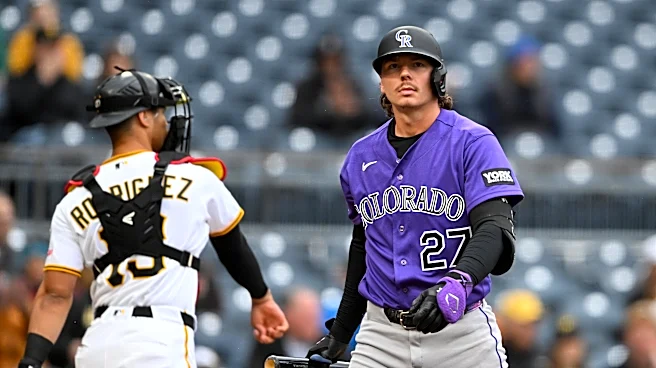


Welcome to the 2026 edition of Ranking the Rockies, where we take a look back at every player to log playing time for the Rockies in 2026. The purpose of this list is to provide a snapshot of the player in context. The “Ranking” is an organizing principle that’s drawn from Baseball Reference’s WAR (rWAR). It’s not something the staff debated. We’ll begin with the player with the lowest rWAR and end up with the player with the highest.
No. 51, Jordan Beck (-0.9 rWAR)
I was genuinely expecting a big season from Jordan Beck.
Maybe not
a breakout into stardom, but another step forward after a 2025 season in which Beck received an extended opportunity in the major leagues. He played 148 games and hit .258/.317/.416 with 16 home runs and 19 stolen bases. There were still holes in his offensive game, particularly the strikeouts, but there was enough power and athleticism to believe he could establish himself as part of the Rockies’ outfield moving forward.
His path through the organization seemed to reflect that progress. Beck was briefly optioned to Triple-A in April 2025, returned less than two weeks later and essentially remained an everyday major-league player from there.
A year later, the path reversed.
Beck opened 2026 with the Rockies, struggled, landed on the injured list with a left hamstring strain and, when his rehab assignment ended in late June, was activated and immediately optioned to Albuquerque. By the time he returned in August, his role had changed.
The numbers
Almost nothing went right. Beck hit .200/.261/.291 in 63 games with one home run. His major-league power disappeared, his already-high strikeout rate climbed, and his approach at the plate became increasingly exploitable.
What actually happened
Beck showed some early flashes. On April 14 in Houston, he got a 2-0 four-seam fastball from Colton Gordon and drove it 359 feet to right field.
It was his only home run of the season.
Six days later came his best game of the year. With Dodgers left-hander Justin Wrobleski starting at Coors Field, Warren Schaeffer moved Beck into the leadoff spot. Beck entered the night hitting .122 and immediately roped a double down the third-base line at 98.7 mph. He would then score on a Brenton Doyle double.
He added a check-swing single in the fifth, then put together perhaps his best plate appearance of the night in the seventh. Beck battled Wrobleski for nine pitches, fouled off three pitches with two strikes, worked the count full and lined a curveball to left field at 96.7 mph for a single.
He finished 3-for-4, with a run and an RBI. The Rockies lost the game 12-3.
Nine days later, Beck was again leading off against a left-hander, only this time everything looked different.
The Rockies battered Cincinnati for 13 runs and 15 hits on April 29. Beck was the only Colorado starter who didn’t get a hit, finishing 0-for-6 with two strikeouts while grounding into a double play.
His first plate appearance also offered an early look at a problem that would follow him throughout the season: after fouling off a fastball, Beck swung through consecutive sweepers from Brandon Williamson, the second finishing down and away for strike three.
There were good games. There were bad games. There just was never a run of the good ones.
The season took a larger turn in May when Colorado placed Beck on the 10-day injured list with a left hamstring strain. He began a rehab assignment with Albuquerque on June 23 and was activated five days later, but not back onto the Rockies’ active roster. Colorado instead optioned him to Triple-A, where he remained until his Aug. 3 recall.
Beck still had flashes after returning. On Aug. 25 in Washington, he went 2-for-4 against left-hander Andrew Alvarez, including a two-strike curveball he lined into center at 97.4 mph.
Beck later scored on a wild pitch, giving Colorado a 3-1 lead in a game the Rockies won by that score. It was a small glimpse of why left-handed pitching remained the obvious place for Colorado to keep looking for offense from him.
By late September, though, even the good at-bats had trouble turning into anything sustained. On Sept. 24 against Arizona, Beck struck out in each of his first two trips against left-hander Eduardo Rodríguez before putting together one of his better plate appearances of the afternoon in the sixth.
Beck fell behind 1-2, fouled off two pitches, worked the count full and lined a 91.6 mph four-seamer into left field at 103.9 mph for a single.
His next plate appearance lasted three pitches.
Dennis Santana threw Beck three consecutive sliders. Beck swung at all three.
He missed the first.
He foul-tipped the second.
And he chased the third down and away for strike three.
Kevin Ginkel struck him out on another slider down and away in the ninth, leaving Beck 1-for-5 with four strikeouts.
Two days later he doubled, and the following day he singled, and that was it. Beck finished the season exactly on the Mendoza Line at .200.
By then, the bigger change was how the Rockies were using him. Beck appeared in 33 of their final 50 games and started 26, with those opportunities increasingly tilted toward left-handed pitching.
The split made that understandable: He hit just .091/.157/.156 in 83 plate appearances against right-handers, compared with .295/.351/.409 against lefties. But even the favorable matchup wasn’t producing consistent results by the end. After returning from Albuquerque, Beck struck out 21 times in 56 plate appearances against lefties — 37.5% of the time.
His defensive role was fairly narrow, too. Beck’s home was in the corner outfield, where his arm remained the most obvious defensive tool, averaging 88.4 mph. On Sept. 5 against St. Louis, he charged a ball in right field and threw Thomas Saggese out at the plate, with replay confirming the call.
The overall defensive value wasn’t quite as strong as the arm, with Statcast grading Beck at -2 Outs Above Average.
By the end of the season, Beck was no longer functioning as an everyday outfielder. He had become a matchup-dependent corner outfielder who also received opportunities off the bench.
The strike zone kept getting bigger
The biggest change in Beck’s offensive profile wasn’t simply that he struck out more. It was that he started swinging at far more pitches he didn’t need to hit.
His strikeout rate did rise, from 29.6% in 2025 to 31.7% in 2026, but that increase alone doesn’t explain how much his production fell. His bat speed was still there, too, ticking up slightly from 73.2 mph to 73.9 mph.
What changed much more dramatically was his swing decision-making.
Pitchers didn’t radically reinvent the way they attacked Beck. The overall pitch mix remained fairly similar to 2025 outside of an increase in changeup usage, and the location profile wasn’t dramatically different either.
In 2025, 23% of the pitches Beck saw landed in Statcast’s Chase region, outside the edges of the strike zone. In 2026, it was 24%. Beck’s response to those pitches changed dramatically: His swing rate in that region climbed from 22% to 36%.
The same thing happened around the edges of the plate. His swing rate in Statcast’s Shadow region jumped from 53% to 63%, while his overall chase rate climbed from 27.4% to 38.0%.

Pitchers didn’t need to completely change how they attacked Beck. He was increasingly willing to expand the zone himself.
That was only part of the problem. When you look at how Beck performed against specific pitch types, another piece of the decline comes into focus: He wasn’t doing nearly as much damage against fastballs, particularly four-seamers.
Breaking pitches weren’t suddenly a new weakness. Beck’s production against them was fairly similar to 2025. Fastballs were different. He slugged .481 against them in 2025 and just .299 in 2026, while his slugging percentage against four-seamers fell from .521 to .282.
That matters because Beck wasn’t simply missing everything pitchers threw in the strike zone. His swing rate on pitches in the heart of the plate was exactly the same in both seasons at 73%, while his contact rate on pitches inside the zone actually improved slightly from 76.9% to 79.3%.
The contact just wasn’t nearly as dangerous.
His barrel rate fell from 9.6% to 3.7%, his hard-hit rate dropped from 38.5% to 32.1% and his expected slugging percentage fell from roughly .395 to .293.
So Beck was dealing with problems on both ends of the at-bat. He was chasing more pitches he didn’t need to hit, and when pitchers did come back into the zone with something hittable, he wasn’t punishing them the way he had a year earlier.
A hitter can survive a lot of strikeouts if the swings that connect produce damage. In 2025, Beck did enough damage to make the flaws work.
In 2026, he kept the flaws and lost the damage.
Where does Beck stand heading into 2027?
Beck is still only 25 years old, the athleticism and bat speed remain, and he is only one season removed from hitting 16 home runs in 148 games. Seven homers in 26 games with Albuquerque also suggest the physical power hasn’t disappeared.
But if he is going to reestablish himself as more than a matchup-dependent player, simply cutting down on the strikeouts probably isn’t enough. He needs to shrink the zone again while rediscovering the damage he did against hittable pitches in 2025.
That leaves Beck in a very different position than he occupied a year ago. He feels like a realistic change-of-scenery candidate this winter, young enough and with enough previous major-league success that another organization could look at the swing decisions, the platoon splits and the remaining physical tools and believe there is still something to unlock.
The Rockies could reach the same conclusion and give him another opportunity themselves.
I expected Jordan Beck to take another step forward in 2026.
Instead, he had moments, but never momentum.
Join the conversation!
Sign up for a user account and get:
- Fewer ads
- Create community posts
- Comment on articles, community posts
- Rec comments, community posts
- New, improved notifications system!
Download the SB Nation app on iOS or Android.
Please keep in mind ourPurple Row Community Guidelines when you’re commenting. Thanks!