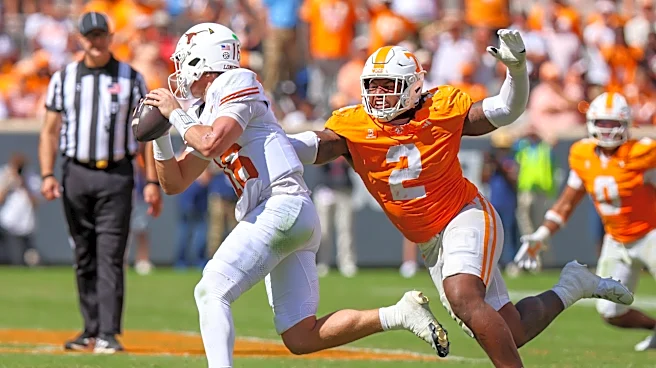

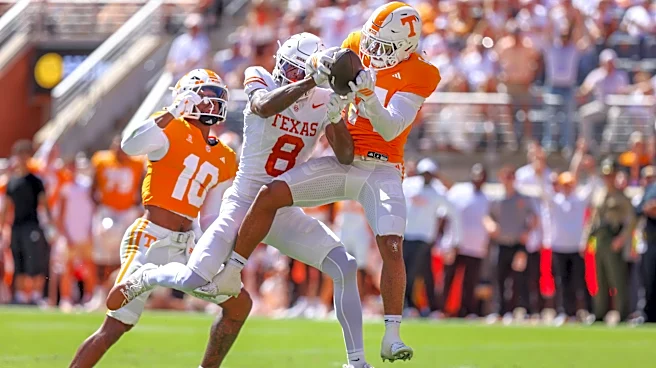
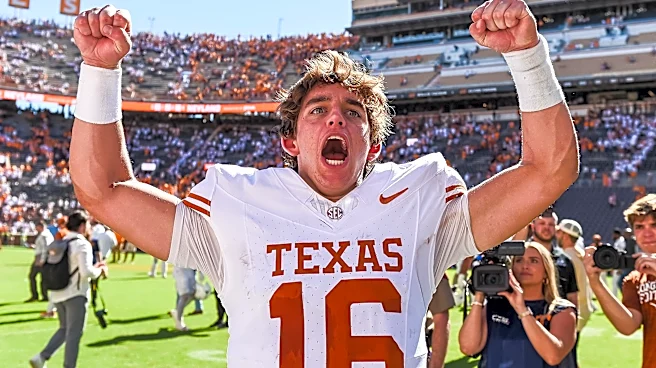
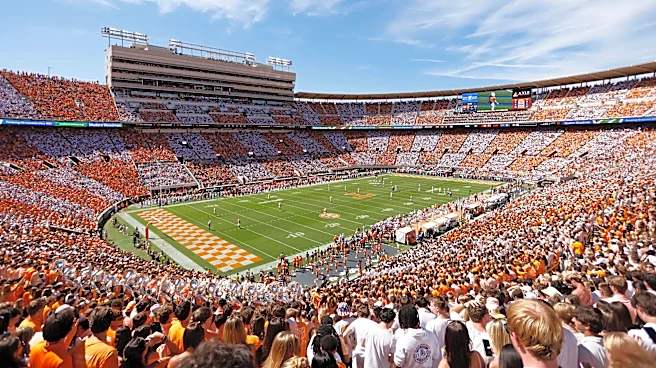
Last Saturday, the No.1 Texas Longhorns held on for a gritty road victory against a talented Tennessee Volunteers team in a sloppy offensive performance after the Longhorns scored a touchdown on the first drive and kicked a field goal on the third.
Texas repeatedly committed penalties, lost all offensive momentum, and failed to deliver a knockout punch, instead being forced to defend until the last play of the game.
“I think that was a really cool way to start. From that point forward, until about
the second last offensive drive, we did not play very good offensive football, and I love to say it was this or that,” Texas head coach Steve Sarkisian said on Monday. “It literally was us taking turns of not doing the things that we had practiced to do, and that was unfortunate because it sometimes it’s easier to say this one position group or this one player or this one thing was the issue, and it really wasn’t.”
Outside of the penalties, struggling on first down was a big reason for scoring just 20 offensive points and putting up six three-and-outs, including three straight between the second and third quarters — Texas finished the game allowing two sacks on first down and averaging just 1.7 yards per carry, even after adjusting for those two sacks.
The difference between the drives that resulted in points versus punts highlights a stark difference in first-down outcomes.
For example, the Longhorns offense marched down the field on a seven-play, 75-yard touchdown drive to open the game. On that series, Texas had four snaps on first down and they played out as follows — eight-yard reception by Ryan Wingo, 43-yard reception by Emmett Mosley V, five-yard reception to Jermaine Bishop on 1st and 5, and a three-yard rush by Raleek Brown.
Three of those four plays resulted in a 2nd and 2 or better, which gave head coach Steve Sarkisian a wide-open playbook. He could take a shot, set up a look for later in the game, or just pound the ball for a first. And it was also 58 total yards on first down, ultimately accounting for almost half of the team’s first-down yardage for the entire game.
If you fast forward to the other Texas touchdown series, an eight-play, 60-yard drive in the fourth quarter, the story was similar. Despite a poor start out of the gate, the Longhorns moved the ball on first down.
Here’s what happened on first-down plays — eight-yard sack, 14-yard reception by Wingo, nine-yard run by Derrek Cooper, 10-yard run by Brown, and a four-yard touchdown run by Brown.
So what does that tell us?
On Texas’ two touchdown drives, six of the eight plays on first down resulted in 2nd and 2 or better, with only one play, the sack, moving the ball backward. The first drive was won with an explosive pass and staying ahead of schedule, while the second was a nice combo of efficient passing and successful running.
On both drives, Sarkisian didn’t allow the Tennessee defense to key in on anything particular as Texas mixed in the run with short passes and even a deep shot so the Volunteers couldn’t just sit on the run.
The second drive was notable because it almost ended before it started. The sack on Manning immediately put the Longhorns in down and distance, yet the offense responded on second and third down, and moved the ball on the ensuing first-down snaps.
Once Tennessee was reeling, Brown and Cooper went to work.
These two drives laid out the formula for success — move the ball well on first down with a mix of runs, quick passes, and explosives while avoiding penalties and negative-yardage plays. However, the six three-and-outs tell a vastly different story.
On those drives, the Longhorns had six first-down plays. Four of the six went for negative four yards or worse, setting up 2nd and 18, 2nd and 22, 2nd and 15, and 2nd and 14. The other two were a one-yard run and a four-yard run.
Zero of the six first-down plays resulted in 2nd and 2 or better compared to six of the eight plays on the two touchdown drives.
When the Longhorns went three and out, Texas was beaten on first down. Sarkisian repeatedly attempted to establish the run on these drives and was stuffed, putting the offense behind the chains because they couldn’t win on the ground on first down.
This then made the offense much more one dimensional — there are not effective play calls for 2nd and 22 — and resulted in punts.
On the three and outs, Texas’ first-down approach became much more run heavy and produced almost no positive momentum, allowing Tennessee to dictate the down and distance. The problem wasn’t that the Longhorns opted to run the ball, it was that the first-down runs weren’t creating anything. In fact, they left the offense worse off than a short pass or even an incompletion.
Volunteers defensive coordinator Jim Knowles, who is known for an aggressive schematic approach, used early-down fire zones effectively against the Longhorns.
When Texas did opt to throw the ball, the Tennessee defense created chaos and beat the Longhorn offensive line.
On this first-down snap, the Volunteers rushed five and still beat the Texas offensive line and Brown, who stayed in to block.
The right side of the offensive line — guard Brandon Baker and tackle Melvin Siani — played the blitz poorly, allowing inside pressure from two defenders as Siani took the outside blitzer, the responsibility of Brown, who was credited with allowing a sack against Tennessee after giving up two pressure against UTSA, according to Pro Football Focus.
Texas scoring its final touchdown required the improbable — overcoming the eight-yard loss on the first play of the drive thanks to a 10-yard run by Brown on second down and an 18-yard catch by Wingo on third down, arguably the biggest throw of the game by Arch Manning.
And finishing the drive required the first-down success the Horns were missing throughout so much of the game.
“I think most importantly, we’ve got to do our job. We’ve got to trust our training offensively to get that done, and that’ll be the task this week throughout the bye week of where we need to improve offensively, and where we can build upon that,” Sarkisian said.
“But again, I’d love to say, man, it was just the right tackle or the right guard or the center or the left guard or the tight ends. But it was like each play, somebody else was kind of taking their turn. So we’ve got to get that rectified. We’ve got to get these guys believing in in their training and trusting their training to perform.”
Through four games, the success of the run game and first down plays, which are intricately tied together, have largely dictated the success of the offense. When Texas can run the ball, they win on first down and move down the field with ease. However, when the run game stalls, the offense is easier to defend and puts Manning into difficult down and distance situations. Against Tennessee this resulted in second and long which frequently turned into punts rather than points.
“How we finished in the middle was clearly not good enough for the way we want to play offensive football,” Sarkisian said.