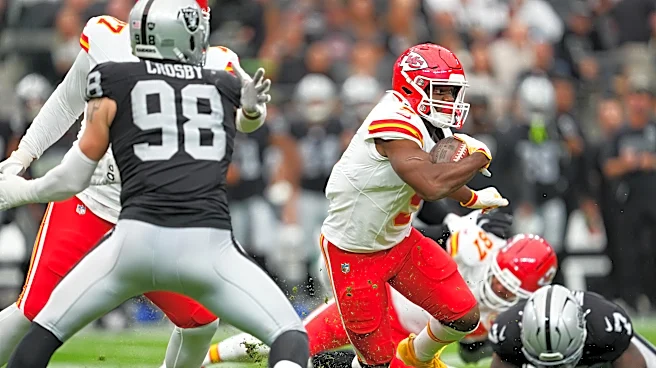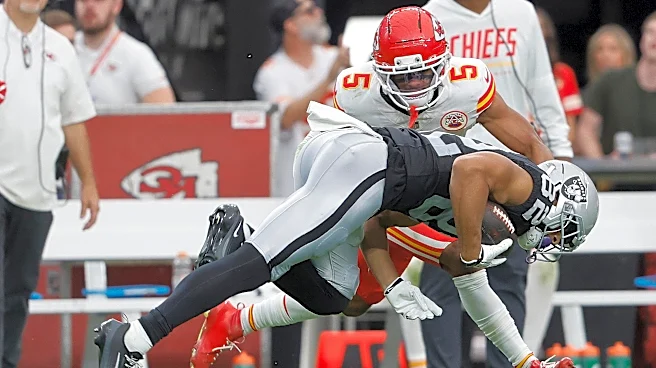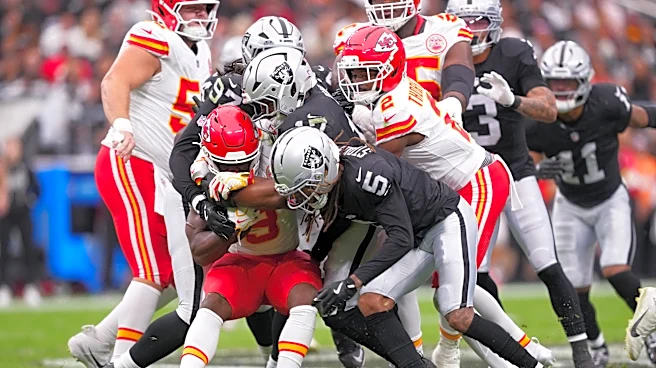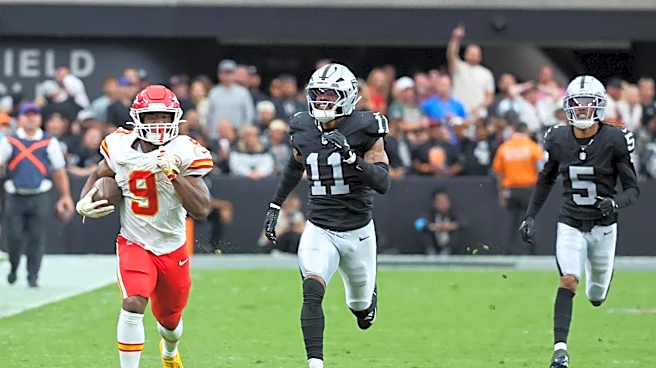


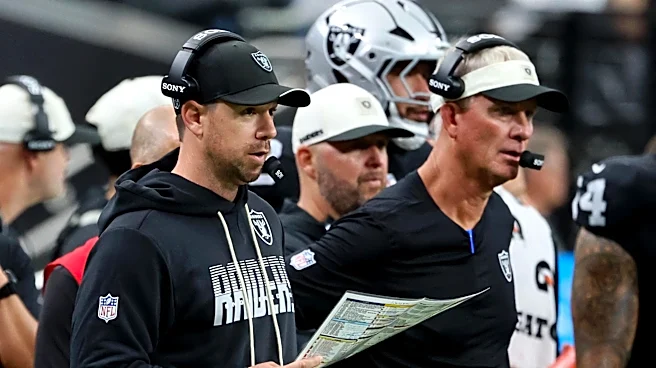
While the Las Vegas Raiders are certainly ahead of schedule and exceeding expectations in the early stages of the 2026 season, the Week 4 loss to the Kansas City Chiefs is a tough pill to swallow. With first place in the AFC West on the line, the Raiders let Chiefs running back Kenneth Walker rush for 177 yards
, 8.0 yards per carry and a pair of touchdowns in the 30-27 defeat.To be fair, Walker has been tough for all of Kansas City’s opponents to stop. But the numbers above were season highs and
his yardage was a career high. Additionally, that was the most rushing yards Las Vegas’ defense has given up so far, and the unit didn’t allow a single player to crack triple digits during the first three games of the year. The Raiders also had their lowest team run defense grade of the season from Pro Football Focus, coming in at 46.7, after being above the baseline (60.0) in each of the first three weeks.
How did that happen? Let’s flip on the tape and dive into a few examples find out.
According to PFF, 174 of Walker’s 543 rushing yards (32.0%) have come around the left edge, and he’s averaging 10.2 yards per attempt on such runs so far this season. That’s the most yards and second-highest rate he has to a specific direction/gap, and the Raiders contributed to the problem last Sunday.
Here, it’s second-and-10, and Kansas City comes out in 11 personnel with tight end Travis Kelce in-line on the short side of the field before motioning across the formation and creating a three-by-one set as a slot receiver in the bunch formation. As a result, Las Vegas’ linebackers, Nakobe Dean and Quay Walker, slide over to mirror Kelce, taking Dean out of the box and forcing Walker to be in the middle of the offensive line.
In other words, the Chiefs are creating a softer edge by pulling defenders away from the direction they want to run. Additionally, the Raiders get caught running a T/E stunt, meaning the defensive end works inside, where the offense wants him to go, and cornerback Hezekiah Masses appears to be in man coverage.
Since Masses gets an inside release from his receiver, he also isn’t in a position to contain and to force Walker inside. By the time the corner recognizes the run, it’s too late, and he has a tough time getting off the block, creating an outside rushing lane for the running back to get an easy 11 yards and pick up the first down.
To be clear, the rookie is far from the defense’s biggest problem here, as several factors led to the chunk run, primarily getting beaten by the play call.
We’ll take a look at another run around the left edge in the clip above, but Walker’s ability to make defenders miss is the biggest factor on this rep. He leads all running backs with 39 missed tackles forced this season, 14 more than Jahmyr Gibbs in second place, per PFF. Technically, Vegas did a decent job of getting the NFL rushing leader on the ground, where he forced a season-low five misses on Sunday. However, just about all of them came on this 21-yard run.
This time, the motion actually works against the Chiefs, since it brings an extra linebacker (Quay Walker) into the box. Additionally, the Raiders fit the power run pretty well, where defensive end Kwity Paye spills the puller to force the running back to bounce outside, while the linebacker and safety are inside of their blocks to continue to spill the ball toward the sideline.
That sets up Masses with an opportunity to make the tackle to keep the run to a two- or three-yard gain. However, the rookie corner lunges and doesn’t bring his feet with him on the tackle attempt, allowing Walker to make him miss. Then, it’s just a collection of bad angles, overpursuits and more missed tackles from several other defenders to put the offense at midfield.
This next run is around the right end where Walker hasn’t had as much success, with 40 rushing yards (22 coming on the play above) and 5.0 yards per carry, according to PFF. However, the result here wasn’t any different than the two previous runs.
Kansas City comes out in 13 personnel, and Las Vegas matches by bringing base personnel into the game. However, with a three-tight end formation and only one wide receiver in the game, the Raiders don’t need to keep four defensive backs on the field and would be better off matching with heavy personnel by adding an extra defensive tackle or linebacker, or at least another strong safety.
Instead, they end up getting into a front where Quay Walker and cornerback Eric Stokes are on the edge, while Kansas City runs outside zone right at them.
The result is Quay Walker getting caught up with the inside tight end, who is arc releasing up to the linebacker (Dean), so Quay Walker isn’t in a position to take on the right tackle’s block and gets pushed out of the way. Additionally, Stokes is at a significant size disadvantage and can’t set the edge against the outside tight end.
On top of that, Kansas City has a subtle wrinkle to a standard play call, where the running back steps downhill and looks like he’s attacking one of the A-gaps. That sets up the linebackers because it gives them the illusion that the play call is inside zone. So, Dean steps downhill and ends up getting caught in the trash with the tight end working up to him, as Walker bounces outside and takes advantage of the soft edge for a touchdown.
Another reason why Las Vegas struggled to stop the run is that Foley Fatukasi, the team’s best run-defending defensive tackle, had his worst game of the season, in my opinion. Fatukasi posted a 54.9 PFF run defense grade and really struggled against combo blocks throughout the afternoon.
It’s second-and-three here, and the Chiefs run mid zone while motioning a receiver across the formation. That forces Dean to slide over and takes him out of the play, as the call is designed to hit in either the weak-side A- or B-gaps. With Kwity Paye lining up as a 4i-technique and doing a decent job taking the left guard’s block, the B-gap is closed.
However, Fatukasi, who is at nose tackle and shaded on the center in the weak- or play-side A-gap, gets a scoop/combo block from the center and right guard, and lets the two offensive linemen get to his outside shoulder. As a result, Fatukasi isn’t close to his assignment and ends up in the back-side B-gap, creating an interior rushing lane with no linebacker to fill the hole.
So, Walker just makes a small cut up the field and gets an easy six yards. Also, Jeremy Chinn can be more aggressive and trigger downhill to replace Dean once he sees the run play, rather than staying deep and waiting for the receiver to come block him.
We’ll wrap up with the big one: Walker’s 76-yard run that led to Kansas City’s go-ahead touchdown in the fourth quarter. This is also a perfect culmination because it touches on a few issues we’ve gone over.
First, the Chiefs come out in 13 personnel again and are in the same formation seen previously, and the Raiders do an even worse job of matching personnel by staying in nickel this time. That means five defensive backs are on the field while the offense only has one wide receiver in the game, forcing Stokes and free safety Treydan Stukes to play in the box.
Granted, those two are far from the defense’s problem here. Fatuaski is the bigger issue, as he’s taking on a combo block from the right guard and center, where the linemen block the defensive tackle first and work up to the linebacker (Dean). Fatuaski ends up getting pushed off the ball by about five yards and into the second level, making Dean’s job tougher when Dean already had a tough assignment.
With Quay Walker — the only other off-ball linebacker on the field — Dean is responsible for two gaps: the back-side A-gap and the front-side B-gap. The A-gap is going to be his primary assignment, which is likely why he starts to pull up and squares his shoulders as the running back approaches the line of scrimmage.
Now, Dean can help himself by staying deeper to scrape over the top once the back commits to the B-gap. But he gets too far downhill and ends up getting caught in the trash by getting too involved with the left guard, and because Fatuaski ends up in his lap.
On top of that, Chinn is rotating into the back end of the defense to play a single-high coverage. So, the play call puts him in a bad spot, where his momentum/initial movement is going in the opposite direction of the offense’s play call. But Chinn makes the problem worse by taking too flat of an angle and failing to keep Walker on his inside shoulder. Then, it’s off to the races!
Overall, Las Vegas had several problems when it came to stopping Walker against the Chiefs. But I have to put a lot of blame on defensive coordinator Rob Leonard, who was excellent in the first three weeks, but the defense was put in a handful of bad spots by play calls and/or bad personnel groupings.