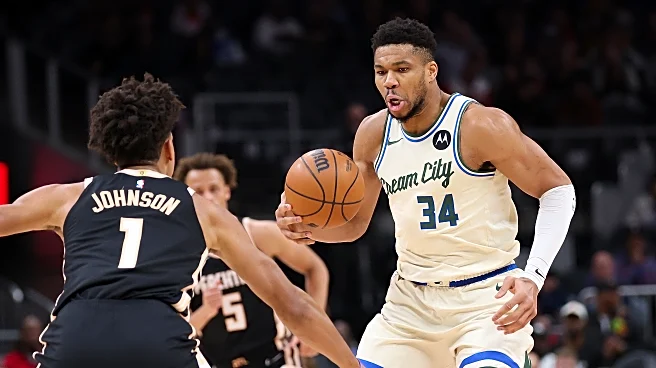

The Hawks have all the assets necessary to put up a strong — and I’d argue a winning — fight in the great Giannis Antetokounmpo bidding war if they so choose to.
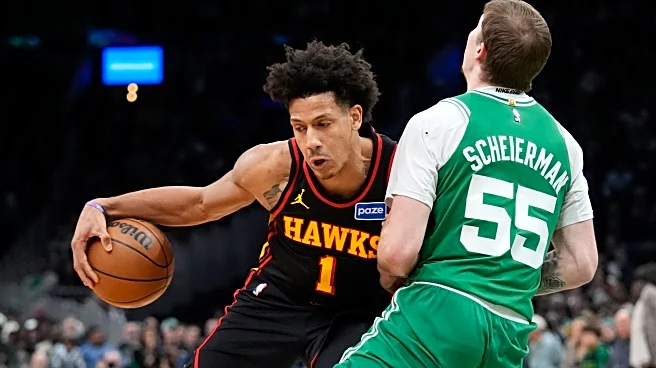
They have soon-to-be one-time All-Star Jalen
Johnson locked up on a long, below maximum value contract, some young desirable talent, and of course a large piece of Milwaukee’s own draft picks in both the upcoming draft and the 2027 draft.
I outlined earlier that the Hawks also had control of every one of their first-round picks — excluding this year’s swap and next season’s pick outright — out to 2032. So, if Atlanta really desired to bring in the former two-time MVP, former two-time Defensive Player of the Year, and former Finals MVP, they could give the Bucks an offer they couldn’t refuse.
But they shouldn’t (and probably won’t) — and here’s why.
Let’s start with the latest from the rumor mill. Per NBA insider Marc Stein of the Stein Line substack blog from Thursday:
The early indications are that Atlanta has not joined the Giannis chase and does not intend to.
The Hawks do have control of Milwaukee’s picks in the next two drafts but have shown no interest to date in surrendering control of them. The Hawks are likewise said to be unwilling to surrender Jalen Johnson in a theoretical Antetokounmpo deal … even though Johnson’s agent Rich Paul said in one of his recent podcasts that the Milwaukee native is precisely whom the Bucks should target.
League sources say Atlanta continues to explore what moves can be made at this deadline with its $40-plus million in expiring contracts when combining Kristaps Porziņģis and Luke Kennard. And you can never forget that A) the Hawks hosted Antetokounmpo for the only pre-draft workout he conducted on American soil before the Bucks swooped in to select him with the 15th overall pick in 2013 and B) had conversations with Antetokounmpo’s agent Alex Saratsis last spring about joining Atlanta’s front office.
However …
Sources say that Atlanta has some level of reservation regarding the skillsets of Antetokounmpo and Johnson and how they would match after trading away Young in early January to make the 24-year-old their new centerpiece.
Onsi Saleh, the newly elevated general manager of the Hawks, on Tuesday spoke with Steak Shapiro and Sandra Golden on the Steakhouse, a show on 92.9 The Game Atlanta SportsRadio. In it, he talked through his team building philosophy including his desire to follow a model similar to the Oklahoma City Thunder or San Antonio Spurs — one in which sustaining winning over a long period of time is held in the highest importance.
“It’s development focused. It’s being flexible,” was one comment Saleh made in the interview as to what he wanted to see in this organization. But that development focus and flexibility would immediately go out of the window if the Hawks made the franchise-altering decision to acquire the former MVP.
“Patience is everything in this league. Once you start trading picks, that’s when you get in trouble,” was another quip from Saleh — something the Hawks now know all too well from the Dejounte Murray trade. Murray is obviously not Antetokounmpo, but there are legitimate reasons for hesitancy in this regard as well.
Three reasons stick out to me as to why it’s right for the Hawks to stay on the sideline for this move:
Giannis’ availability and signs of decline can’t be ignored
Giannis Antetokounmpo is very much still an all-world basketball player, even as he enters the heart of his 30s. Last season, he averaged 30.4 points, 11.9 rebounds, and 6.5 assists per game on 63% true shooting, and he deservingly finished third in MVP voting.
This season, the Bucks have a gargantuan 16.6 points differential per 100 possessions between Antetokounmpo being on versus off the floor. I can confirm with my own two eyes that he’s still a beast.
But any team that trades for him is trading for what the future holds for him, including very presumably the rights to hand him a four-year, $275 million maximum extension this offseason. That’s 68.8$ million per season out until 2029-30.
Antetokounmpo has struggled this season with a rash lower body injuries — calf, adductor, groin, knee, ankle, you name it. As a result, he’s only played in 30 of a possible 46 games so far this season.
Add to that the fact that while his offensive impact is as clear as it’s ever been in his career, his defensive impact has fallen off a cliff since his Defensive Player of the Year days.
BBall Index’ LEBRON metric has estimated that Antetokounmpo has the third biggest falloff in defensive impact in the entire NBA between last season and this season:

DARKO D-DPM (Defense Daily Plus Minus) shows a career trajectory that is steadily aiming downwards:

And plain old defensive on-off rating has Antetokounmpo as not particularly moving the needle lately compared to his +7.8 on-off peak in 2019-20:

And the eye test largely matches these metrics. Antetokounmpo just doesn’t have the motor or defensive range he once had. Of course, he’s had to almost singlehandedly prop up the offense in the post-Holiday/post-Middleton era, so the heavy offensive load does matter, but it’s still a worrying trend.
You can’t live in the past when making a move of this importance. Projecting the future of a player you acquire is the most important aspect of which to be mindful. And if the Hawks gut their roster to acquire a great but no longer transcendent talent, the future state of the franchise could quickly turn grim.
The Hawks won’t be able to maximize the window with Giannis
With Antetokounmpo showing some signs of decline, any team that takes the plunge to acquire him has to try to compete as soon as possible. One must consider what is left over after a deal of that magnitude.
For example, if the Hawks send Jalen Johnson the opposite way alongside a bundle of picks, they’ll have very little ammo to upgrade the roster to maximize Antetokounmpo’s skillset. A devastating downhill scorer, Milwaukee has targeted a number of catch-and-shoot specialists and stretch big men over the past few years to open up the spacing for his drive and kick game.
The fact of the matter is that the Hawks are 24-26 and face an uphill climb just to make the postseason this season — adding to the fact that Antetokounmpo will be on the shelf for a number of weeks according to medical physician Giannis Antetokounmpo.
But look at the Bucks. You can point to some misguided moves there — stretching and waiving Damian Lillard over five years to sign Myles Turner was certainly a choice — but despite their best efforts to prove to Antetokounmpo that they will compete, they are now 18-28 and floundering.
The Hawks do have a surplus of shooters, but does Antetokounmpo fit with non-shooter Dyson Daniels long term? What happens when you take the ball out of the hands of others and centralize the gameplan around the Greek international? If he continues to have less and less range and impact on defense, where do you go for the defensive pieces to form a championship-contending team?
There are just so many difficult roster questions to answer that the Milwaukee Bucks themselves haven’t been able to answer (just one playoff series win since their title run in 2021). As great a player as he is, Antetokounmpo’s greatest gift may be his curse — he’s a dominant but inflexible centerpiece of a basketball team on the court.
Atlanta would lack the salary space and the draft assets to plug any holes if this trade were to go through unless they received a heavy price discount. And with teams like the Warriors ready to send virtually all future assets to give Stephen Curry a twilight sendoff, Atlanta matching that deal would be entirely too risky an endeavor I firmly believe.
The superpick is just too valuable
The 2026 NBA Draft Lottery was recently announced to take place on May 10. Yesterday, January 30, marked 100 days until the date when the Hawks will find out their fate — assuming they hold onto the superpick that is the best post-lottery result of the Pelicans’ and Bucks’ first-round picks.
Let’s not mince words — this freshman class in college basketball is absolutely special.
There are five players on schedule to have the best BPM (box plus-minus) metrics in recent one-and-done history: Cameron Boozer, Darryn Peterson, AJ Dybantsa, Kingston Flemings, and Caleb Wilson. This quintet is joined by recent luminaries like Zion Williamson, Cooper Flagg, and Chet Holmgren.
Of course, a big BPM figure is no guarantee of superstardom at the NBA level (hello Bol Bol and Nerlens Noel), but this quantity of blue chip prospects is nearly unprecedented. Even beyond the presumptive top five, talent absolutely abounds.
NBA superstars just don’t hit the open market. They get extended or traded to a team that will extend their contracts almost exclusively nowadays in the NBA.
I understand the irony of this piece being about weighing trading for Giannis Antetokounmpo, but the only other primary avenue to acquire franchise-pillar talent is through the draft — and typically you have to be a bad team to strike it rich.
The Hawks are near .500 (yes, once again), but they still may have a better chance at the top pick and at a top-four pick than whichever team finishes with the worst record.
As of Friday afternoon, the combined odds from the Pelicans (tied for the worst record) and the Bucks (alone with the seventh worst record) would give the Hawks north of a 20% chance at the top pick and north of a 55% chance at a top-four pick.
Onsi Saleh, in the above interview, acknowledged the strength of the draft class and the ability to add that talent to a young Hawks core. Preserving ownership of that pick is not a bet that the player they pick will eventually be better than Giannis Antetokounmpo (altogether unlikely) — it’s a bet to have a cost-controlled, moldable talent for the next eight, nine, or 10 seasons to lead this franchise over a costly superstar in his fading seasons.
If the Bucks consider inclusion of the superpick a must to get a deal done, then, for me, there is no deal there. The Hawks have dabbled with impatience throughout their history and been burned repeatedly. It’s simply time to play the long game.