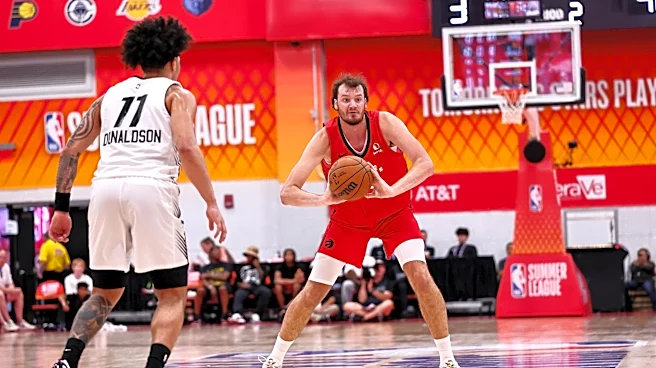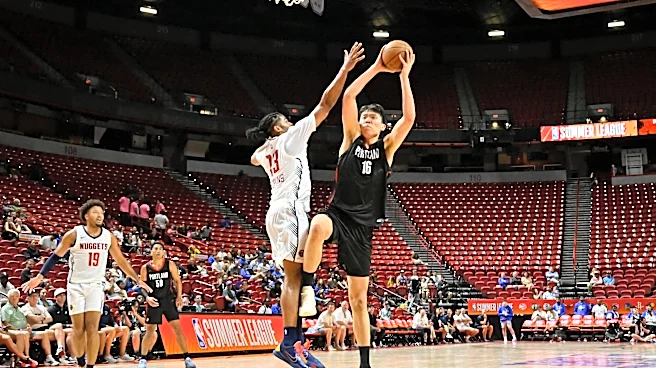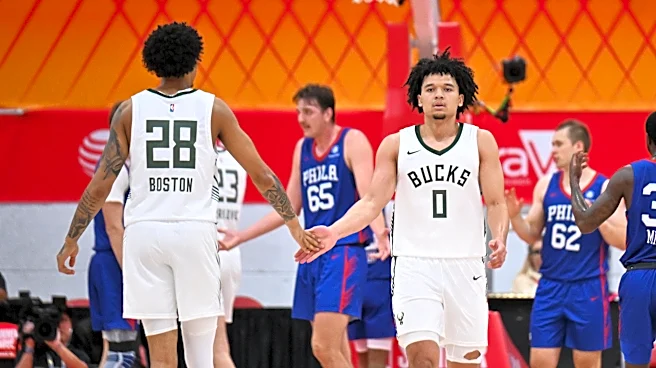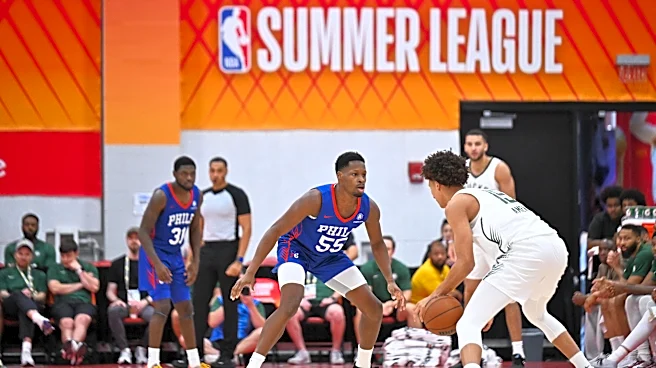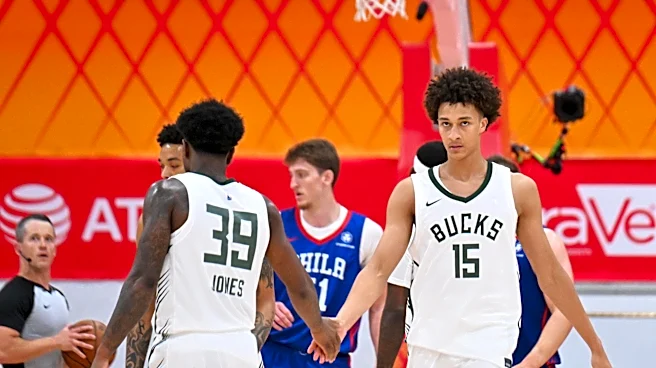





The post-Giannis era has just left its first impression. Following a nail-biting win against the Philadelphia 76ers, the Milwaukee Bucks have wrapped up their part in this year’s Las Vegas Summer League. The Bucks finished their campaign with a respectable 2-3 record, winning their final two outings after a trio of losses to start.
More important than the wins, Bucks fans can now breathe a sigh of relief after both of their first-round draft picks—Brayden Burries and Nate Ament—showed their stuff.
Burries, in particular, looked a step above the competition and figures to be at least a rotational piece for the real Bucks from day one, while Ament, after a rather passive first three games, finished strongly to suggest that he might just be on the right path too.
But it wasn’t just the Bucks’ prized first-rounders who demanded our attention. Kasparas Jakučionis, Bogoljub Markovic, Pete Nance, and Kam Jones all had moments too. So, with Summer League now in the books, it’s time to hand out their report cards.
Note: Only players who have reported contracts with the Bucks—standard or two-way—have been graded.
Brayden Burries
4 GP, 27.1 MPG, 23.5 PPG, 4.5 RPG, 4.3 APG, 2.0 SPG, 1.0 BPG, 0.8 TPG, .500/.364/.667, -6
Talk about a high floor—you need stairs just to get up to this one! Burries came into Summer League largely as an afterthought, certainly in comparison to his fellow top ten draftees and arguably in comparison to his new Bucks teammates too (at least if the Brew Hoop comment section is anything to go by). At one point before Summer League, I considered penning a “Brayden Burries Boredom” piece; there was that little talk about him. The way he played, he just might’ve felt the oversight too.
Put simply, Burries was the best player on the court regardless of who he played against (or with). The numbers show that—volume scoring, peripheral contributions as a rebounder and passer, unfathomable efficiency. But it’s the way he got them that stood out. Burries was a true three-level scorer, bodying defenders to get to the paint and to the line, drilling pull-up middies, and splashing “Did you see that!?” treys, including some truly amazing step backs. And he did it all like he’d been there before.
He’ll go by “Buzzer Beater Burries” from here on out (thanks, Mitchell).
Grade: A+
Nate Ament
5 GP, 23.4 MPG, 11.2 PPG, 4.8 RPG, 1.4 APG, 0.6 SPG, 0.4 BPG, 2.8 TPG, .500/.389/.600, -6
Ament made no real positive impact in the first three games, but I also wouldn’t say he had a negative impact either. While his defence was certainly not all that additive, it wasn’t as if he was shot-chucking or turning the ball over a tonne; he was kind of just… out there. Some of that is context-dependent: for example, I don’t think it was a coincidence that Ament looked much more engaged when he got more chances to handle the ball.
His fourth game was by far his best, dropping 23 points on 7/13 shooting. Then, in the final game, he had nine points in the first quarter, only to score three for the rest of the game, missing a bunch of bunnies in the second half. All in all, Ament ended Summer League looking like a different player from the seemingly timid guy he was at the start. And don’t get me wrong, there’s a lot of work to do, but that mindset to push through adversity was really great to see.
Grade: B-
Kasparas Jakučionis
2 GP, 21.7 MPG, 9.0 PPG, 1.5 RPG, 5.0 APG, 2.5 SPG, 0.0 BPG, 3.5 TPG, .263/.500/.667, -6
Jakučionis played only in the first two of Milwaukee’s Vegas matchups—losses to his former Miami Heat and also the San Antonio Spurs. In those, he showed flashes of the court vision and passing that enable you to envision him as a starting-caliber offensive maestro, tying with Kam Jones for the Bucks leader in assists per game despite playing fewer minutes. He had some really nice dump-off dimes in the paint after drawing help from opposing bigs, while also showing skills as an inbounder, setting up cutters for rim finishes. Beyond his passing, Kas shot it well from distance, going an efficient 3/6, and used his quick hands to generate steals.
However, Jakučionis struggled mightily finishing anything inside the arc (2/13) and also with ball pressure, most noticeably against the Spurs, where he coughed up five turnovers. In all, it was a somewhat underwhelming performance given his potential and the anticipation that comes with a new, young prospect. But really, Jakučionis simply showed us who he is and why there’s still work to do.
Grade: C
Bogoljub Markovic
5 GP, 22.8 MPG, 8.8 PPG, 5.8 RPG, 1.2 APG, 0.2 SPG, 1.0 BPG, 1.2 TPG, .381/.364/.667, -2
Bogi demonstrated marked improvement offensively compared to last year’s Summer League. While his overall shooting percentage did drop, he took considerably more shots (42 to 29), and his three-point stroke looked much smoother. He also had some moments distributing the ball, with several really nice feeds throughout the five games, and looked comfortable with the ball in his hands.
Markovic’s best game by far came against the Phoenix Suns, where he scored 16 points, grabbed eight rebounds, and even had a block. There was a lot to like, and clearly his season overseas helped hone his skills on that end of the floor. It’s a shame his Summer League ended with a stinker against the Philadelphia 76ers—a 1/9 performance—otherwise, it was a good offensive summer for Markovic.
Defensively, it was another story. While Markovic did get himself a block a game, he still seemed slow and had a hard time staying in front of guys. He’s going to need to make more strides in this facet of his game, and I’m not sure that can happen with some of his physical limitations. Overall, the arrow is pointing up for Markovic heading into the offseason, but he’ll need to keep building if he hopes to earn a roster spot by the time opening night rolls around.
Grade: C-
Pete Nance
5 GP, 25.2 MPG, 10.6 PPG, 3.8 RPG, 2.6 APG, 0.4 SPG, 0.8 BPG, 1.4 TPG, .487/.464/.500, -1
I mean, Pete Nance was Pete Nance: a reliable, no-nonsense hooper who plays his role and makes his teammates better. Nance has turned his three-ball into a legit threat and found his niche as a pick-and-pop big, which is huge for his long-term future in the NBA. Before, he was something of a jack-of-all-trades without a definable NBA skill, and he has clearly worked his behind off to turn that three-point shot into his fastball. He also flashed some nice passing ability as the Bucks used him more as a hub than I can remember them doing in the past.
Grade: A-
Malique Lewis
2 GP, 8.8 MPG, 2.5 PPG, 2.0 RPG, 0.5 APG, 0.0 SPG, 0.0 BPG, 1.0 TPG, .167/.500/.100, -2
Lewis was basically a non-factor across both the California Classic and Vegas Summer League. He did not look like an NBA player, that’s for sure. His three-point shooting was fine (for the small number of attempts he got up), but any time he was forced to put the ball on the floor, things got ugly. Granted, minutes were scarce for Lewis, and he didn’t really get a chance to redeem himself in Vegas.
I will note that, having seen this guy play for two years at the NBL, the context of Summer League is not advantageous for him. Lewis is a three-and-D specialist, and that’s it; rarely, if ever, was he asked to create off the bounce in Australia, and naturally, players are forced into roles they’re not meant for in the Summer League environment.
Grade: D
Cormac Ryan
2 GP, 25.3 MPG, 11.0 PPG, 6.5 RPG, 1.5 APG, 2.0 SPG, 1.0 BPG, 3.5 TPG, .350/.356/.400, -19
We didn’t really learn a whole lot about the 27-year-old Cormac Ryan through Summer League, and to be honest, I’m not too sure what the point was for playing him at all. We know what Ryan is (a secondary creator and spot-up shooter) and what he is not (a primary creator). Throughout the Vegas Summer League, Ryan was forced more into that latter category, which led to inefficient shooting nights that cut into the rookies’ reps. I’m not even necessarily blaming this on him either—maybe the coaches gave him that role—but the whole campaign really seemed like a waste of time, evidenced by him getting shut down after three games.
Grade: B-
Kam Jones
3 GP, 23.5 MPG, 10.0 PPG, 3.3 RPG, 5.0 APG, 1.7 SPG, 0.0 BPG, 1.3 TPG, .440/.357/.100, +3
I really liked Jones’ impact on this Summer League team. He didn’t get to play much until the back end of Vegas because he was behind some guys, but I actually liked his minutes more than the guys who were playing over him initially. Jones was a willing playmaker for others, but was also aggressive in picking his spots when it was his turn. He was a true floor general and brought a calming presence to the team when things got shaky or sped up. I still wonder about Jones’ long-term NBA viability because of his lack of size and explosion, but he was great in the Summer League setting.
Grade: B
Rafael Castro
3 GP, 8.2 MPG, 1.3 PPG, 1.3 RPG, 0.0 APG, 0.0 SPG, 0.7 BPG, 0.3 TPG, .200/.000/.500, 0
Not much to see here, folks. Castro looked like a legitimate defensive menace at times in the California Classic, racking up steals—seven across two games—and altering shots, but he didn’t get much of an opportunity in Vegas. He sure is athletic, but has a ways to go on the offensive end, especially catching the ball. The fact he played just 8.8 MPG in only three games makes you wonder whether his reported signing with Milwaukee on a two-way deal will actually come to fruition.
Grade: D
Bonus breakdown: Zack Austin
4 GP, 16.5 MPG, 5.5 PPG, 2.0 RPG, 0.8 APG, 0.5 SPG, 1.5 BPG, 0.8 TPG, .286/.167/.800, -2
Milwaukee has one more two-way spot to hand out (Cormac Ryan and Kam Jones occupy the other two), and of all the non-contracted players on the SL squad, Zack Austin looked like the strongest candidate to fill that opening. The counting stats don’t reflect it, but he radiated “NBA-caliber wing” vibes throughout the California Classic and the Vegas games. His motor and athleticism are central to his appeal. Most guys of his size don’t dunk and block shots like him. He can also shoot it really well off the catch—don’t let his poor splits from these exhibitions fool you; he was a 40.4% sniper on volume in the G League last season. All in all, the Bucks can’t let Austin leave their system, even if he begins next year with the Herd.
Grade: A-
What do you think, Brew Hoop family—are our assessments fair or do you need to speak with the principal? Hand out your grades below and add your thoughts in the comments.