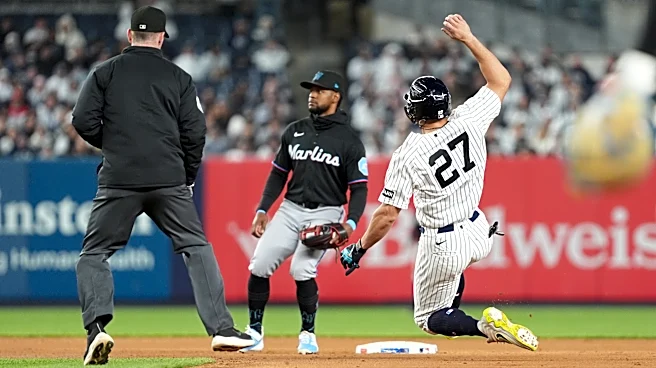




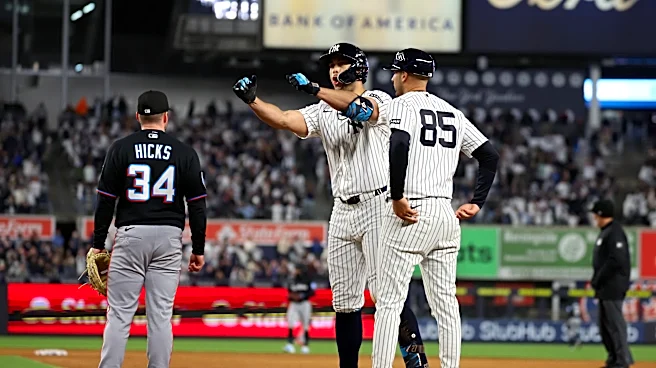


This past Saturday, Giancarlo Stanton stole the show not for his stupendous power but for his baserunning. The slugger whose speed can charitably be described as “plodding” nonetheless swiped second base in the seventh inning when the Marlins neglected to hold him on first. His first steal since the 2024 ALDS and just his second overall since 2020 was followed by a brisk jog to third on an out, then one last race to the plate on a wild pitch, giving the Yankees a big insurance run.
An inning later,
Stanton provided the go-ahead two-run single in a 9-7 win.
This isn’t an isolated incident with Stanton. Evidently, he’s feeling great—the series against the Mariners saw him run all over the place, with rather mixed results. Still, there’s plenty of reason to feel giddy about Stanton’s improved running. For one, it’s a sign he’s healthy enough to take off the limiters and try to make an impact beyond the pop in his bat. For another, if the player who has the most incentive of anybody in the dugout to take it easy and not run too hard is running hard anyway, it’ll have a positive downstream effect on the rest of the team.
In the arduous grind of an MLB season, example is the best form of leadership. Mantras and motivational speeches can ring hollow if they don’t lead to results, particularly over 162 games. The Yankees under Aaron Boone don’t depend on the rah-rah kind of leadership beyond the occasional bombastic ejection. Similarly, team captain Aaron Judge and his deputy, Stanton, are not going to be caught on camera yelling at their teammates to motivate them. They do it by, as ballplayers say, “going about their business.”
Teammates are effusive of Stanton’s willingness to be a resource on hitting, but until last week I’m not sure anyone would have expected him to show his leadership on the basepaths. The Marlins certainly didn’t, giving him an easy opportunity to steal second base and help bring in a big insurance run. Opposing clubhouses will certainly be paying more attention to Stanton now, but so will his own clubhouse. It’s a lot harder to justify not giving your all on a baserunning play if Big G’s busting his hump on the paths.
This is part and parcel of a broader evolution the Yankees have attempted over the past few seasons. The prevailing criticism of the team in recent years has been that they’re not maneuverable enough, so to speak—that they’re so reliant on the home run ball that they lose their potency if the ball isn’t leaving the yard. I find that criticism a touch disingenuous, but there’s certainly nothing wrong with making your team more athletic and better positioned to take advantage of opponents’ mistakes. And at the very least, the Yanks needed to make fewer mental errors of their own—particularly on the bases and in the field.
It’s early yet, but the numbers back up a more aggressive approach working for the Yankees. Last season, they were tied with the Mariners for the lowest rate of extra bases taken in the league at 37 percent. So far this year, they’ve take the extra base more than anybody else, at 59 percent.
To be clear, this isn’t really a sustainable figure—the Tigers’ led the league in XBT% each of the last two seasons, managing a 53 percent last season after doing so 49 percent of the time last year. But if the Yankees can approach the latter figure and sit in the top ten leaguewide while mitigating outs on the bases, that’s a massive improvement from their station-to-station incarnations in previous campaigns. It should appreciably improve their ability to bring home runners when the ball isn’t carrying. And as a team that always works oodles of walks, they should have plenty of baserunners to bring home.
Last year, the Yankees made waves with their torpedo bats. Fans and media alike wondered if the Yankees had cracked some kind of offensive code. In reality, the team was just off to a hot start—it remains to be seen whether the shape of their bats had any real impact on that. But if the Yankees’ newfound ability to consistently take the extra base sticks, that would be no mirage. It would be another sign that the Bronx Bombers are becoming an even tougher puzzle for opposing teams to solve.