



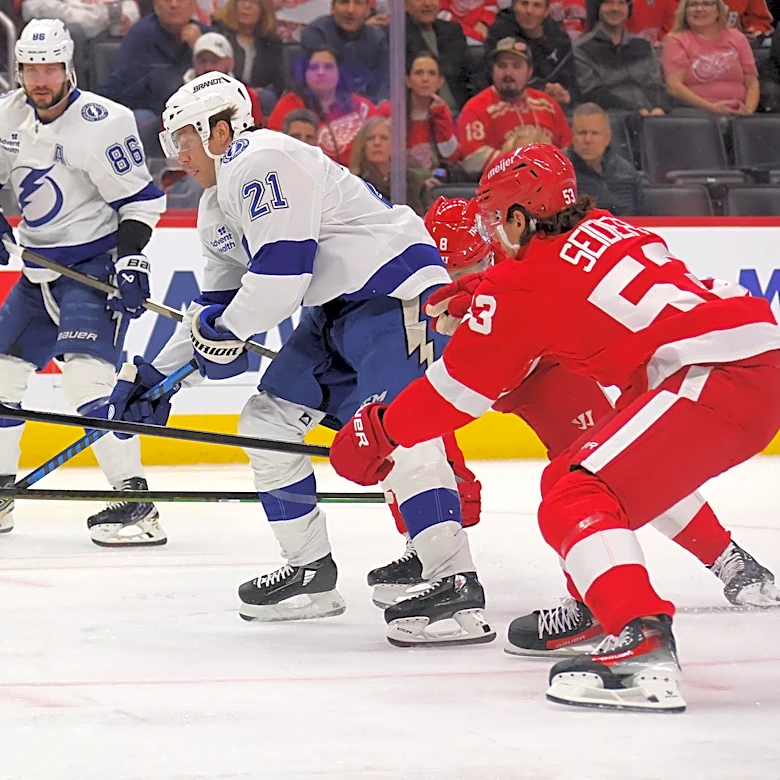





It remains to be seen as to what Pittsburgh Penguins general manager/president of hockey operations Kyle Dubas has planned for this summer, but one area he night not have to touch much is the bottom-six forward group. That is because he already did a lot of his work in securing it during the regular season when he locked in forwards Blake Lizotte and Connor Dewar to contract extensions, keeping them from reaching the unrestricted free agent market.
Those deals are already aging wonderfully.
Lizotte
signed a three-year, $6.75 million deal with a $2.25 million per year salary cap number.
Dewar signed a two-year, $4.50 million deal with matching $2.25 million per year salary cap number.
Tidy business.
Especially tidy when you already look around the NHL and see what similar players are getting even before they hit the open market.
- Beck Malenstyn just re-signed with the Buffalo Sabres for six years, $17.50 million with a $2.96 salary cap number for year.
- Michael McCarron re-signed with the Minnesota Wild for six years, $20 million with a $3.33 million salary cap number per year.
- Jack Drury, having just been traded from Colorado to Nashville, re-signed with the Predators for five years, $22.5 million and a $4.5 million per year salary cap number.
Five and six year teams.
Salary cap numbers exceeding $3 million per year.
For similar — and in some cases — inferior bottom-six forward options.
Let’s just look at some numbers over the past three years. The table below includes all five players mentioned, as well as their 5-on-5 goal share, 5-on-5 expected goal share, goals/60 minutes, points/60 minutes and offensive zone start share.
The only player with better underlying numbers from a goal share and expected goal share is Drury, who has also been given far more favorable shift starts, with the majority of them coming in the offensive zone. Dewar and Lizotte are consistently starting closest to their own net and still typically pushing the play together.
Their numbers since joining the Penguins (and playing alongside one another) are even better than their overall numbers over the past three seasons.
Not only do Dewar and Lizotte push play better and outscore their opponents at a better rate, they also generate more offense for themselves individually.
And they have the shortest contract terms and lowest cap numbers here.
I’m not even saying the Malenstyn and Drury deals are bad (McCarron … I’m not as sold on) for their teams. I’m just saying they make the Penguins deals look even better.
With the rising salary cap, a weak free agent class, and general managers having money that is burning holes in their pockets it should not be a surprise that there is a bump for the lower-tier players. Those players already get a bump on the free agent market because teams get into bidding fights for players that have already played their best hockey for somebody else. Or players that were deemed expendable by their previous team. It is not a bad thing for the players, obviously, but from a team perspective it is still a salary cap league and every dollar that you spend on one player is a dollar you do not have for another player.
Are little bargains like this on their own going to move the needle and turn the Penguins into a Stanley Cup contender? Of course not. But every little mistake potentially adds up into a big mistake. Conversely, every little advantage can add up into a bigger advantage. If you are saving $1 million or $1.5 million in your bottom-six or on your fourth line, that is a little extra money you have to throw at your top-six or a top-four defenseman. And that could make the difference.
Not tying yourself into five-and six-year deals for fourth-liners is also beneficial if you ever feel the need or have the need to trade them.
It has just been good business. Not franchise-changing business. Just good business. You already got a couple of roster spots filled with useful players at what is probably a team-friendly rate.