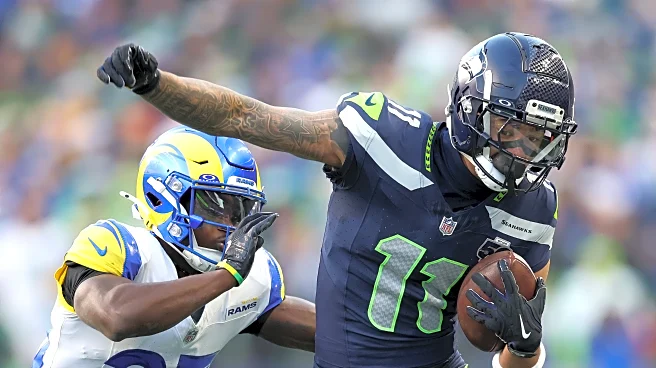




The Los Angeles Rams losing to the Seattle Seahawks wasn’t predictable by itself. These are two teams that played each other historically close over three games this season. Seattle takes the series 2-1, and they claim victory in the most important playoff matchup.
But how the Rams lost was easily foreseeable. Glaring issues that plagued this team all season long again reared their ugly head. Some of the root causes date back to offseason trade-offs. Others were patched midseason but not 100%.
Let’s
breakdown the three areas that sent Los Angeles packing from the playoffs and how they were issues for most of the year.
Special teams woes
Chase Blackburn opened the season as LA’s special teams coordinator. The Rams fired him in favor of assistant Ben Kotwica in addition to changes at the specialist spots:
- LS: Alex Ward —> Jake McQuaide
- K: Josh Karty —> Harrison Mevis
While the Rams were able to fix the field goal operation, there is still plenty left to complain about on this special teams unit. Just a few weeks ago, the team allowed a punt return touchdown by Rashid Shaheed that effectively cost them the NFC West and homefield advantage in the postseason. The Panthers blocked a punt in the opening round of the playoffs. Ethan Evans shanked another the next week to give the Bears strong starting field position on a drive where they soon scored.
The return game again proved problematic in Seattle. Xavier Smith fumbled twice in punt return duties. The first he harmlessly recovered. The second gave the Seahawks the ball in the red zone and they quickly punched in a touchdown. This mistake extended Seattle’s lead and it ultimately became insurmountable.
It’s karmic justice that the Rams’ season was derailed by special teams woes. LA has not adequately invested in specialists or coaching and it has caused a years-long issue. The Rams must now look themselves in the mirror and be honest on how they will fix this problem moving forward.
Lack of talent at corner
To the surprise of many Rams fans, the team did almost nothing to reinforce corner over the 2025 offseason. Sure, they claimed Emmanuel Forbes off waivers from the Washington Commanders late last year. It was still overly optimistic to expect him to become a premium starter. Re-signing Ahkello Witherspoon at the back stage of his career always seemed doomed to fail. Cobie Durant is the best of the bunch but still is undersized and is capable of very low lows.
Maybe LA thought they could get by until the NFL’s trade deadline. It’s possible the market never materialized for someone who could actually fix the problem. Instead, they acquired Roger McCreary from the Tennessee Titans and rarely put him on the field. McCreary didn’t get his first significant run until the playoffs, and even then the Rams seemed uncertain as to who their best two perimeter corners were.
How do the Rams move forward? The changes may need to be wholesale.
Only Forbes, Darious Williams, Josh Wallace, and Quentin Lake (if you count him) are under contract in 2026. The Rams can save money by cutting Williams. Forbes and Wallace should be depth pieces.
Would LA consider re-signing Durant? His playoff production with three interceptions could drive up his demand. Even if the Rams have two first-round picks, you can’t really expect to make it to the Super Bowl with two rookie corners.
After watching this Achilles heel take down the Rams in 2025, it’s could prove even more difficult to fix this position into next year.
Poor game management
In both of the recent games against the Seahawks, Sean McVay cost his team by not being aggressive and refusing to chase two-point conversions early. The modern trend in the NFL is that coaches should strive for two points early so they know their cards later in the game. McVay should have went for two following the long touchdown to Puka Nacua that brought the game within one score.
I don’t fault Sean McVay for how he handled Seattle’s final offensive possession. The risk was too great to challenge Cooper Kupp’s first down conversion if it put another timeout in jeopardy. The real blame falls on the defense for not getting a stop and leaving sufficient time for Matthew Stafford and the offense.
But the math could have changed for Stafford if he only needed three points instead of four. The Rams also could have kicked the game-tying field goal with the ball at the goal line instead of coming away without points. If they would have failed the earlier two-point try, they still would have known they needed a touchdown and could have attempted again to recover the two points.
Also important to game management is McVay’s poor strategy at the end of the first half. The Rams had the ball with roughly two minutes to go. They called two straight passes on second and third down. A run on second down would have chewed time off the clock but left enough time for the offense to score (with smart management). If they were to fail the third down conversion anyways, Seattle would’ve had much less time on the clock. Maybe they settle for a field goal in that scenario instead of finding the end zone.
It’s notable that John Streicher, McVay’s in-game strategist in 2024, decided to re-join Mike Vrabel with the New England Patriots this season. Vrabel is consistently one of the best coaches at decision making and it’s a major reason why New England is once again in the Super Bowl.
For as great as McVay is as a offensive mind and motivator, he’s far from the best at game management. It’s an area where he’s displayed growth but still has a ways to go.