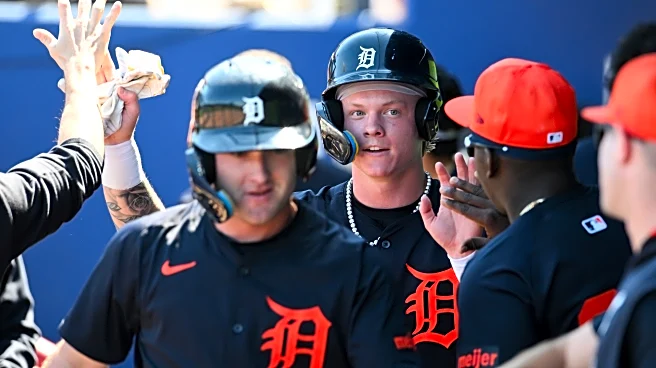

Welcome to the Bless You Boys preseason top prospect list for the 2026 Detroit Tigers.
This year’s edition finds the Detroit Tigers’ farm system still strong at the top, but with some cracks emerging beyond
their clutch of blue chip prospects heading the yearly rankings. The Tigers have only picked in the top ten once since Al Avila took Jackson Jobe third overall back in 2021, so that’s somewhat to be expected. At the same time, the farm system has also reached a clearer delineation between front office regimes, as the vast majority of prospects now found on our rankings were acquired under current president of baseball operations, Scott Harris.
The graduations of Jackson Jobe, Dillon Dingler, and Troy Melton represent the last major wave of Avila acquired talent hitting the big leagues, though there are still a few impact prospects left from the prior front office. Slugger and possible catcher, Josue Briceño, signed back in 2022, is the cream of that crop. Left-hander Jake Miller, drafted back in 2022, is another Avila acquisition with a good chance of having some major league impact. But beyond them, the group remaining from Avila’s term is largely an assortment of possible role players further down the list who have struggled to gain traction towards the big leagues in recent seasons.
One of Harris’ first moves when he took over in the fall of 2022 was to rebuild the Tigers’ scouting department, hiring Rob Metzler from the Tampa Bay Rays as the new scouting director. Metzler has since been promoted to an assistant general manager and vice-president role, though he continues to oversee the scouting department in that capacity. Mark Connor, former director of amateur scouting for the San Diego Padres, took the same role with the Tigers and remains their point man running amateur scouting and the draft.
Metzler and Connor quickly established a pattern of focusing on up the middle prep talent. Through three drafts they haven’t taken a single college player in their five total picks prior to the second round. They’ve drafted three high school shortstops, a center fielder, and a potential slugging catcher with those selections. They’ve mixed in selected college picks in rounds 2-5, but beyond that they’ve mainly picked college players they could sign cheaply and who can play up the middle. If one of them finds some power to go with speed and defensive ability they might have a minor steal on their hands in time, but the point is mainly to free up bonus pool money elsewhere. The rest of their bonus pool has been deployed to convince good prep pitchers who haven’t gotten themselves to early round status to sign anyway and start their pro careers. This is sensible strategy the Padres have typically employed under Connor’s former boss, GM A.J. Preller. It will just take time to see if it pays off.
The Padres are more known for their success in the international free agent market, but other than a few select players on our rankings, most of the IFAs inked under Harris are still too young to really evaluate at this point. Doing better in this department has been a focus for years now without a whole lot to show for it. We can hope they’ll have more success than the Avila-led Tigers did. Gregory Soto, Keider Montero, and Wenceel Pérez are really the only IFAs from the Avila years who have worked out to any notable extent, though the aforementioned Briceño, still just 21 years old, remains the best hope of the former GMs entire tenure.
The other half of the puzzle of building a farm system is player development. There, the Tigers have had a lot of consistency over the past four years. Ryan Garko has done a fine job in organizing and modernizing the Tigers’ processes for evaluating and coaching their young talent, providing individually tailored development plans and working to have them followed consistently at each affiliate level within the farm system. Along the way, the Tigers have continued the investments in technology, facilities, analysts, and support systems begun under Avila. Generally the Tigers are now regarded as a pretty state of the art organization though positive results haven’t exactly been conclusive to date.
Like Metzler, Garko has also been promoted into a VP and assistant general manager position. In October of 2024, Shane Farrell was hired from the Blue Jays to serve as the new director of player development after a long stint as the Blue Jays’ director of amateur scouting. Dan Lunetta, who has been with the Tigers since the Dave Dombrowski era, remains part of the player development leadership working on particular projects, while Kenny Graham has now spent six years with the Tigers, mostly working as the director of the hitting department.
The main question mark in the front office this offseason remains the search for a new director of pitching. Gabe Ribas, who was hired as the previous director of pitching in one of Garko’s first big moves, left for a job with the Rockies after a pretty rough season for pitching development in 2025. The Tigers have had a good amount of success developing pitching over the last few seasons, and there are ongoing points of emphasis where scouting and development have matched up well. The Tigers have a particular affinity for extension to the plate, and they’ve been successful in teaching splitters and kick changes to pitchers struggling to adapt the standard circle change. Still, they don’t just focus on one type of pitcher and show signs of trying to develop a deeper mix of arm angles and pitch types throughout the system.
The Tigers have done a better job developing command, improving pitches and pitch shapes, and getting a little more velocity out of their young pitchers in Garko’s time running the show. The big issue has been in keeping them healthy and building them up toward a major league workload. In 2025, there were a whole litany of pitching injuries in the system, particularly throughout their prep arms selected over the last few draft classes. They’ve tried being very careful with workload, and they’ve invested a whole lot of money over the last 5-6 years on medical and biomechanics staff, but they haven’t seen any particular return in terms of keeping their young pitchers healthy. Hopefully they’ve got some plans to adjust. Garko and company are still hunting for Ribas’ replacement as of this writing. We’ve been waiting for an announcement, but the Tigers can probably take the rest of January to replace Ribas before it might start to seriously impact their preparations for spring camp.
As always, you won’t find players who turned 26 or older during the past season on the list. Unless there’s a major injury to explain why they haven’t cracked the major leagues by that point, said player isn’t really a prospect in the strict definition of the term. That doesn’t mean a Triple-A level player like Trei Cruz, who is now 27 but recently added to the 40-man roster, can’t contribute to the club in 2026. It’s more that his tools are developed as fully as they’re going to get, and the rest is how well he adapts them to major league pitching should he get that opportunity.
Likewise, we’re not really in a position to add much information or context on international players who haven’t reached the A-ball levels unless they’re pretty high profile, so there are only a few of those players represented on the 2026 rankings.
Here are our 2026 top 51 preaseason prospects for the Tigers system, grouped by future value tiers. Each players’ name links to their FanGraphs page for quick reference. I will link the individual reports in their place as they come out. That process will start this weekend or to begin next week.
60 FV
55 FV
45+ FV
45 FV
40+ FV
40 FV
35+ FV
Quick Commentary on this year’s rankings
Reports on all 51 players will follow over the next few months, with the aim of finishing them all by the time the World Baseball Classic reaches its final rounds in mid-March.
If you’re not familiar with future value grades you can read FanGraphs explanation of the 20-80 scale here.
A simple way to think about 40 vs. 45 is that the former refers to non-closer type relief prospects and bench players for the most part. 45 gets into backend starters, potential “closer” level relievers, and platoon player candidates. The plus tiers usually generate the most debate. We typically use them for players that have either standout tools that elevate them from others in the tier, or those who are just more polished overall with a lower risk of failure, injuries notwithstanding.
RHP Kelvis Salcedo and OF Cris Rodriguez are good examples of very young players showing multiple major league caliber tools developing already as teenagers. They’re just so far from the major leagues that the risks of a bust are still very high. Franyerber Montilla’s smooth defense up the middle combined with solid zone discipline, developing power, and speed are undercut by quite a bit of swing and miss. However, he’s not yet 21 and a switch-hitter to boot, so he’ll draw plenty of interest as he tackles the High-A level in 2026.
The top two names of our rankings will come as no surprise. Kevin McGonigle is probably the best pure hitting prospect the Tigers have had since the mid-70’s. I’m a little more optimistic than some that he can continue to develop defensively and play something not far from average shortstop. Max Clark showed more power potential to go along with his good hit tool this season, and also improved his reads and routes enough to be pretty confident in future plus defense. McGonigle’s low risk of failure as a hitter makes him the top dog, but Clark’s all around game puts him on the same tier, with perhaps a little more overall upside than McGonigle’s more limited defensive and baserunning value offers in the years ahead.
2024 first rounder Bryce Rainer was extremely impressive in his short stay in Single-A ball before a season ending shoulder injury ruined the rest of his pro debut. He was deadly against fastballs, producing an awful lot of really hard contact and showing the ability to drive the ball the opposite way up the left centerfield gap with authority. He has plenty of work to do to handle breaking and offspeed stuff better, but he was only 19 and facing his first pro pitching so that’s to be expected. Hopefully his arm strength returns fully after shoulder surgery, because Rainer showed off a cannon from the shortstop position and could prove an above average defender there in time.
Josue Briceño still looks more like a backup catcher at best who will spend his time mainly at first base and in a DH role, but his bat translated well to the Double-A level just as he turned 21 and he looks on track to be a dangerous power hitter with a little more seasoning. We should see him at the Triple-A level this year, and he could even make his major league debut if the Tigers decide to use him in a 1B/DH role. If he’s going to catch, it’s going to take more time but he’s plenty young enough not to be rushed if they still think he can make it as a part-time catcher.
We’ll get into all of it in the individual reports, but here are some more notes on players and various issues in the system.
I covered the topic of injuries ravaging the pitching department pretty extensively back in December. You can find that full article here, but the gist is that most of the top picks the Tigers have spent on prep arms over their first three drafts have really struggled to stay healthy and make progress. Few have even pitched at the Single-A level yet. We even left a few off the list, like LHP Blake Dickerson, RHP Johnathan Rogers, and RHP Andrew Dunford, simply because they haven’t pitched much and there’s really no information on their status. At least Rogers got a few innings at the Complex League this year. There are also a couple of pitchers taken in the 2025 draft that could have made the end of the list, but they haven’t made a full pro debut and this could go on and on.
While this is definitely a problem worth keeping tabs on, to some degree it’s also a function of drafting a lot of un-tested teenaged pitchers. It’s a particularly high risk cohort, and we may not really have a better bead on their futures until they’re reaching the age of college juniors.
The potential for 2024 draft prep pitchers like Owen Hall and Zach Swanson, or Ethan Schiefelbein, to name the most prominent members of this club who all got big bonuses, hasn’t really changed that much, and so we haven’t dropped them much in our rankings. Other players have climbed past them in some cases, but a slow start to their pro careers doesn’t really mean a whole lot unless they can’t move past that point and start making significant progress over the next year or two. The future strength of the farm system is going to depend quite a bit on some of them getting past the injuries and making good progress. This all ties back to why selecting a new director of pitching development is a key front office hire to watch this offseason.
The Tigers did lose some prospect pitching talent this year at the trade deadline as well. RHP Josh Randall and LHP Micah Ashman would likely both be pretty high up in the 40+ tier, with right-hander RJ Sales a little further back. Randall has the most upside as a starter, while Ashman could make a pretty nasty southpaw reliever in time. Both were impressive in their time at the A-ball levels with the Tigers and their loss, combined with the injuries elsewhere, certainly leaves the future of the system looking pretty murky once the top guys graduate.
Top prospect relief options for the Tigers in 2026 include RHP Ty Madden and RHP Dylan Smith, who both pack solid fastballs and good sliders. Madden’s injury plagued season means it’s time to stop regarding him as a starter, though the 25-year-old does have a deep repertoire of pitches to work with. He could really use a resurgent season in 2026 and might still surprise us by finally putting it together more convincingly. Smith was likewise injured much of the year but showed some flashes of success in his major league debut. Beyond them, RHP Moises Rodriguez has a nasty triple digit sinker and could move quickly in the upper levels if his breaking stuff becomes more consistent in 2026.
In terms of near major league ready starting depth, the Tigers have several graduated former prospects like Keider Montero, Sawyer Gipson-Long to go along with minor league veteran signings like Troy Watson at the Triple-A level.
Their two best hopes for rotation help in the farm system in 2026 are left-handers Jake Miller and Andrew Sears.
The 24-year-old Miller has a quality mid-90’s fourseamer and a plus changeup. His slider is still pretty average and could stand to be a ittle sharper. That work was delayed as Miller missed much of the year with an undisclosed injury that was presumably shoulder related. However, Miller is already very polished for a prospect, showcasing excellent command of his basic three pitch mix. Something will have to pop in terms of his stuff to make him a full-time major league starter, but that advanced command puts him a step above Sears, and the Tigers added Miller to the 40-man roster this fall, knowing he would never get through the Rule 5 draft.
I debated leaving Miller in the regular 45 tier because of the injury concerns, but the Tigers are giving out very little information on injuries unless they require surgery, so trying to parse his health and ability to get back on track is just guesswork anyway. Miller was initially supposed to get some work in the Arizona Fall League, but those plans changed late and he didn’t end up participating. Whether that was due to health or because the Tigers didn’t want to show him off prior to the Rule 5 is anyone’s guess, but they ended up protecting him on the 40-man roster anyway. His command makes him pretty close to a lock to pitch in the major leagues in the near future and we’ll expect to see him in Detroit this summer as long as he’s healthy.
The 23-year-old Sears was drafted out of Connecticut and given the minimum bonus with the Tigers’ 10th round pick in 2023. They are definitely getting their money’s worth thus far. The southpaw profiles best as a change of pace type of long reliever/spot starter who works quickly and aggressively pounds the strike zone. He doesn’t rack up ground balls the way Brant Hurter does, but keeps hitters off balance with timing instead, collecting a lot of weak contact in the air. Sears improved his changeup this year to go with a quality fastball-slider combination that showed a little more pop this season. He didn’t miss a beat in moving up to Double-A over the final month of the season but we’ll have to see how that carries into 2026. If he can sharpen his command a bit more, he should be in Toledo soon. He’s young enough to hope for a little boost in terms of velocity and stuff that could make him a full-time starter, but that mixed role still seems like the sweet spot for him when he’s ready.
Catcher Thayron Liranzo was the most debated among the Tigers top handful of prospects this fall. As predicted in our last edition a year ago, the jump to the Double-A level was an eye-opener for the young backstop. Without weaker pitching to pick on, Liranzo found his weaknesses exploited much more consistently. He still showed pretty good discipline in terms of the strike zone, but he’s a pretty grooved swinger without a lot of feel for the barrel. To succeed and get to his power enough, he’ll have to do a better job picking the right pitches to swing at in order to advance. The spike in strikeouts and drop in power, along with some struggles to handle the workload of a full year behind the plate sent his stock spiraling in some quarters.
Personally, I think it was fairly predictable that a 21-year-old switch-hitting catcher advancing to Double-A with some obvious holes in his swing was going to need a year to start adapting. There was a lot on his plate and the bat was always going to take time. A bigger concern to me was that he seemed to run out of gas and didn’t catch that much late in the season, catching only 45 games total all year despite no significant injuries reported. That may speak to some conditioning issues that will have to be addressed to go along with the obvious high risk offensive potential. He has plenty to clean up in his defensive game as well. Point being, one year wasn’t enough for me to drop him as far as some did, but he needs to come back stronger and show more in all facets of his game in 2026. There is still a lot of potential here as a switch-hitting catcher with huge raw power and solid plate discipline, but it’s time for more actualization in 2026.
Likewise, RHP Jaden Hamm had a rough year with some stretches where he struggled to top 90 mph, and then a lengthy IL stint in the mix as well. I’m not too scared off yet, as Hamm only turned 23 in September and managed to survive a year at the Double-A level despite clearly battling his body. It’s entirely fair to drop him into the 40 tiers, but we’ll hang on with him and see if he gets his health and conditioning sorted out over the offseason.
There is much, more more to debate and discuss, of course.
As always, I’ve covered the farm system in depth over the last decade, watch a lot of minor league baseball, and have some pretty good resources developed, but I am not and never have been a pro scout. There’s enough available data now that the job is a little easier to do at a distance, but there’s still tons of player information that it’s accessible to the public. So, while I have my arguments for my positions, there is all sorts of room for disagreement and debate.
Of course that’s true no matter who you’re talking to, as projecting baseball players is just far more difficult than in football or basketball with much more development required to even reach the game’s highest level. Even good major league organizations are wrong constantly, and beyond the first few rounds it’s essentially a bulk business where you’re hunting for undervalued players that fit your club’s development strengths, hoping to find a few gems in the rough.
The goal here is just to give a deeper look at the system that the national sites have time for. We don’t expect to do better than they can in terms of predicting outcomes. We’re just trying to deliver more detail and context than others can via a long-term working knowledge of the system and the players and a singular focus on one farm system.
I hope you enjoy the reports as they roll out, as well as the discussions in the comments. There may not be too much else to talk about until pitchers and catchers report six weeks from now.