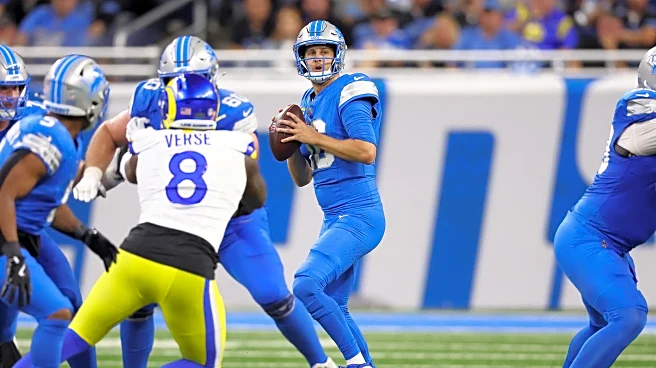

Two NFC contenders of the past few seasons meet on another collision course as the Lions travel to Los Angeles to face the Rams. Detroit is fighting for its playoff life, while Los Angeles is battling
for the 1-seed and a first-round bye in a loaded conference. And thanks to the quarterback Yankee swap and the Lions poaching Brad Holmes and Ray Agnew from the Rams’ front office, these two franchises now share several identity traits.
The Lions handled Sean McVay’s Rams—as favorites—in their two epic recent meetings: the 2023 Wild Card game and the 2024 season opener. Both were tightly contested, down-to-the-wire finishes. This time, though, Detroit may have to search for thinner margins, more reminiscent of their 2021 matchup when Dan Campbell’s first Lions team ran a fake punt and recovered an onside kick to storm out to a 10–0 lead over the eventual Super Bowl champions. Detroit enters Week 15 as six-point underdogs—their largest number under Campbell since the 2023 NFC Championship Game, their largest regular-season figure since 2022, and their first time as more than 4.5-point dogs in the last two seasons.
The Lions now face the MVP favorite, former 12-year franchise quarterback Matthew Stafford, without defensive backs Terrion Arnold, Brian Branch, and Kerby Joseph—all of whom may soon land on injured reserve (with Arnold already there). Kelvin Sheppard’s unit, with a few extra days to prepare, will need to throw the kitchen sink at this Rams offense, while Detroit’s offense must rise to the moment to stay competitive on the road against the NFL’s betting favorite to hoist the Lombardi Trophy.
This preview dives into four key statistical matchups to determine the game’s outcome.
Note: Unless otherwise indicated, all statistics are sourced from NFL Pro, TruMedia, FTN Fantasy, or Pro Football Reference.
McVay shedding his skin
Much of the recent narrative surrounding this matchup—and the Rams’ offense—has centered on Sean McVay’s increasingly unique deployment of 13 personnel. Once synonymous with an almost exclusive reliance on 11 personnel, McVay has undergone a clear metamorphosis, becoming far more versatile and, like the Lions, adept at marrying both zone and gap run schemes from heavier looks.
Since Tyler Higbee’s injury in Week 11 against the Seahawks, the Rams’ usage of three tight end formations has spiked. From Weeks 1–11, Los Angeles already led the league with an 18.5% 13-personnel rate. From Weeks 12–14, that number ballooned to a league-leading 31.8%.
Los Angeles Rams’ offense — 13 personnel (Weeks 12–14, min. 5 snaps):
- 6.8 yards/play (3rd)
- 70.9% success rate (2nd)
- +0.34 EPA/play (2nd)
- 12.7% explosive play rate (4th)
The Rams have leaned heavily—and effectively—on groupings featuring Davante Adams (or Puka Nacua), Colby Parkinson, Davis Allen, Terrance Ferguson, and either Kyren Williams or the recently blossoming Blake Corum. Despite the heavier personnel, Los Angeles has remained multi-faceted when deploying it, operating with a 61% run rate and 39% pass rate outside of garbage time.
Brian Branch would have been an ideal chess piece to deploy as a middle-of-the-field defender against this approach. Still, the Lions’ increased usage of heavier three-linebacker base looks with Jack Campbell, Alex Anzalone, and Derrick Barnes all out on the field should leave them equipped to handle these matchups.
Detroit Lions’ defense — 13 personnel (season):
- 49 snaps (6th)
- 3.5 yards/play (9th)
- 32.7% offensive success rate (9th)
- +0.20 EPA/play (t-9th)
- 4.1% explosive play rate (7th)
Detroit’s success against three tight end sets stems from its tendency to play sound base defense and its prioritization of power over speed in the trenches. By most metrics, the Lions rank top 10 against both the run and pass versus 13 personnel, and top five in first-down or touchdown rate allowed.
Neutralizing this trick up McVay’s sleeve will be critical if Detroit is to keep the Rams’ offense in check and narrow the margin as road underdogs.
Stafford zoning out
As the MVP favorite, Matthew Stafford has shredded virtually every defensive look he’s faced this season—zone, man, blitz, no blitz, or any combination thereof. Finding ways to neutralize his quick-trigger, rhythmic passing and cannon arm has been a challenge, as the Rams’ passing attack has operated like a well-oiled machine.
The Lions’ propensity to lean on man coverage and bring pressure—blitzing on 5.4 man coverage dropbacks per game (9th), while ranking fifth in success rate when doing so—is unlikely to be as effective against Stafford. Against man-coverage blitzes this season, Stafford has been lethal: 18 passing touchdowns (1st), zero interceptions, a 123.8 passer rating (3rd), zero sacks taken, and a 2.33 average time to throw (4th). Letting Stafford identify and attack man blitzes is a recipe for letting him carve up coverage before pressure ever arrives.
The one area where Stafford and the Rams’ passing offense have found comparatively less success is against straight zone coverage without a blitz, when defenses keep at least seven players in coverage.
Matthew Stafford vs. zone defense, no blitz:
- 6 passing touchdowns, 3 interceptions
- 97.4 passer rating (6th)
- 69.7% completion percentage (13th)
- 8.2 yards/attempt (t-5th)
- 51.0% success rate (2nd)
- +0.14 EPA/dropback (6th)
- 16.0% explosive pass rate (7th)
- 3.7% sack rate (t-5th)
- 1.6% turnover rate (16th)
- 2.81 average time to throw (8th)
While Stafford still ranks top 10 across most metrics—a testament to how prolific this season has been—this is where small cracks begin to show. He’s slightly less accurate, takes a bit longer to throw, is sacked more often, and has forced more balls into covered zones that have resulted in interceptions.
That’s all Detroit needs: a handful of impact plays. A takeaway or two, or a timely negative play, could be enough to keep the Lions within striking distance. Mixing in more zone looks—an area where Detroit ranks just 30th in usage at 55.2% of dropbacks—could serve as the curveball that keeps Stafford off rhythm and invites a mistake.
The formula is simple and stark: the Lions are 7–1 when their defense forces a turnover, and just 1–4 when it doesn’t.
Putting it on Goff’s shoulders
The Rams’ defense under second-year defensive coordinator Chris Shula—the longtime friend and former college teammate of Sean McVay, and grandson of Hall of Famer Don Shula—has punched above its weight with well-designed schemes and a physical brand of football.
Overall, Los Angeles ranks third in FTN’s defensive DVOA this season. However, similar to the Lions defense, the Rams’ pass defense hasn’t been quite as sharp since Week 9 (following their Week 8 bye). During that span, they’ve leaned heavily into zone coverage at a league-high rate (80.1% — 6th), nearly a 10% increase from Weeks 1–8 (70.4% — 12th). That shift may be partially driven by recent injuries to key defensive backs Quentin Lake, Roger McCreary, and Darious Williams (who may return against the Lions).
Los Angeles Rams’ passing defense (Weeks 9–14):
- 10 passing touchdowns, 9 interceptions
- 81.7 passer rating (13th)
- 65.0% completion percentage (22nd)
- 6.6 yards/attempt (t-13th)
- 46.3% offensive pass success rate (22nd)
- +0.04 EPA/play (t-11th)
- 11.7% explosive pass rate (9th)
- 4.6 YAC/reception (6th)
- 3.0% turnover rate (8th)
- 35.1% pressure rate (19th)
- 4.6% sack rate (t-7th)
While the Rams’ defense has still been resilient in recent weeks—limiting yards after the catch, curbing explosive plays, forcing turnovers, and getting after the quarterback—it hasn’t consistently shut down opposing passing games over the last month and a half.
If the Lions’ pass protection can hold up against a still-dangerous Rams front—one whose pressure rate (42.0% — 4th) and sack rate (9.2% — 4th) have dipped from their top-five levels from Weeks 1-8—opportunities will be there. With Amon-Ra St. Brown closer to full strength, Jameson Williams firing on all cylinders, and Goff playing efficiently and cleanly to deliver the ball on time, Detroit’s offense should be capable of sustaining drives and putting points on the board.
Carolina copycat
When the Carolina Panthers stunned the Rams in Week 13 as double-digit underdogs, they did it by pounding the rock—40 rushing attempts for 164 yards (4.1 yards per carry). They accomplished that despite facing stacked boxes on 50% of their runs, still churning out 96 rushing yards (4.8 yards per carry) against heavy fronts.
Carolina did struggle—and largely avoided—leaning on man or power concepts. Where they found their most consistent success was on outside zone, ripping off 64 rushing yards on 12 attempts (5.3 yards per carry). On those outside zone runs, the Panthers posted a 50% rushing success rate and generated two explosive gains, key ingredients in their upset win.
Since Dan Campbell took over play-calling duties in Week 10, Jahmyr Gibbs has been lethal on outside zone: 25 carries for 206 yards (8.2 yards per carry), three rushing touchdowns, and an absurd 28.0% explosive run rate. Over that span, Gibbs has arguably been the league’s most dangerous outside zone runner.
Expect the Lions to lean into that blueprint—spreading and stressing the Rams’ defensive front, running away from nose tackle Poona Ford, and forcing defenders Jared Verse, Byron Young, and Braden Fiske to play laterally. That approach puts linebackers Nate Landman and Omar Speights in chase-and-sift mode, where overpursuit can open up cutback lanes for Gibbs to punish.