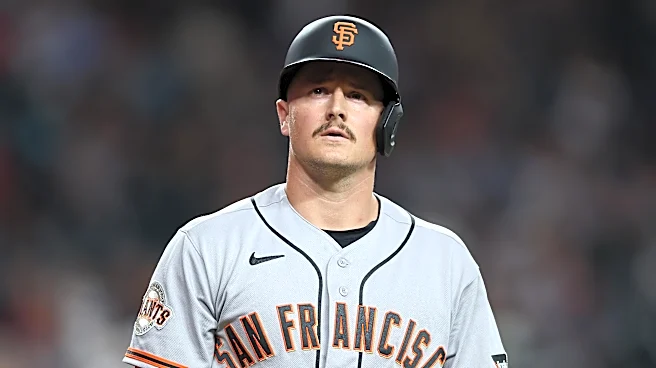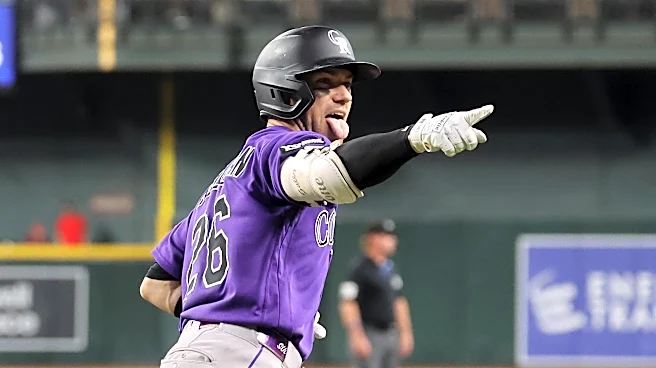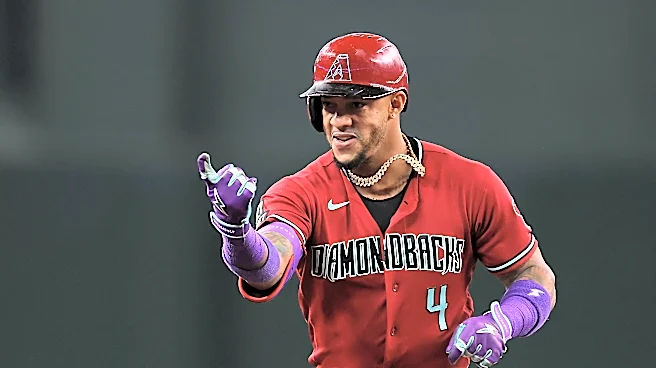

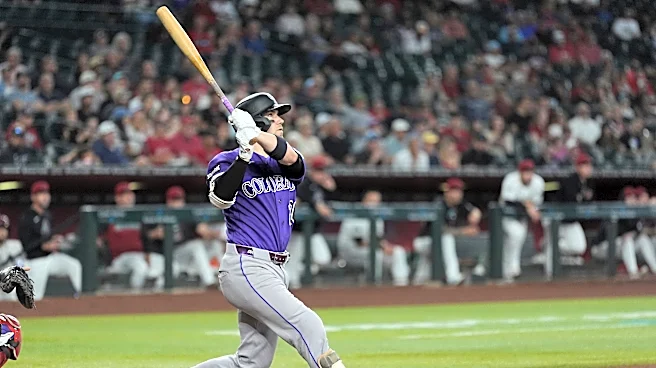
He debuted with the Baltimore Orioles in June 2024, was traded to the Miami Marlins at that year’s deadline, spent much of 2025 working around injuries and returned to Triple-A this summer after his offense backed up. Then came another trade, this time to the Colorado Rockies as part of the return for Victor Vodnik.
Eight days later, Norby was back in the majors.
At 26, he is no longer a prospect waiting
for his first opportunity. He has more than 700 major-league plate appearances and a fairly clear set of strengths and weaknesses.
There is also a version of Norby that has never quite disappeared.
He never became a consensus Top 100 prospect, but consistently ranked among the better second-base prospects in the game, placing 10th at the position entering 2022, sixth in 2023 and seventh in 2024. Second base was his primary defensive home through much of the minors, while his bat was built around patience and above-average power.
The production backed that up. Norby hit .279/.360/.526 with 29 home runs in 2022, then .290/.359/.483 with 21 homers and 40 doubles at Triple-A in 2023. His strikeout rate generally sat in the low 20s, manageable for the amount of damage he produced.
His platoon splits also gave little reason to view him as a right-handed specialist. In 2023, for example, he hit .292/.360/.473 against right-handers and .285/.356/.510 against lefties.
That profile reappeared this summer. In 121 Triple-A plate appearances, Norby hit .291/.397/.544 with eight doubles, six home runs, 17 walks and 23 strikeouts.
The harder part has been getting those skills to coexist against major-league pitching.
The problem is contact
In 2024, Norby struck out in 33.0% of his plate appearances but produced a 14.8% barrel rate, a .202 ISO and a .448 xSLG. The strikeouts were ugly. The damage gave them somewhere to hide.
He cut the strikeout rate to 26.7% in 2025, but his barrel rate fell to 9.4% and his xSLG to .417. Even so, the overall profile stayed roughly above water: 0.3 bWAR in 194 plate appearances as a rookie and 0.8 bWAR in 337 plate appearances last season, with 162WL% marks of .499 and .498.
This year, the balance broke.
Norby hit .205/.313/.325 in 233 plate appearances with Miami before being optioned in late June. His strikeout rate returned to 30.0% while the barrel rate slipped again to 7.5%.
His swing decisions, however, have improved.
Norby has chased only 26.9% of pitches this season and walked in 10.8% of his plate appearances. The contact numbers are much less encouraging: a 77.0% zone-contact rate and 32.3% overall whiff rate.
The problem runs across the pitch mix, but breaking and off-speed pitches have punished him most severely. Norby has whiffed on 47.8% of his swings against sliders, 44.4% against changeups, 40.0% against sweepers, and 66.7% against curveballs. His four-seam whiff rate is also elevated at 33.1%.
This looks much more like a bat-to-ball problem than a swing-decision problem. Norby knows the zone reasonably well; making enough contact when he attacks has been the harder part.
The contrast between his swing decisions and his ability to make contact shows up in these two pitches:
Whether timing, swing path, contact point, or sequencing is driving that is harder to say.
The quality of the contact he does make has slipped, too.
Norby’s fly-ball rate remains high at 37.3%, but his sweet-spot rate has fallen from 47.0% in 2024 to 42.0% last season and 29.9% this year. His under rate is up to 32.1%, while his barrel rate has dropped from 14.8% to 9.4% to 7.5%.
The power still shows up when he gets the barrel there.
But that’s not often enough. More of Norby’s air contact is coming from underneath the baseball instead of becoming line drives and barrels.
His average exit velocity sits at 87.1 mph, only modestly below league average, while his bat speed has been fairly steady. So the problem does not appear to be a simple loss of bat speed.
That contact shape still makes Coors Field interesting. Norby already gets the ball in the air and has enough power and speed to benefit from the outfield when he squares one.
Coors can reward his contact. It cannot create the contact for him.
Where the glove fits
How much offense Norby needs depends on where he plays.
His +5 Outs Above Average this season is driven mostly by first base, where he has been +3 over 100 attempts. There is some major-league history at second: Norby handled 28 Statcast attempts there in 2024 and finished at 0 OAA. But that opportunity is now fairly distant, and his current sample with Colorado is only beginning to build.
Third is less encouraging. Norby is +1 there in 20 attempts this season after finishing at -4 OAA in 2025 and -5 in 2024. His arm has never been an above-average part of the profile, either.
First looks playable, while third has produced the most negative evidence. Second remains the more immediate question.
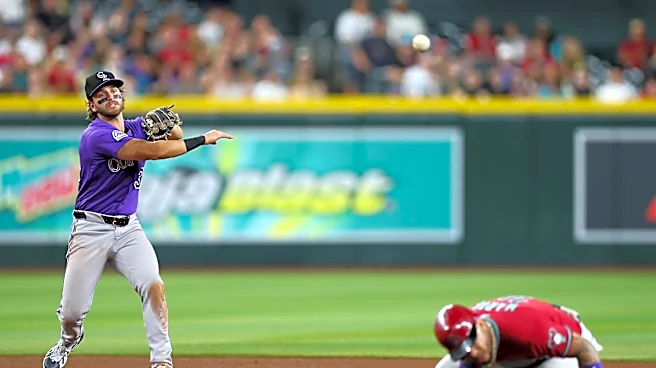
The position itself is familiar. Second base was Norby’s primary defensive home through much of the minors, and the early eye test with Colorado has been encouraging. He has not made spectacular plays, but he has looked competent and comfortable, handling routine ground balls, feeds and double-play pivots without much trouble.
Norby does not need to become a standout defender there. If he can simply provide adequate defense with some regularity, the offensive standard becomes considerably easier to clear than it would be at first base or DH.
Same bet, different ante
Norby is still looking for his first hit as a Rockie, but Friday night was the kind of ballplayer’s game that shows why his value does not have to begin and end with the bat. He went 0-for-2, walked twice, stole a base, scored a run and handled a busy night at second base without looking out of place.
The hit column was empty. His impact was not.
The comparison with Edouard Julien is difficult to avoid because the profiles are not dramatically different.
Both came to Colorado around the same age with offensive skills worth testing and questions about whether those skills could combine into enough major-league production.
Same bet, different ante.
Julien hit the ball hard and controlled the strike zone, but too much of that contact stayed on the ground. Once the bat failed to produce enough, there was little defensive or baserunning value underneath it. He departed with a 65 wRC+ and -7 DRS at second base.
Norby is not an established offensive upgrade. His major-league bat needs recovering, too.
But he is right-handed, runs better, gets the ball in the air and offers more defensive possibilities. His overall game had already produced some major-league value before this season, and his first few games with Colorado have already shown how some of that secondary value can surface even before the hits do.
The right-handed bat also helped the rest of the roster make more sense. Tyler Freeman’s trip to the injured list had removed a right-handed bat from the mix, even if much of his recent work had come in right field. Norby gave Colorado a right-handed hitter who could also handle the infield, restoring some of that balance without simply duplicating Freeman’s role.
That mattered when the Rockies moved on from Julien and recalled Zac Veen. The transactions were not one-for-one replacements: Norby had already arrived for Freeman, while Veen took Julien’s roster spot. But the resulting roster kept a right-handed infield option in Norby while replacing Julien’s left-handed bat with Veen.
That is roster balance with actual utility.
Making the competition mean something
Second base has been a below-average offensive position for Colorado this season. Rockies second basemen rank 24th in batting average, 21st in slugging and 18th in OPS. They have drawn the fifth-most walks at the position, but also have the fourth-most strikeouts while ranking only 16th in home runs.
There has been some on-base value, but too many strikeouts and not enough damage around it to produce a complete offensive profile.
Norby does not have to fix all of that himself.
He just has to raise the standard of the competition.
The Rockies no longer need another player who can merely play second base. They need players good enough to make the competition at second base meaningful.
Norby has a legitimate path to a majority of the playing time himself. If enough of his minor-league offensive profile translates and he proves adequate defensively, a second baseman who walks, gets the ball in the air, produces 20-plus-homer power and can stay in the lineup against both right- and left-handed pitching has plenty of value.
If not, there is still a potential role as a right-handed, multi-position bat with some pop.
Either way, Colorado does not need to clear the position around him.
Adael Amador can compete for it. Ryan Ritter can force the issue from Triple-A. Roc Riggio provides another possibility farther down the line.
None of them has to be evaluated in a vacuum. Even with an unsettled offensive profile, Norby has already shown he can hover around neutral major-league value.
He gives them an actual major-league baseline to beat.
On the farm…
Triple-A: Albuquerque Isotopes 4, Oklahoma City Comets 2
The Albuquerque Isotopes (61-57) beat the Oklahoma City Comets (65-51) 4-2, using a three-run fifth inning to erase an early deficit before adding an insurance run late.
Newly acquired Mason Adams started for Albuquerque and allowed two runs on three hits over four innings, walking two and striking out four. Mason Green followed with two scoreless innings to earn the win, lowering his ERA to 5.71, and Jaden Hill worked a clean seventh with one strikeout to pick up his first hold. TJ Shook recorded the final out in the ninth for his 11th save, after taking over for Evan Shawver with two outs.
The Isotopes trailed 2-0 before breaking through in the fifth. Jose Cordova singled, Drew Avans reached on an error, Ryan Ritter singled to load the bases, and Roc Riggio walked in Albuquerque’s first run. Braxton Fulford then delivered the big swing with a two-run single to put the Isotopes ahead.
Fulford finished 2-for-4 with two RBI and now has a .910 OPS, while Ritter went 2-for-5 and is hitting .325 with an .881 OPS. Cordova added two hits and is now batting .299 with a .731 OPS. Charlie Condon went 0-for-3 but drew a walk and added a sacrifice fly in the seventh, giving him 74 RBI with a .919 OPS.
Double-A: Erie SeaWolves 2, Hartford Yard Goats 1
The Hartford Yard Goats (55-56) dropped a tight 2-1 game to the Erie SeaWolves (65-46), with all three runs coming in the fifth inning.
Bryson Hammer started for Hartford and took the loss, allowing two runs on five hits over 4.1 innings while walking one and striking out four. The damage came in the fifth, when Erie used a walk, a double, a bases-loaded walk, and a sacrifice fly to take a 2-0 lead. Hammer is now 0-1 with a 5.40 ERA.
GJ Hill accounted for Hartford’s only run, going 3-for-4 with his 14th home run of the season. Hill’s solo shot came in the bottom of the fifth and cut the deficit to one, but the Yard Goats could not push across another run.
Dyan Jorge added his 14th double of the season, drew a walk, and stole his 44th base. Andy Perez, Cole Messina, and Skyler Messinger each added a hit, but Hartford went 0-for-10 with runners in scoring position and left eight on base.
High-A: Everett AquaSox 3, Spokane Indians 2
The Spokane Indians (50-61) were walked off in a 3-2 loss to the Everett AquaSox (58-54), with Carter Dorighi’s ninth-inning single ending a tight game.
Newly acquired Aiden May started for Spokane and allowed two runs on six hits over five innings without a walk, striking out one. He owns a 2.79 ERA on the season.
Kelvin Hidalgo led the offense with three hits and stole his 19th base of the season. Roldy Brito and Tanner Thach added two hits apiece, with Brito stealing two bases to give him 17 on the year and Thach adding his second steal.
Spokane trailed 2-0 after the second but chipped back. Cameron Nelson doubled home Clayton Gray in the third, and Thach scored on a wild pitch in the sixth to tie the game. Seth Clausen took the loss after allowing a leadoff double in the ninth, followed by Dorighi’s walk-off single.
Single-A: San Jose Giants 6, Fresno Grizzlies 4
The Fresno Grizzlies (61-51) gave up three runs in the eighth inning in a 6-4 loss to the San Jose Giants (62-50), another late lead slipping away for a Rockies affiliate.
Fresno fell behind in the first but answered in the third, when Cristian Arguelles drew a bases-loaded walk to tie the game. The Grizzlies took the lead in the fourth after Jack Natili was hit by a pitch, Ryan Niedzwiedz doubled, and Juan Martinez reached on an error that brought both runners home.
Natili added his first home run of the season in the sixth, giving Fresno a 4-1 lead. Arguelles, Daniel Jackson, Natili, Niedzwiedz, and Aidan Redahan each had one hit, but the Grizzlies finished 0-for-4 with runners in scoring position and were held hitless over the final three innings.
Luichi Casilla allowed one run over four innings, but the bullpen could not hold the lead. San Jose scored three times in the eighth, with Luke Hansel taking the loss.
Goodman gets night off with shoulder inflammation | MLB.com
Hunter Goodman was held out of Friday’s lineup with left shoulder inflammation that dates back to a swing Wednesday in Arizona. Manager Warren Schaeffer said Goodman is day-to-day as the Rockies give him treatment and see how the shoulder responds. His absence is significant: Goodman leads Colorado in OPS, RBIs and runs while ranking fifth in the majors with 34 home runs entering Friday.
How Roc Riggio’s Promotion Impacts Rockies Middle Infield Talent Pipeline | SI.com
Roc Riggio’s latest promotion adds another name to the Rockies’ increasingly crowded middle-infield pipeline. The piece looks at where Riggio now fits among Colorado’s second-base options and what his rise means for the organization’s depth at the position.
Nick Frasso reflects on his MLB debut | purplerow.com
Nick Frasso’s path to the majors changed quickly after the Rockies acquired him from the Dodgers at the trade deadline. His debut came in the 11th inning at Coors Field, and Frasso reflected on the experience, what he learned from it and how he is beginning to settle into Colorado’s bullpen.
Join the conversation!
Sign up for a user account and get:
- Fewer ads
- Create community posts
- Comment on articles, community posts
- Rec comments, community posts
- New, improved notifications system!
Please keep in mind our Purple Row Community Guidelines when you’re commenting. Thanks!