


Portland Trail Blazers history is studded with All-Stars and significant contributors. Clyde Drexler and Damian Lillard have eras named after them. Bill Walton is linked inexorably with the franchise’s only NBA Championship. In between we can talk about Brandon Roy and LaMarcus Aldridge, Maurice Lucas, Kiki Vandeweghe, Arvydas Sabonis, and any number of easily-recalled players who will bring smiles to the faces of Portland fans.
But what about the lesser-known contributors?
This summer we’re running
a series called “Do You Remember?” It highlights players who didn’t produce 20 points per game or lead the team to playoffs victories, but proved distinct for one reason or another. Maybe these guys aren’t a main course all on their own, but they’re side dishes who gave the Blazers more flavor. Over the years, you may have forgotten that they existed. Let’s bring them back for a walk down memory lane!
We started the series with lesser-known forward Richard Anderson. Now we move to a shooting guard/small forward combo player who played for the Blazers five years but never averaged 6 points per game, barely inched above 3 rebounds in his most productive season, and hit exactly 1 three-pointer in 15 attempts during his entire Rip City tenure. How can anybody get away with those stats while averaging 17 minutes per game over 250 appearances?
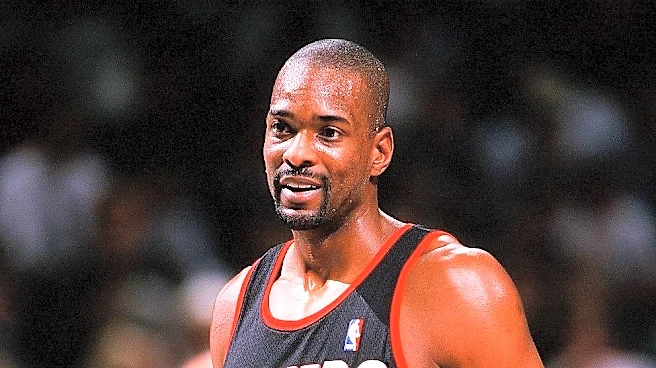
Well, you can do it if your name is Stacey Augmon.
Augmon came into the league in 1991, drafted ninth overall by the Atlanta Hawks. He played for five years in Atlanta, had a cup of coffee with the Detroit Pistons, then got scooped up by “Trader” Bob Whitsitt in 1997 to complement his new, Frankenstein-esque roster rebuild. What do you do when Damon Stoudamire, Jim Jackson, Isaiah Rider, and Bonzi Wells need a break? Call on Plastic Man.
The name—a precursor to Elastigirl for you younger folks—came to Augmon because of his condor-like wingspan and nose for the ball on defense. You didn’t dribble against Stacey Augmon. You worked. Everywhere you wanted the ball to go, his hands were already there, looking for a steal. And woe be to the player he decided to help on defensively.
Portland’s offensive-minded guards often let penetrators slip past to the bucket. If Augmon was in the quadrant, there was going to be trouble. His chase-down game was a sight to behold. You’d see him cut through the lane, then rise with impeccable timing. The layup that two seconds ago had looked completely clear all of a sudden got smothered by a rolling thunderstorm of doom. The scorer would float the ball towards the backboard, then the soaring shadow would hit and a big mitt swatted away what looked like a sure two points as Portland crowds cheered riotously.
Augmon got only cursory consideration for All-NBA Defensive teams. He didn’t factor in the polls for Defensive Player of the Year. Those honors went to starters and volume shot-blockers. He was a $2 million, 17-minute-per-game player for the vast majority of his career. But his defense was like orange juice concentrate hitting a pitcher of water. Sampled alone, it wasn’t good. Mixed in with a five-man lineup, especially of bench players, and all of a sudden you had an identity and a stouter backbone. He was a one-man threat essentially playing only one side of the ball, not a guy you could ride all day, but a player coaches felt secure with.
In a bit of trivia, Augmon also became one of the six players the Blazers traded to Houston for forward Scottie Pippen in October, 1999. The Rockets waived Augmon just after. Portland promptly re-signed him and he played two more seasons for the team.
Do you remember Stacey Augmon? Reminisce in the comments section below and offer suggestions of other seldom-mentioned players we should cover in this series!