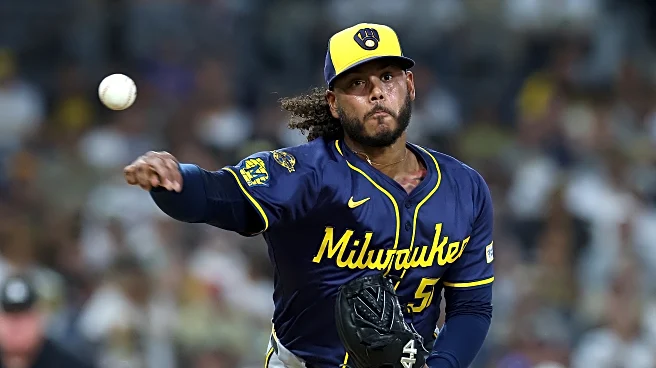

Freddy Peralta, one of the Mets’ latest additions in a very busy week, began his professional career in baseball as an international signing with the Mariners out of the Dominican Republic in 2013. Following a solid season in the Dominican Summer League that year, Peralta was promoted to Seattle’s rookie ball affiliate in Arizona for his age-18 season in 2014 and repeated the level in 2015, putting up slightly better results in his second go-around after struggling a bit in his first.
Following the
2015 season, the Mariners traded him and a pair of fellow pitchers to the Brewers in exchange for Adam Lind, who was coming off one of the best years of his career and went on to put up a .717 OPS and -0.3 bWAR in his lone season in Seattle before putting up a solid-if-unspectacular stat line with the Nationals in the final season of his major league career in 2017.
The Brewers had Peralta spend his 2016 season in Single-A and High-A and used him out of the bullpen fourteen times while having him make just ten starts. In total, he 82.0 innings in the minors that year and finished with a 3.62 ERA in his age-20 season.
Peralta opened the 2017 season in High-A, fared much better there than he had in his stint at the level in the previous year, and earned himself a promotion to Double-A. He thrived there, as he had a 2.26 ERA in 63.2 innings, and across both levels, he made the vast majority of his appearances as a starter.
After making seven starts in Triple-A at the beginning of the 2018 season, Peralta was called up for his major league debut in mid-May and had a rather electric outing against the Rockies at Coors Field as he went five-and-two-thirds innings and racked up thirteen strikeouts, gave up just one hit, and didn’t allow any runs. Following his second start against the Twins in the next turn through Milwaukee’s rotation, Peralta went on to bounce between Triple-A and the big leagues for the rest of the season, but he threw 78.1 innings with a 4.25 ERA and a 3.72 FIP in his time with the Brewers.
Milwaukee decided to use Peralta mostly as a reliever in 2019, and that season didn’t go particularly well for him. In 85.0 innings, he finished with a 5.29 ERA and had a pretty significant home run problem, as he gave up 1.6 per nine innings, largely erasing the good work he did in striking out 115 batters that year. The Brewers stuck with using him out of the bullpen in the shortened 2020 season, a small sample that saw him put up a much better 3.99 ERA.
In 2021, however, the Brewers moved Peralta back into the rotation on a full-time basis, a move that worked so well that he’s remained a starting pitcher ever since—aside from a lone appearance out of the bullpen in each of the 2021 and 2022 seasons. In 144.1 innings in the former, he had a 2.81 ERA and a 3.12 FIP and was worth 3.7 bWAR.
The 2022 season didn’t go quite as swimmingly for Peralta, who dealt with lat and elbow issues and made just 18 appearances, putting up a 3.58 ERA in just 78.0 innings. But from 2023 through 2025, Peralta turned into one of the more durable pitchers in the game. He logged 516.0 innings over that span, the 15th-highest total in baseball, and finished those three seasons with ERAs of 3.86, 3.68, and 2.70, respectively.
Peralta’s percentile rankings on Statcast looked very good in the 2023 and 2025 seasons, and last year, he used a four-pitch arsenal that included a four-seam fastball that he threw a majority of the time, a changeup, a curveball and a slider.
That pitch mix hasn’t changed all that much since the Brewers moved him into rotation, though it might be worth noting that he went from his slider being his most-used secondary pitch in every season from 2021 through 2024 to his least-used one in 2025. He’s thrown his changeup more in each season since 2022, and the 2025 season was the first time that he threw it more than either his slider or his curve.
Finally, Peralta is in the last year of his contract, an incredibly team-friendly deal that he signed with the Brewers ahead of the 2020 season for seven years and $30 million. He’ll turn 30 years old in June, making this his age-30 season, but he’d be a pretty good candidate for an extension should the Mets be interested in keeping him around for more than the 2026 season.