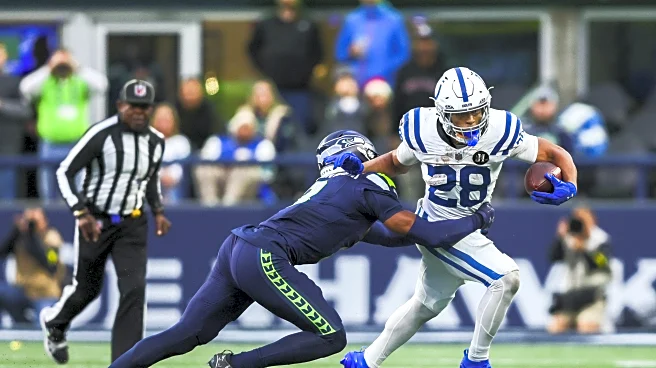




The Seattle Seahawks’ win over the Indianapolis Colts fits neatly into the category of games where the final score masks a lot of underlying issues. From an All-22 perspective, snap by snap, this was a win built more on competitiveness, defensive execution, and timely plays than on a coherent or efficient offensive performance.
In classic Field Gulls fashion, the tape presents a very clear split between what worked and what absolutely did not.
The Bad
Offensive line and the run game: no answers, no push
The Seahawks’ inability to run the ball was not about play
selection or running back vision — it was about the offensive line losing, repeatedly and decisively, at the line of scrimmage.
On film, the Colts consistently controlled the point of attack. Interior defenders penetrated gaps almost immediately, disrupting zone concepts before they could develop. Guards struggled to generate lateral movement, combo blocks rarely reached the second level with balance, and defensive linemen were able to shed blocks far too quickly.
This showed up most clearly on early downs. Inside zone plays were blown up by penetration, outside zone was strung out due to poor leverage, and even gap concepts failed because pullers were late or met by unblocked defenders in the hole. On multiple snaps, the running back was forced to redirect before the mesh point was even complete.
When an offensive line can’t create displacement or maintain angles, the result is predictable: minimal gains and an offense constantly stuck behind schedule. That reality left Seattle in too many obvious passing situations and removed any sense of offensive balance.
Here’s a big problem with the play call. The Seahawks call a full-slide to the left, even with four threats on the right side and only two on the left, leaving the running back with the responsibility of block the right edge. Two blitzers come to the right side and due to the bad play call, there’s a free rusher against the quarterback. Sam Darnold still manages to throw the ball even with the defender on top of him.
This was a mistake by Zach Charbonnet, but again, the call is a full slide. This type of concept will often leave the running back against the edge rusher, and that’s not a favorable matchup. I only like this type of call when the quarterback moves to the opposite side. The fact that the snap ends with Sundell and Bradford on the ground is not a good sign.
Sam Darnold’s inconsistency
Sam Darnold’s performance was a snapshot of the season as a whole: flashes of competence mixed with stretches of hesitation and poor timing.
Darnold, like the Seahawks’ offense, is inconsistent throughout the game. It seems he can take on multiple versions of QBs during the match, and often during the same drive.
On tape, there are plays where Darnold correctly diagnoses coverage, throws with anticipation, and delivers the ball on rhythm. Those snaps are immediately followed by delayed reads, unnecessary movement in the pocket, or rushed decisions when pressure is implied rather than real.
While the offensive line deserves its share of the blame, Darnold also missed opportunities against relatively simple coverage structures. The Colts mixed zone-match principles with two-high shells, and Darnold was slow at times to identify leverage pre-snap, which disrupted the timing of route concepts.
He didn’t implode, but he also didn’t elevate an offense that clearly needed help.
Why Klint Kubiak’s game plan never found rhythm
One of the most frustrating aspects of the All-22 is how poorly the offensive plan adapted to what was actually happening on the field.
Even as the run game repeatedly failed, Seattle continued to call predictable early-down plays that put the offense behind the chains. There was limited effective play-action, minimal pre-snap motion to clarify defensive intentions, and very little quick-game usage to mitigate pressure and help the quarterback.
The thinking becomes “justified” when you run to set up the play action. However, there were only eight play action attempts out of 36 passes attempted. Defenses no longer respect the Seahawks’ running game, they are using base defense less and less, and Kubiak can’t adapt to that.
Most concerning was the slow adjustment to obvious advantages on the perimeter. Jaxon Smith-Njigba and Rashid Shaheed consistently won their routes, yet the structure of the offense rarely prioritized getting the ball out quickly to those matchups. The Colts were without their two starting cornerbacks, and the team failed to consistently exploit that fact.
Watching the tape, the offense feels disjointed — I’m not saying the offense can’t make good plays. The real problem is that the offense can’t consistently make good plays and has trouble maintaining its rhythm throughout the entire match.
The Good
How the Seahawks won the fight in the trenches on defense
While the offense struggled to impose its will, the defensive front absolutely did.
Byron Murphy II and Leonard Williams were central to Seattle’s success, and their impact is unmistakable on the All-22.
Murphy was disruptive throughout the game, particularly against the run. His first-step quickness consistently stressed the interior of the Colts’ offensive line, forcing early adjustments and clogging running lanes before they could fully develop. Murphy played with excellent pad level, strong hands, and showed the kind of gap discipline that prevents cutback lanes. Even when he didn’t record a stat, he was often the reason plays were redirected.
Leonard Williams, meanwhile, was the tone-setter. He controlled blockers at the point of attack, collapsed the pocket from the interior, and forced the Colts’ quarterback to speed up his process. Williams’ ability to convert power into push showed up repeatedly on passing downs, where he compressed the pocket and limited escape lanes. His presence made life easier for everyone else up front.
Together, Murphy and Williams anchored a defensive performance that consistently forced long third downs and kept the Colts from establishing offensive rhythm.
Rashid Shaheed: speed that changes defensive rules
Rashid Shaheed continues to prove why speed matters, even when volume isn’t overwhelming. His impact doesn’t always show up in raw numbers, but it shows up in how defenses are forced to play Seattle. Shaheed alters coverage geometry in a way this offense previously lacked.
On film, Shaheed consistently won on vertical and intermediate routes, forcing the Colts’ secondary to adjust its spacing. Safeties played deeper, corners gave more cushion, and underneath defenders were less aggressive as a result.
Jaxon Smith-Njigba: the stabilizing force
If Shaheed provided the explosion, Jaxon Smith-Njigba provided the reliability. Great game with the exception of one snap where there was an unusual drop.
JSN was Darnold’s most dependable option throughout the game. His route running against zone coverage was precise, his feel for soft spots was excellent, and he consistently presented a clean target on critical downs. Against blitz looks and match coverage, JSN was often the correct answer — and he delivered.
When the offense stalled, JSN was the player who kept drives alive.
Final thoughts
This win counts, but the tape is just honest. The offensive line’s run blocking remains a major concern, Sam Darnold’s inconsistency continues to limit the ceiling of the offense, and Klint Kubiak must do a better job tailoring his plan to what this team can execute.
At the same time, the defensive front — led by Byron Murphy II and Leonard Williams — showed real dominance, and the pairing of Rashid Shaheed and Jaxon Smith-Njigba gives Seattle legitimate building blocks in the passing game.