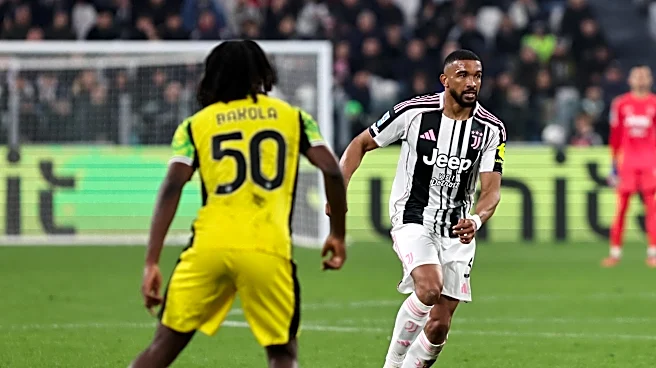


Like a true sicko, I’ve rewatched Juventus’ 3-2 loss to Sassuolo a couple of times now, and I keep landing on the same word: languid. Not slow in the methodical, patient sense. Slow in the sense of nothing actually happening. Guys getting the ball and looking up at statues. The whole thing carried a weirdly passive energy, like everyone on the pitch was waiting for someone else to make the first move. That passivity breaks down into three separate problems.
First is the most fundamental: a total lack
of off-ball movement. It killed Juventus’ ability to move the ball side-to-side and completely eliminated runs in behind once they reached the final third. Second is a decision-making rot that sets in whenever a half-decent look actually exists. This team looked allergic to a good-not-great chance, preferring either to force a spectacular highlight or attempt nothing at all. Third is the inevitable result of the first two: when someone finally gets the ball in a promising spot with zero support, possession degrades into desperate one-man efforts against a defense with absolutely no reason to panic.
None of these complaints are exactly new, and Sassuolo didn’t have to invent anything clever to expose them. They didn’t hit us with some complex defensive trap or overwhelm us with high-intensity pressing; they simply sat in a compact shape, guarded their spaces, and let Juventus choke on their own lack of tempo.
But while these structural flaws have been bubbling beneath the surface for weeks, this match stands out as the cleanest, most damning distillation of that inertia we’ve seen all season. It served as a stark diagnostic reel of a team trapped in its own head, showing precisely how a side can hold all the territory on paper while offering zero actual threat on the pitch.
Static circulation and isolated reference points
None of this manifests as a broken passing percentage or a collapse in control — according to WhoScored, Juventus held 58% of the ball. The breakdown was purely physical: no one made a run to justify shifting the ball, and no one made a run to receive it once possession reached the final third. Every other offensive issue in this match sits directly on top of this inertia.

This complete lack of dynamic movement transforms territorial control into an empty stat. The field tilt chart confirms Juventus owned the pitch everywhere outside their own 18-yard box, but that territory plateaued precisely where it needed to become dangerous. Much like Juve’s defensive approach against Milan the weekend prior, Sassuolo conceded harmless perimeter possession, trusted their low block, and waited for Juve’s ball movement to stall out on its own.
The mechanics behind that stagnation are plain in the pass network. Heavy distribution lines flowing out from Guglielmo Vicario indicate how often possession had to be completely reset to the back line rather than sustained in central areas.

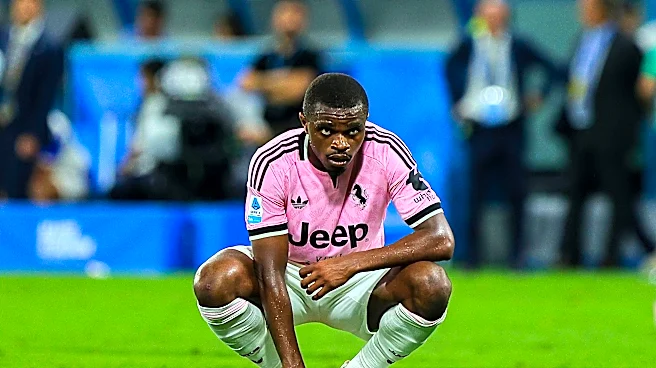
Beyond Randal Kolo Muani’s isolation, the pass network shows how predictable Juve’s wide play became. On the right, Pierre Kalulu and Francisco Conceição formed a functional tandem, as did Zeki Çelik and Kerim Alajbegović on the left. But both wingers naturally prefer coming short to ask for the ball at their feet. With neither fullback overlapping to offer depth when they dropped, no one was left to stretch Sassuolo’s back line vertically. That turned every side-to-side shift into an arduous chore: rather than pinging a sharp, direct switch to freeze the defense, the ball had to bounce through several players first. By the time possession actually trickled over to the far side, Sassuolo had already slid across, reset their block, and closed down the space.
Ultimately, this is the foundational flaw. Possession didn’t stall because Sassuolo solved Juventus; it stalled because no one off the ball gave the passer a reason to play forward. Everything else — the forced shots, the low-margin dribbles — stems from 11 players occupying territory without ever attacking it.
Rejecting the simple look in the box
When Juventus did manage to advance into dangerous areas, they exposed a different problem entirely: a refusal to accept moderately good looks in favor of forcing non-existent, high-probability ones. A functioning attack sustains momentum by taking the unglamorous, clean looks that present themselves over 90 minutes — the half-yard of space at the edge of the box, the first-time strike through a lane. Juventus routinely rejected those open windows, opting instead to attempt to dribble through multiple defenders deeper into a packed box to manufacture a tap-in. The result was a self-inflicted bottleneck — either turning the ball over in traffic or being forced to recycle possession all the way back to the defensive line, restarting the static build-up loop all over again.

The shot map illustrates this bad habit clearly. The attempts cluster heavily at the extremes: a wall of low-threat efforts taken out of frustration from range, and a few isolated moments right in front of goal, with almost nothing bridging the gap. A team taking 19 shots should generate a steady middle class of decent opportunities — the low-angle finishes, the clean hits from the penalty spot. Juventus skipped that tier entirely, leaving a shot map that looks like two different teams took turns: one that settled for low-percentage long shots, and another that overthought every clean look in the box until the angle vanished.
That overthinking bled into set pieces as well. On corners, Juve consistently sent only three players into the box, opting for short routines rather than committing bodies and backing a direct delivery. A short corner in this context is just another symptom of the same disease — an attempt to over-engineer a clean sequence rather than trust a direct, dangerous ball into the mixer.

The box entries map shows this indecision from another angle. It is a congested picture, with ball after ball funneling into the exact same central channel from identical deep angles. When that many entries converge on a tiny pocket of space, the extreme choices make sense: a crowded box smothers the simple pass, leaving players to either force a ball through heavy traffic or pull the trigger early from range out of desperation.
Conceição was the clearest embodiment of this habit, largely because he is the one player capable of creating something out of nothing. He consistently beat his man in tight spaces, but his final decision was almost always the same: driving a low ball across the face of goal into a crowded box rather than laying it off to an open runner at the top of the area.
The 44th minute provided the textbook example. After beating his marker on the byline, Conceição fizzed a ball across a six-yard box populated only by green and black shirts, completely ignoring an unmarked teammate standing at the edge of the penalty box with a clear sight of goal. A similar beat occurred in the 35th minute, where a potential lay-off turned into a low-percentage ball across the box that was easily cut out.
Whether these were misread passes or stubborn decisions is beside the point. The broader rot remains identical: a team that refused to move off the ball to build an advantage, and then, on the rare occasions an advantage presented itself, refused to trust the simple, repeatable option.
Isolated 1-v-1 as a last resort
Every so often, someone received the ball in a genuinely promising spot and looked up to find zero support — leaving a solo dribble into traffic as the only card left to play. Alajbegović ended up in that exact trap three times. All three of his dribbles occurred inside the penalty box. Merely controlling the ball in those areas against a defense sitting this compact is an accomplishment in itself, but the sequences immediately stalled out.
Only one of those three moments produced a shot: an 83rd-minute effort that yielded a meager 0.03 xG. It came from a spot on the pitch that typically carries far more threat, but Alajbegović had been squeezed into a tight angle with defenders collapsing on him every step of the way. His other two dribbles simply ran out of road. He did the hard work of breaking into a dangerous pocket, discovered no teammates arriving to relieve the pressure, and was left trying to force his way through one defender too many.
That pattern exposes the real structural issue. An attacker does the individually impressive work — navigating tight spaces under pressure to manufacture something out of nothing — only to realize there is no second act. There was no give-and-go option to drag a center-back out of position, nor a late run to the back post to force the crowd to disperse. Without off-ball movement, three or four defenders can comfortably collapse on a single player, confident that no unmonitored threat is lurking behind them.
To be fair to Alajbegović, this isn’t a critique of his individual decision-making in the way Conceição’s crossing habit was. Alajbegović put himself exactly where a high-value chance ought to exist. The breakdown was purely structural: by the time he arrived, the overwhelming defensive numbers around him had already been dictated by his teammates’ collective inertia.
That remains the defining throughline of the entire game. A team that refuses to move for one another early in possession inevitably ends up here — settling for low-percentage long shots at one extreme, and asking an isolated attacker to solve an 11-man problem at the other. Neither failure is about the individual attempting the dribble or forcing the cross. Both are simply what remains when no one else has done their job.
None of these three issues exist in a vacuum. The static build-up forces the impatient, low-margin decisions in the final third, which in turn leaves whoever receives the ball in a promising area stranded on an island. It’s a self-reinforcing loop of passivity. When a team stops making early, unselfish runs, the pitch shrinks, the defense settles in, and every subsequent action becomes twice as difficult as it needs to be.
The one stretch where this actually broke was, tellingly, powered by the exact ingredient missing everywhere else. Edon Zhegrova’s first goal came off a rebound — Lloyd Kelly crossing for Kolo Muani, who for once had actually made the run into the box, forcing the goalkeeper into a save he couldn’t fully control and leaving Zhegrova to pick up the loose ball in space. His second followed the same logic: Kolo Muani pinned his defender with his back to goal, creating the pocket for Zhegrova to slide a pass through, demand it back, and finish past his markers. Both goals required someone centrally creating a physical problem the defense actually had to solve. It’s not a coincidence that Juventus’ only two goals came from the only two instances of an attacker genuinely drawing defensive focus in the box.
The most frustrating part of watching Juventus against Sassuolo isn’t that they lacked talent or were outplayed by a superior tactical setup. Sassuolo didn’t invent a revolutionary trap — they simply recognized that Juventus were content to move at walking pace, sat in their mid-block, and waited for Juve to get in their own way. Holding nearly 60% of the ball while generating almost zero sustained central threat isn’t control; it’s just delayed turnover.
Until Juventus restore off-ball urgency and stop treating possession as an end unto itself, matches like this won’t be treated as weird anomalies — they’ll be the blueprint for every compact defense in Serie A. The structural framework is there, but without movement, even the most expensive setup on paper is just 11 players standing still.