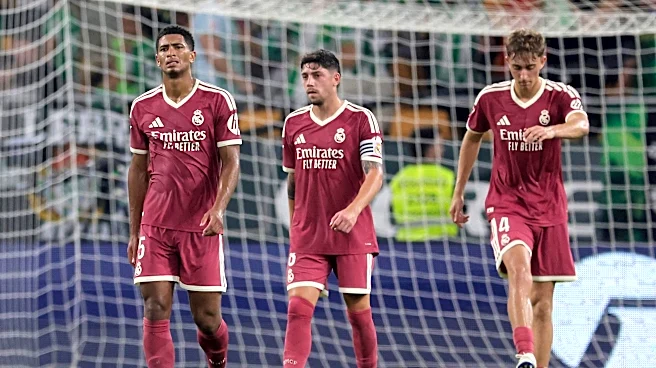




Two versions of Real Madrid faced Real Betis at La Cartuja Stadium. The first one was wasteful in front of the goalkeeper, whereas the second was constrained and without solutions.
In the first half, Real Madrid created goal-scoring chances relying on versatile approaches: counterattacks, set pieces, and settled possession.
Off the ball, Manuel Pellegrini’s team sat in a 4-4-2 medium block, whereas Real Madrid lined up in a three-box-three formation in possession. Marc Cucurella tucked inside as a situational
center-back, while Denzel Dumfries pushed high and wide.
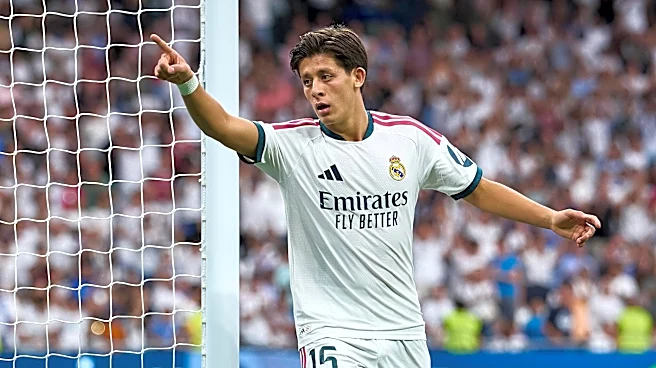
With the time and space Real Madrid’s back three had on the ball, Jose Mourinho’s team looked to exploit Real Betis’ high line. 14 minutes in, Dean Huijsen, with a long diagonal pass, set Dumfries beyond Fran Garcia. It’s worth mentioning that Arda Güler pinning Betis’ left-back contributed to releasing the Dutch into the space behind.

Fornals’ retreat was slightly late, which allowed Real Madrid to capitalize on the overload generated around the box.

A one-two combination between Kylian Mbappé and Güler set up the Turkish attacking midfielder behind Real Betis’ backline. Arda Güler guided the ball across toward the far post zone, which Vinicius Junior attacked and hit the post.


Real Madrid was able to find inroads through Manuel Pellegrini’s team. Eduardo Camavinga or Fede Valverde comfortably picked up the ball around Betis’ front line. In this sequence, Mbappé, operating in the left half-space, drives Facundo Bernal to shift across and cut off the passing lane between the French compatriots. Marc Roca tends to block off the diagonal access between Camavinga and Guler. As a consequence, Bellingham can collect the ball uncontested in the gap between the double pivots.

Bellingham turns and sets Mbappé around Diego Llorente. The French cuts across Real Betis’ backline, whereas Denzel Dumfries arrives late in the box. Mbappé opts to shoot into traffic rather than setting the Dutch right-back around the six-yard box.


As aforementioned, Real Madrid was multifaceted in creating chances. The ingredients to score from a counterattack were present. As an opposition team, defending against a team that contains good passers in Huijsen and Güler and pacey players in Vinicius Junior and Mbappé in open spaces and coached by Jose Mourinho, is not a situation to experience.
Close to the end of the first half, Real Betis intended to exploit the high positions of Real Madrid’s front four from a quick restart. However, it was that close to bite Pellegrini’s team back. Huijsen, Cucurella, and Camavinga delayed and limited the danger of Cucho Hernandez and Antony around the box. Camavinga’s position ahead of Huijsen enabled him to intercept the reverse pass, whereas the Spanish midfielder immediately picked out Arda Guler to initiate the counter.

From a pass from a first touch, Arda Guler broke down Betis’ counter-press. Meanwhile, Mbappé and Vinicius Junior, operating high and spreading across the pitch, stretched the distance between the center-backs for Bellingham to slide that pass to Vinicius Junior in behind. The latter squares the ball to Mbappé, who failed to finish on the first attempt and on the rebound.

Three minutes in, Real Madrid was close to scoring from an out-swinging corner.
Real Betis deployed four zonal players across the six-yard box. Hector Bellerin and Marc Roca covered the front and back posts, respectively. Hernandez and Bartra slotted between Camavinga and the goalkeeper. Bernal operated at the edge of the box, whereas Natan, Fran Garcia, and Fornals marked Dumfries, Huijsen, and Bellingham. Isco screened Mbappé, while Antony remained close to Vinicius Junior in case Real Madrid played a short corner. As Güler was on his way to deliver, Camavinga held his marker to allow the ball to fly toward the edge of the six-yard box. In the meantime, Huijsen, Bellingham, and Konaté moved to different positions and ended up queuing at different heights diagonally at the edge of the six-yard box. The telos was to enable the trio to frame the cross from different zones and at different times as the ball traveled. As a result, Bellingham was able to tower over and head the ball to the left of the net. However, the goalkeeper saved the Englishman’s effort.

Real Madrid didn’t have a problem finding routes to Real Betis’ penalty box or creating clear-cut chances. However, it was more about the last action and decision the players made. Real Madrid generated 2.68 Non-penalty xG and 7 big chances, but the team missed them all.
It is worth noting that Real Madrid created 6 big chances in the first half and only one in the second. Additionally, the team tallied 1.8 xG from open play in the first part of the game, whereas it fell to 0.23 xG in the second part. The same happened for shots, as Mourinho’s team’s shots went from 15 to 5.
Los Blancos appeared to be lacking the tools against Real Betis’ medium block. There weren’t enough runs in behind, deeper and counter-movements to pull apart Betis’ defensive unit. The likes of Mbappé and Vinicius Junior wanted the ball at their feet, while the right side was neglected before Arnold and Diomandé came on, which made the defenders’ job easier.

Multiple reasons played a role in the performance drop in the second half. First, the physical level still hasn’t reached the end product yet. Secondly, José Mourinho’s approach isn’t built around pinning back opponents and exerting territorial dominance, as Real Madrid allows the opposition team to have possession of the ball through different stretches by retreating into a medium or low block. Not only that, but Real Madrid still hasn’t developed a good out-of-possession strategy to reduce the opponents’ danger during passive periods in the game.
This scene is a prime example where Vinicius Junior stepped up on Bellerin, while Camavinga remained in his place and got caught watching the ball, which stretched the space between Real Madrid’s lines for Bellerin to find Isco.


Surrendering possession and resorting to defending deep over certain periods gave the opposition team the opportunity to look for different routes to generate threat and return in the score, especially when Real Madrid doesn’t display compactness and coordination during these phases. In fact, it becomes riskier in neutral game states, as the team concedes play near the penalty box, which means it becomes susceptible to giving up more crosses, shots, set pieces, etc and as a consequence, the probability of conceding goals increases.
Against Real Betis, Real Madrid squandered chances on multiple occasions. Resultantly, the team found itself playing in a neutral game state for a long period of time. Before the corner leading to Betis’ goal, Real Madrid conceded a foul. After that, Cucurella and Bellingham found themselves defending against Deossa, Riquelme, and Bellerin before Vinicius Junior joined to support. The latter regained the ball, but he couldn’t keep it as Deossa won the physical battle. Therefore, Los Blancos were under a second wave of attack closer to the penalty box, ending up in a corner, from which Pellegrini’s team scored. In the end, Real Madrid was in a position of a negative game state.

Not being clinical does contribute to the final score against Real Betis. However, creating close to nothing in the second half, lacking solidity when defending, and surrendering control over different spells of time also left Real Madrid open to variance and raises eyebrows and question marks about the capability to develop into an all-round team and compete over the next 34 games in the league.