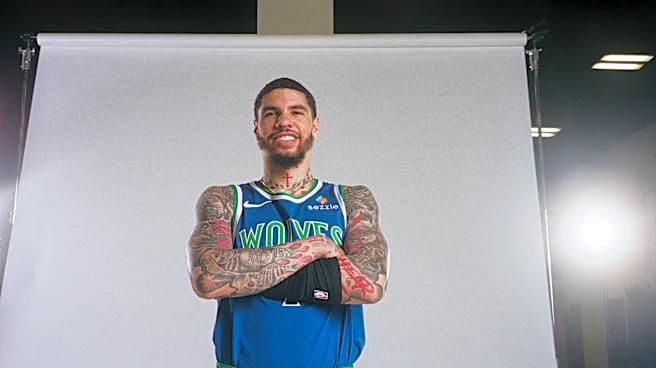




A few years ago, I came on this site to write about Nickeil Alexander-Walker and how he was worth believing in for the Minnesota Timberwolves. That piece eventually got back to Nickeil and he thanked a Canis staffer at his introductory press conference, saying it meant the world to him.
Now I am decidedly not as bullish on today’s topic as I was on NAW a few years ago. However, I tell you what: if I had a nickel for every time the Utah Jazz dumped a young player in Minnesota only for them to revive
their career and become a fiercely important and valuable member of the Wolves, all while wearing number nine, well, I guess I’m saying there’s no reason I can’t have two Nickeils (Canis is back, baby!).
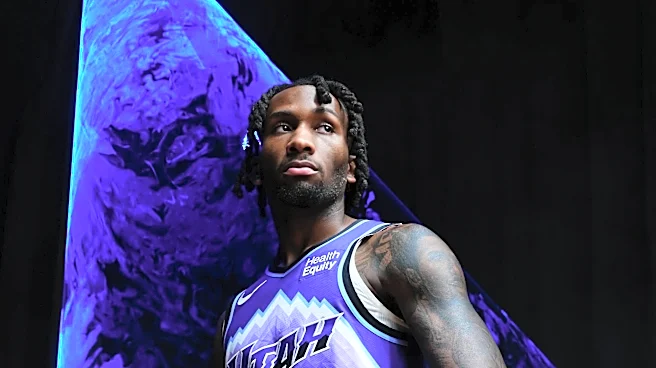
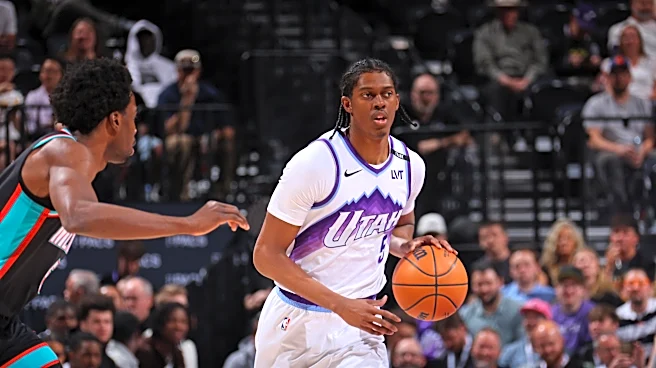
While the appeal for Nickeil was as much an emotional and aesthetic one as it was an on-court one, the argument for Cody Williams is built entirely on who he was as a prospect and what he needs within a team structure. Remember, this is a former top-10 pick who has been branded among the worst players in the league just two years into his career. The expectations are really low.
Williams came into the league with an outlier body type in every regard. Despite being 6’8 with a 7’1 wingspan, Williams weighed only 180 pounds. Ironically, his weight-to-size ratio only really compares to one player: former Timberwolves lottery pick and 2024 draft classmate Rob Dillingham.
Even Brandon Ingram, a common comparison for Cody, was reported at 198 pounds, over 15 pounds heavier than Williams.
Effective athleticism alongside usable mass is king in the NBA. That’s exactly why Dillingham was bound to fail. As Williams’ first year dragged on, this lacking of a frame became abundantly clear. While Williams had been drafted to be a big wing with some point forward skills, his handle was not good enough to be a factor on offense, and his body prevented all of his biggest strengths on defense. As such, he was branded, as Dane Moore mentioned, the worst player in the NBA.
There’s a statistical argument to defend that take. In fact, it’s pretty easy to make. Williams had an offensive rating of 112.9 and a defensive rating of 124.4 in 2025-26, making the tanking, dreadful Jazz lose the minutes he was in the game by 11.5 points per 100 possessions.
By comparison, Josh Green, whom the Wolves traded to acquire Williams, had a net rating of +8.3 last year.
This numerical glance was never the argument with Cody, though. It rarely is for second-draft candidates. They’re bad; that’s why they’re available in the first place.
No, the argument for Cody Williams is this. He is a 6’8 wing with a +3-inch wingspan who played as a point forward in college at Colorado (ignore the 1.6 assists per game, that does not tell the full story). During that time in college, he averaged 12 points per game, largely by attacking the rim and running in transition.
Many of the answers to who the Wolves will want Williams to be can be found in his college tape. They will want him to hit his threes. He hit 41.5% from deep on 43 attempts in college. They will want him to be able to attack closeouts. He made 59% of his shots within the arc, coming largely at the rim after attacking rotations. They will want him to defend interchangeably. That was his largest appeal coming into the draft.
Notably, they’ll want him to play off of LaMelo Ball in transition. While this is an admittedly imperfect comparison, Williams’ freshman year came next to KJ Simpson, a pace-pushing point guard with far less size and talent than the mercurial Ball.
Williams was stuck on one of the worst teams in the league, being asked to do far more than he probably should have been doing. Maybe more structure on the Wolves will help him in that regard. Importantly, after a freshman year that was marred by injury, Williams has played in 117 of a possible 164 games.
Considering NAW got his shot in Minnesota by nature of being one of the few wings that were healthy by the start of the playoffs – after Jaden McDaniels broke his hand punching the tunnel wall – Cody’s best chance at seeing the floor is availability.
We could very well be sitting here next year with Williams cut, his option declined, and his career functionally over. That’s how it always is with these types of players.
But there’s a tantalizing upside play here. With how weak the Wolves’ forward rotation is (Jaden McDaniels, Jonathan Kuminga, TJ Shannon, Jaylen Clark, and… who’s next? Is Trey Lyles cracking the rotation?), there should be some minutes available to him during the duldrums of the season, when innings eaters are needed.
The ideal version of Williams is similar to a Gen Z Lamar Odom. Cody is reportedly still underweight, sitting at 200-odd pounds, but progress is being made. Odom served as a rebounding pivot point and was at his best moving in transition and finishing opportunities he either scrounged around or had created for him.
There are real reasons for hope as well. After the All-Star break, Williams had impressive averages while doing things that should lend themselves to winning basketball as well.
There is obviously the Josh Jackson effect to consider (when talented top picks break out late in the season, when their teams are incentivized to lose and give their worse players a ton of reps), but some of this stuff looks replicable. He had his bad games, bad enough to be crowned their tank commander, but the aesthetics of what he can do truly pop in moments.
If you want a statistical argument, Williams does not provide it. If you want hope, you can find it pretty easily.
And isn’t that what it means to be a fan? To hope.
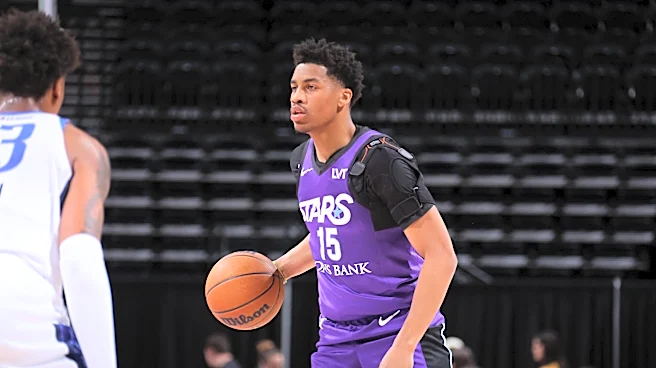
Here’s some bottled hope, all packaged up in the form of a two-minute cut-up. Stay hopeful, Wolves fans. Maybe Cody Williams will be the next NAW. Maybe, just maybe, he could be even more.