
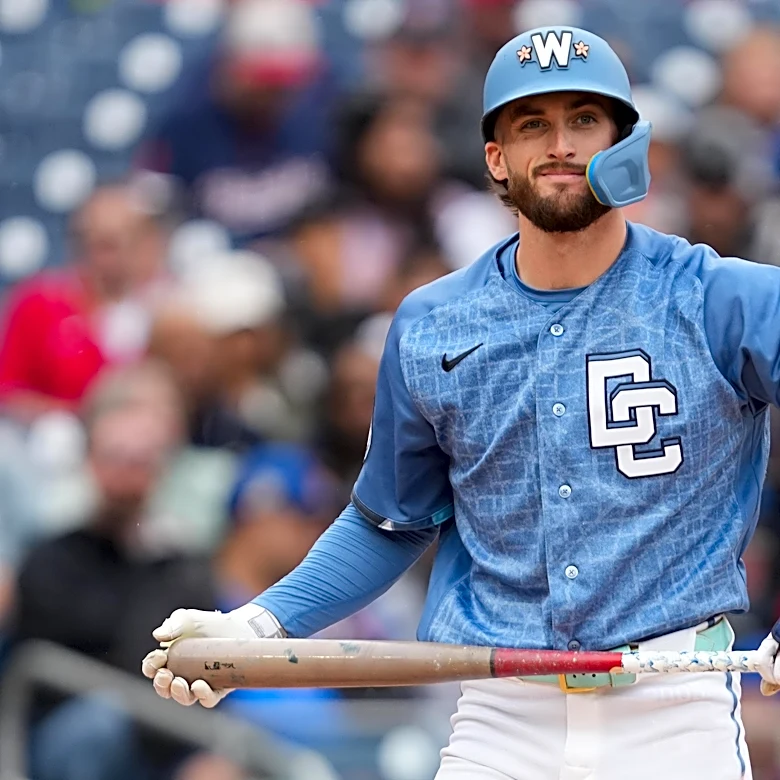

Lane Thomas seemed destined to be a Brave in 2026: he was playing for a non-contender on a reasonable, expiring contract, and offered a specific, not-too-complicated skillset that the team could use on a matchup-by-matchup basis (or not). So, it wasn’t surprising when the Braves went ahead and acquired him at the Trade Deadline. Unfortunately, an injury meant that Thomas didn’t really bring anything to his new team.
How Acquired
A well-traveled veteran who was drafted in 2014 and made his debut in 2019, Thomas
signed a one-year worth $5.25 million with modest playing time bonuses with the Royals in the 2025-2026 offseason.
The Royals quickly drifted out of playoff contention (playoff odds below 10 percent starting in late May and sliding to zero by mid-July), which made Thomas and his middling performance an obvious trade candidate. The Braves sent minor league arms Lucas Braun and Carter Holton to Kansas City in exchange for the services of Thomas and Bailey Falter.
What were the expectations?
Thomas has had a very journeyman-esque career, playing for three clubs before the 2026 season, and putting up a combined 1.7 fWAR-per-600 PAs in parts of seven seasons. He was a full-timer in 2022-2024, which included a career-best 2.9 fWAR in 2023, but was an aging platoon-ish bat coming off an injured and pretty awful 2025 (-0.5 fWAR).
Thomas’ career has basically had one strong point: he mashes lefties. He’s been serviceable in the outfield, but it generally hasn’t been a strength of his. He’s been there to do one thing, even though teams have attempted to make him a full-timer and play him in center, largely to their detriment. That’s pretty much what he was doing with the Royals at the time of the trade:
- 2026 with Royals, against LHP: .355 wOBA (125 wRC+), .349 xwOBA
- 2026 with Royals, against RHP: .296 wOBA (84 wRC+), .297 xwOBA
His overall value in Kansas City was a little suppressed (0.8 fWAR in 328 PAs) because he both hit against a bunch of righties (about 59 percent of the time) and because the Royals chose to play him in center for some reason (-4 OAA-based runs there, and +1 in a corner outfield spot). The Braves likely figured that Thomas not in center field, playing largely against lefties, would be a pretty nice guy to have. So, the expectation was probably “a really solid short side platoon guy,” which is a great thing to acquire for two very fringy prospect arms.
2026 Results
Though the process of getting Thomas into Atlanta was sound-if-obvious, the results went awry for a number of reasons. The biggest one: Thomas went down with an intercostal strain just about a month into his Atlanta tenure, and didn’t return until the NLDS. That basically halved what the Braves acquired him for, i.e., September and as many playoff series as possible.
Because of the injury, Thomas got just 46 regular season PAs as a Brave, and another seven in the NLDS. Neither tenure was any good: Thomas put up a .261 wOBA and xwOBA (61 wRC+) and -0.1 fWAR in the regular season, and went 1-for-7 with four strikeouts and no walks in the playoffs (.127 wOBA, .129 xwOBA).
Overall, he finished the season at 0.7 fWAR in 374 PAs, which was a huge improvement over his miserable 2025 (-0.5 fWAR in 142 PAs), but otherwise a pretty disappointing year in which he did his main party trick (mash lefties) and not much else.
What went right?
Well, he did the thing he was acquired to do. 30 of his 46 PAs with the Braves in the regular season came against southpaws, and he put together a .353 wOBA (123 wRC+). Mission accomplished, sorta.
Thomas got healthy enough to play against the Dodgers in the NLDS, which was kind of a win considering how much time he missed.
In sort of fitting fashion for a guys whose Braves tenure was kind of lame for reasons not entirely within his control, Thomas’ best game as a Brave was one they ultimately lost. On August 19, he pinch hit for Dominic Smith while the Braves down 4-1 in the sixth, representing the tying run against the Minnesota relief corps. Thomas singled, the Braves’ third straight hit. After a sacrifice fly and a single, the Braves were down 4-3… and Tommy Nance balked with Thomas on third base to push the tying run across. Unfortunately for the Braves, Dylan Lee and the defense gave up two runs in the seventh, and the Braves ended up losing 6-4, with Thomas striking out against a right-hander in his next plate appearance.
What went wrong?
The injury was the big thing, but, though 46 PAs isn’t much, we can also add a few other things. While Thomas maintained his lefty-mashing outputs with his new team, his inputs against lefties included a much more modest, .319 xwOBA. That’s not lefty-mashing. On top of that, he completely fell apart against right-handers in 16 PAs: .087 wOBA (-55 wRC+), .154 xwOBA. Yeah, it was just 16 PAs, but when 16 PAs in a split are a third of your total, that really drags down the batting line. Thomas also didn’t do much defensively, which is how he ended up with -0.1 fWAR as a Brave despite the decent outputs against lefties.
Some of this came to roost in the playoffs, where Thomas actually had more PAs against righties (four) than lefties (three), despite coming off injury. He didn’t do anything there, either, and in fact, his sole safety in the 2026 postseason came against a righty.
Thomas’ worst appearance as a Brave came in a 2-1 win against the Rockies in August. The Braves weren’t generating any offense against a tattered pitching staff, and Thomas, who came into the game in the fifth, didn’t help. He grounded out against a lefty in his first plate appearance, then struck out against a righty with two in scoring position, two out, and the tying and go-ahead runs in scoring position in the seventh… by taking five pitches in a row. Yeesh. Fortunately for him, Mauricio Dubon doubled home both of Atlanta’s runs in the game in the next inning, so it wasn’t that brutal, but a five-pitch strikeout taking all the way in a key spot is brutal.
2027 Outlook
Thomas’ recent seasons have had twists and turns. In 2024, he was a below-average regular whose bat was propped up by mashing lefties. In 2025, he had a lost season, missing most of it and playing horribly while on the field. 2026 was kind of a mix: he was 2024-esque with the Royals, but then injuries struck after the trade, and his performance wasn’t up to par with his new team.
Put that together, and you have a guy who looks like a straight-up bench player. Steamer’s early release has him around 0.5 WAR in a half-season, and I find it hard to argue with that on any side. His ability to hit lefties, unless it somehow evaporated in the late summer of 2026, makes him worth rostering, but he may not even be a preferred choice for the short side of a platoon at this point because he doesn’t offer much in the way of defense, or ability to hold his own against right-handed pitching.
The Braves have done worse in terms of their bench. (Dominic Smith wasn’t hitting anyone for months.) Maybe they’ll re-add him for a limited role. Or, maybe he’ll seek a larger role (and perhaps more compensation). Still, he played for $5.5 million last season coming off a terrible year, so I don’t expect more than $4.5 million or so to retain his services for 2027.