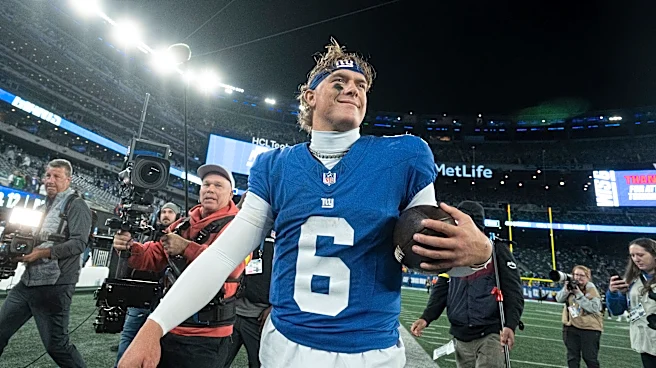


I don’t know about you, but I felt that the New York Giants were a considerably better team in 2025 than the team that went 3-14 in 2024, and in fact better than any Giants team of the past three years. The scoreboard in one sense bears that out. The Giants’ point differential in 2025 was -58…not what you want, but considerably better than the -141 of 2023 and -142 of 2024. Yet they only won one more game than the 2024 team and 2 fewer than the 2023 team. You are what your record says you are, I think
someone once said.
The knee jerk reaction is to blame the late fourth quarter collapses by the defense for the Giants’ 4-13 record, and certainly those were a big part of the problem. Looking at the games as a whole, though, we can see some things that the team needs to improve upon if 2026 is going to be the start of something good. Moving the ball and making it hard for the opponent to do so is certainly Job 1, but in the end it comes down to scoring and allowing points, which are not quite the same thing.
To look at this, below I show plots of the yards gained vs. points scored by every NFL team in 2025, and also the yards vs. points allowed by each team:

I’ve included the linear fit line to the two datasets, as a representation of what the “average” (whatever that means) NFL team could expect to score and give up based on the yards they had gained and surrendered over the season. An offense to the right of the best fit line on the left hand plot is efficient (scoring more than expected given the yards they gained), and one to the left of the line is inefficient (scoring less than expected). The same is true for the right hand plot except that a defense to the left is efficient (giving up fewer points than expected), etc. I’ve labeled a few teams of interest either because they made it at least as far as the conference championship game, or because they were outliers, or because they were the Giants.
Consider the Los Angeles Rams. Their scoring was pretty close to that expected given the league-leading yards they gained, i.e., they just said “eff that efficiency, we’re just going to score almost every time we have the ball.” The defense was mediocre but pretty good too when it counted – teams were able to move the ball on them, but they managed keep opponents out of the end zone often enough that they gave up about 40 points less than they should have. Super Bowl champion Seattle couldn’t match the Rams’ offensive output, but they were very efficient, scoring about 40 more points than they should have given the yards they gained. That’s half of how you win a Super Bowl. The other half is that the Seahawks were absolutely stifling on defense, giving up the fewest points in the NFL and right in line with the yards they gave up.
Over in the AFC, the Patriots were very similar to the Rams on offense, scoring as much as you’d expect given the yards they gained, and on defense they were equally on target and almost as good as the Seahawks. Denver gained fewer yards on offense but also scored at the expected rate, while on defense they weren’t as efficient as New England but still very effective.
Giants: Offense
That brings us to the Giants (all numbers to follow are from Pro Football Reference). On offense (middle point in the cluster of three above) they were middle of the pack but 20-30 points shy of what the league average would predict given the number of yards they gained (FYI, they were No. 17 in points scored while being No. 13 in yards gained). Some of that can be attributed to their kicking problems. The Giants led the NFL with 5 missed extra points, for an 87.8% XP success rate. (Eight teams did not miss an extra point all season.) Their field goal percentage of 88.5% was 11th in the NFL, but they only attempted 26 FGs, second lowest in the NFL.
Their offensive problems went beyond that, though. Their 38.8% of drives ending in a score were 13th worst in the league. It wasn’t due to their rushing game. The Giants finished fifth in rushing yards and tied for fourth in rushing TDs. However, they were only 21st in passing yards and 24th in passing TDs while being 20th in pass attempts…and this with two quarterbacks who played well and a third who at least had one monster game.
Looking at the graph at the top of this post, the Jacksonville Jaguars had only 66 more yards of offense than the Giants, but they scored 93 more points. The Jaguars also scored 8 more TDs. According to PFR’s advanced stats, Giants receivers’ drop rate was only 3.6%, one of the better rates in the league, their ADOT of 8.1 yards was fifth best, and their YAC were tied for ninth. They just didn’t get into the end zone often enough.
Giants: Defense
On defense, the Giants were one of the worst teams in the league in both yards and points surrendered…but amazingly they were a bit more efficient than the league trend would predict given the yardage they yielded. That jibes with the fact that despite 13 losses, they were only blown out twice, in Philadelphia and New England. Their MetLife co-tenant, the Jets, gave up almost as many yards but 64 more points. So many of the Giants’ losses were fourth quarter collapses that turned victories into defeats.
The Giants’ 8.3% turnover rate was ninth worst in the NFL. Their 43.3% of drives ending in an opponent score was tied for seventh worst. Their 145.3 rushing yards yielded per game was second worst in the NFL, to no one’s surprise. Their 5.3 yards per rushing attempt was the league’s worst. Their 21 rushing TDs yielded was tied for fourth worst.
The pass defense was not as bad, The Giants gave up 3642 passing yards, 16th in the NFL. Their 65.1% completion rate against was 18th. Their 24 passing TDs given up was tied with the Super Bowl Patriots and three other teams for 14th. Unfortunately their 1.6% interception rate was seventh worst.
For a team whose pass rush was supposed to be ferocious, the Giants’ 39 sacks were only tied for 15th in the league, and their 96 QB hits were 16th.
The bottom line
For 2026, the Giants’ offense doesn’t need to get a lot better than what we saw in 2025. The 2025 team moved the ball well enough, it just didn’t score as much as it needed to. The kicking game can’t be worse than it’s been the past couple of years. A better running game would help, especially down near the goal line where the Giants had trouble getting that final yard and too often had to settle for field goals. The passing game doesn’t need to be dramatically better than it was last year, but with the loss of Wan’Dale Robinson and Malik Nabers coming off a second surgery a couple of the Giants’ new receivers are going to need to step up.
The defense is really the big question. With the addition of D.J. Reader and Shelby Harris, plus Tremaine Edmunds and Arvell Reese at the second level, the run defense just has to be dramatically improved. (Doesn’t it? Right?) The pass rush may no longer come from the inside as often, but overall it has to start getting home more often. The big question is the secondary, but if even two of Colton Hood, Greg Newsome, Ar’Darius Washington, and Jason Pinnock can play well, it will make a significant difference. With the Cowboys and Rams (the two highest offensive yardage teams last year) up in the season’s first two weeks, the answer won’t be long in coming.