





The Phoenix Suns have numerous decisions ahead of them this upcoming offseason, including multiple restricted free agents, unrestricted free agents, and players with trade value. The following series will examine those decisions as our writing team presents both a point and a counterpoint for each.
When you’re having these holistic conversations about which players should be retained and which players could potentially be moved, it’s hard not to inject a little emotion and bias into the equation.
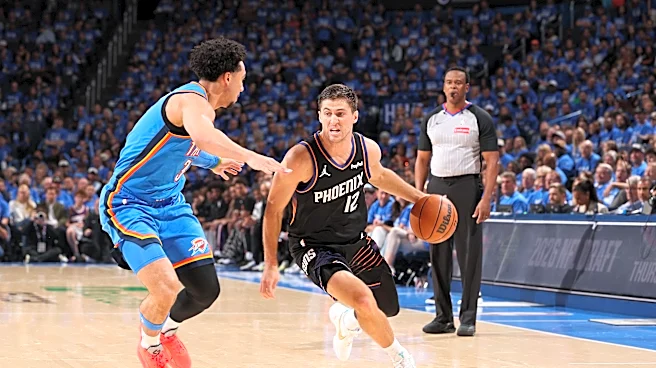
In the case of Royce O’Neale, the third-longest tenured member of the Phoenix Suns, he’s honestly a player I like having on this roster. What he brings, especially in terms of consistency, has real value. It’s one of those things you don’t fully appreciate until it’s gone. Think back only eight years ago, when the Suns ranked 30th in the NBA in three-point shooting. You would’ve killed for an O’Neale-type player on that roster.
So if next season starts and Royce is still on the team, I’m completely fine with it.
In the spirit of the thought exercise though, there are absolutely reasons why he could become a trade candidate, and it starts with the simple reality that he possesses one of the more tradable contracts on the roster paired with skill sets that fit almost anywhere.
Three-point shooting carries massive value in today’s NBA. Every team needs it, and the teams that already have it are constantly searching for more. So when Royce O’Neale shoots 40.8% from three in a season and owns a career 38.9% mark from deep, that’s naturally going to attract attention from teams around the league looking to improve in that area.
Then you factor in the contract. O’Neale is scheduled to make $10.9 million next season, which makes him even more attractive as a trade target. Plenty of teams will look at that combination of shooting, versatility, and contract value and see someone worth pursuing.
Of course, simply because other teams want what you have doesn’t mean you need to hand it over. For the Phoenix Suns, though, the primary reason I could see them moving O’Neale wouldn’t necessarily be basketball-related. It would be financial. More specifically, avoiding repeater tax territory.
This is an organization that appears interested in bringing back Collin Gillespie and Jordan Goodwin, and rightfully so. If the number makes sense, probably Mark Williams as well. The challenge is that retaining all three would put Phoenix in a very uncomfortable luxury tax situation. At that point, shedding salary where you can starts becoming part of the equation, and O’Neale’s contract becomes one of the more logical avenues to explore.
Let’s go ahead and do some math here.
The current luxury tax for the 2026-27 season is projected at $209 million. Before signing anyone, the Suns sit at $185.5 million (thank you very much, $23.2 million dead cap). Let’s say they bring back Collin Gillespie at $11 million next season and Jordan Goodwin at $5.5 million. That adds $16.5 million, pushing Phoenix to $202 million, barely above the first apron line at $201 million. Then comes the Mark Williams question. If his health hurts his value on the open market and the Suns bring him back on the $9.6 million qualifying offer, now you’re at $211.6 million. That puts Phoenix over the luxury tax with one open roster spot still left to fill.
So how do you shed salary? How do you get under the luxury tax and avoid repeater tax penalties? The path is pretty simple. You trade Royce O’Neale, and you do it with a team where you can take back a contract worth roughly half of his.
Need an example? How about the Portland Trail Blazers, a team that finished dead last in bench three-point shooting last season at 32%. A deal where Phoenix sends O’Neale to Portland for Kris Murray and a second-round pick would save the Suns $5.6 million in payroll.

That drops Phoenix to $206 million, $3 million under the tax with one roster spot to fill. That means they can sign one more player to a veteran minimum deal, provided the player has 5 years of experience or less. It gets them under the tax and opens up a little flexibility.
And yes, I know it’s not about where you start the season relative to the luxury tax. It’s about where you finish. Still, that’s a tightrope the Suns walked this past season very carefully, and they may have to do it again if staying under the tax is part of the plan.
Of course, you could always make the same argument, and instead of Royce’s name, you insert Grayson Allen’s. My response to that is Allen is much more servicable in the rotation than Royce. Allen spent 84% of his time playing a guard position, so he fits in nicely as the backup two. Royce? Only 7% of his time was spent ot the shooting guard position, and he primarily played as a wing. Unfortunately, O’Neale starts to look like the odd man out in the rotation.
Let’s say the Suns are running a 10-man rotation, and let’s say they do it in the way I think they should:
- PG: Booker, Gillespie
- SG: Green, Allen
- SF: Brooks, Goodwin
- PF: Fleming, Oso
- C: Williams, Maluach
There simply aren’t enough consistent minutes in that group for O’Neale. Sure, he becomes useful when injuries occur, and we know they will. You still don’t build your roster around injuries, and you probably shouldn’t have a $10.9 million player sitting outside the regular rotation. Moving off him gives you cleaner rotations, more defined roles, and a better opportunity for the youth movement to actually take hold.
These are the decisions facing the Phoenix Suns.
If the organization values Mark Williams more than Royce O’Neale, then O’Neale is probably the player you move in order to create luxury tax flexibility. If O’Neale is viewed as the more important piece, then Williams is likely the one who doesn’t return.
There is, of course, another scenario where the Suns simply don’t care about the luxury tax or the penalties attached to it and bring both players back regardless. There’s also the possibility that Phoenix understands the real goal is to be under the tax by the end of the season, not necessarily at the beginning. In that case, you could absolutely see them bring back both Williams and O’Neale with the intention of moving salary later in the year once the market shifts and opportunities present themselves.
But if you are looking for reasoning as to why the Suns could and perhaps should move off of Royce O’Neale, now you have a more complete picture as to what, why, and how.