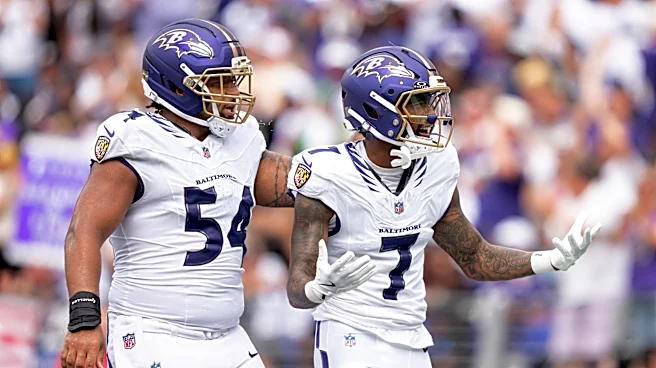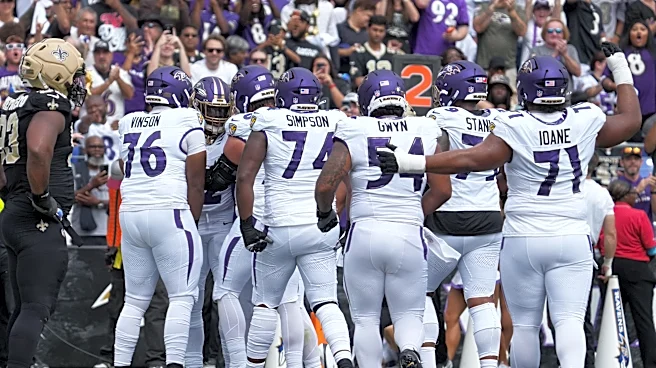




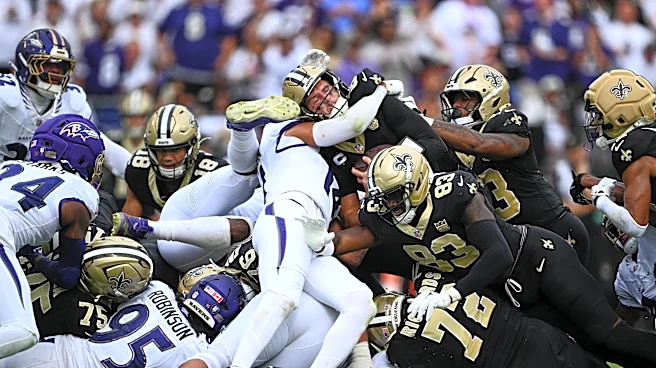
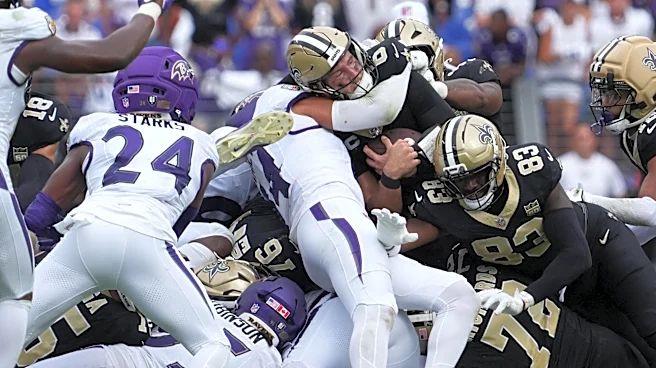
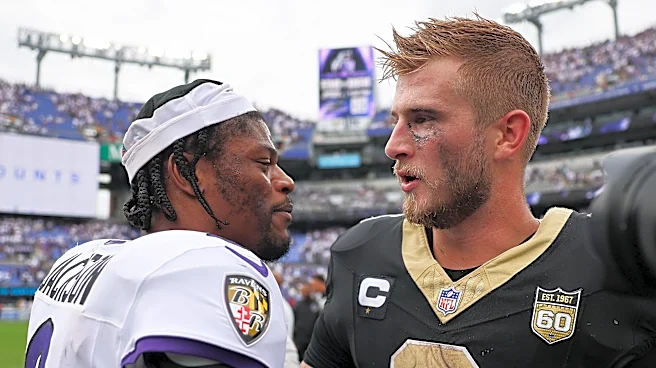
The Ravens’ Week 2 matchup against the New Orleans Saints may not have produced the home-opening result Baltimore wanted, but there were still several encouraging individual performances in the team’s first loss of the season.
Right tackle Roger Rosengarten continued to show signs of a Year 3 leap, displaying the technical refinement and improved play strength that could make him a stabilizing presence along Baltimore’s offensive line. Linebacker Trenton Simpson showcased the athleticism and physicality
required of a modern NFL linebacker, particularly when playing in space and attacking screen concepts. And with Zay Flowers sidelined, wide receiver Rashod Bateman stepped into the No. 1 receiving role and became Baltimore’s primary source of explosive plays through the air. Here’s what stood out from that trio in Week 2:
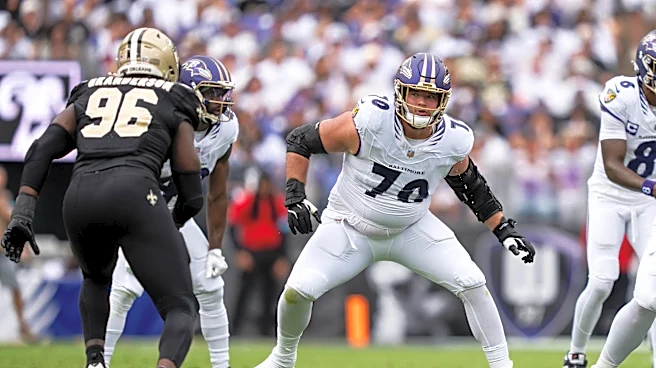
RT Roger Rosengarten
58 snaps | 40 pass blocking | 18 run blocking | 0 pressures allowed | 78.2 true pass set grade
Rosengarten has been excellent to start his 2026 campaign at right tackle with zero pressures allowed through two games and 73 pass-blocking reps.
The biggest development has been his growth as both a technician and a run blocker. Rosengarten’s initial strike carries noticeably more strength and conviction than it did earlier in his career. His hand placement has become more deliberate, and he is doing a better job controlling defenders once contact is established. That improvement has carried over into pass protection, where Rosengarten consistently gave Jackson enough time to operate.
There were several reps where Rosengarten either won his pass set outright or, just as importantly, ‘lost slowly.’ Even when a defender gained an initial advantage, Rosengarten remained attached and forced the rusher to take a longer path to the quarterback, buying Jackson the additional fraction of a second needed to get the ball out.
One particularly interesting addition to his pass-protection toolbox has been the snatch-and-trap technique. Rosengarten used the rusher’s forward momentum against him, pulling the defender downward before finishing on top of him. Adding counters like this is an encouraging sign of the technical development taking place entering his third season.
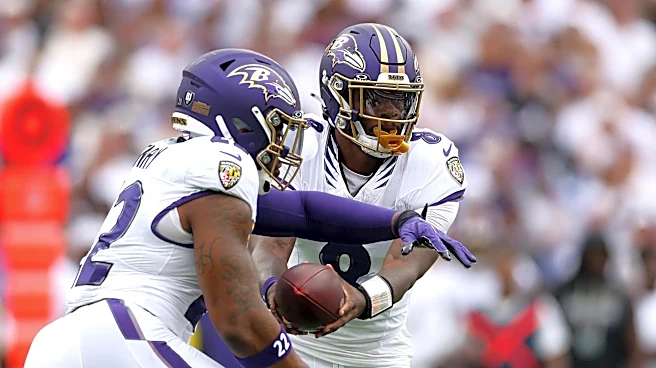
His movement ability was equally noticeable in the running game. On one rep, Rosengarten climbed roughly seven yards beyond the line of scrimmage, located the linebacker at the second level, and sealed him away from the running lane for Derrick Henry. On another, he was able to engage a defensive lineman, flip his hips, and establish positioning to create another lane.
Rosengarten’s development could have implications beyond right tackle. If Baltimore can consistently trust him to handle one-on-one assignments without additional protection, the Ravens can allocate chips, slides, and other forms of protection help toward weaker areas of the offensive line.
That makes Rosengarten’s Year 3 leap potentially pivotal to the offensive line’s ability to improve as a unit. Through two games, the combination of improved play strength, movement ability, and a growing pass-protection toolbox has made him one of Baltimore’s most encouraging early-season developments.
LB Trenton Simpson
42 snaps | 21 run defense | 8 pass rush | 13 coverage | 2 pressures | 5 tackles | 10 yards allowed on 3 receptions
Simpson’s performance against New Orleans offered another glimpse at the type of modern NFL linebacker his athletic profile could allow him to become.
What stood out most was his ability to operate in space without sacrificing physicality at the point of attack. On a screen thrown to his side, Simpson worked through a block in space, stayed square to the ball carrier, and secured the tackle for a minimal gain. It was a good example of his athleticism translating into functional pursuit ability rather than simply testing numbers.
His physical development also showed up against the run. On another rep, Simpson met an offensive guard at the point of attack, absorbed the contact, disengaged, and finished the play in the backfield. That ability to take on offensive linemen and work through contact has been an important part of his development.
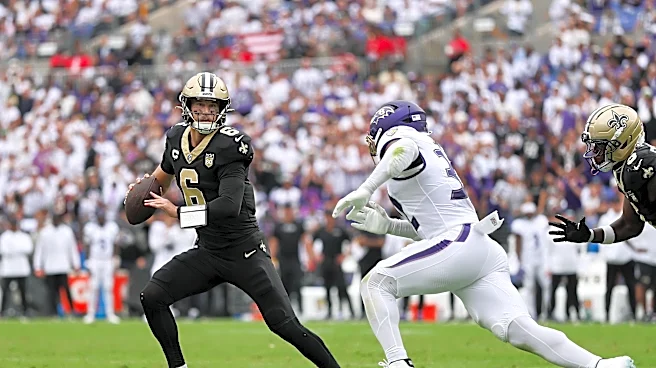
Simpson also made his presence felt as a blitzer. On one pressure, he crashed downhill before recognizing the quarterback preparing to throw. Simpson used his high-end athleticism to time his jump and take away the throwing lane, forcing the quarterback to pull the ball down and ultimately contributing to a sack.
The athleticism has always been there with Simpson. The encouraging development is how much more controlled and functional that athleticism looks within the structure of the defense. His ability to process, play through contact, and impact passing concepts in space will be worth tracking as the season progresses.
WR Rashod Bateman
9 targets | 7 receptions | 88 yards | 1 touchdown | 2.44 yards per route run
With Flowers unavailable, Baltimore needed someone to assume a larger role in the passing game. Bateman answered that challenge with seven receptions for 88 yards and a touchdown while accounting for several of Baltimore’s most explosive plays through the air.
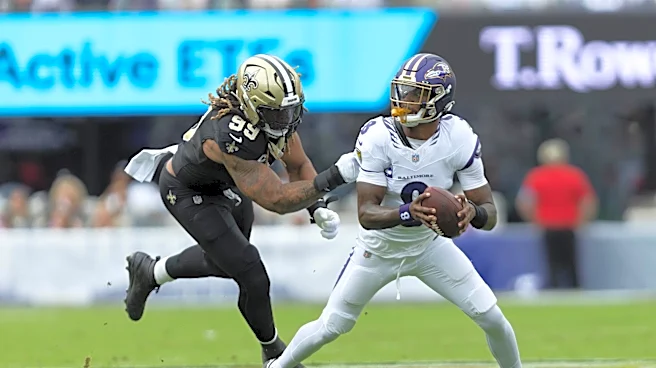
One of my criticisms of Bateman in the past has been his ability to consistently get ‘friendly’ to the quarterback. There have been instances where he could have shortened routes against zone coverage, settled into open grass, and gotten his head around earlier to give Lamar Jackson an easier throwing window.
That wasn’t an issue Sunday. On several reps, Bateman recognized the soft spots in New Orleans’ zone coverage, adjusted his route accordingly, and presented himself to Jackson. Rather than simply running the route as drawn, he showed a better understanding of how to manipulate space and make himself available to his quarterback.
His route-running ability also showed up against tighter coverage. On two separate plays, Bateman snapped off his route at the breakpoint, combining quick feet with head fakes to manipulate the defender and create separation. Those are the subtle details that have always made Bateman an intriguing route runner when healthy and involved.
The biggest question coming out of this performance is what Bateman’s role looks like once Flowers returns. Flowers remains a major part of Baltimore’s passing attack, but Bateman showed against New Orleans that he can handle additional volume. Rather than simply functioning as a complementary option, this performance strengthened the case for keeping him consistently involved even when the receiving corps returns to full strength.
Advanced metrics via Pro Football Focus.