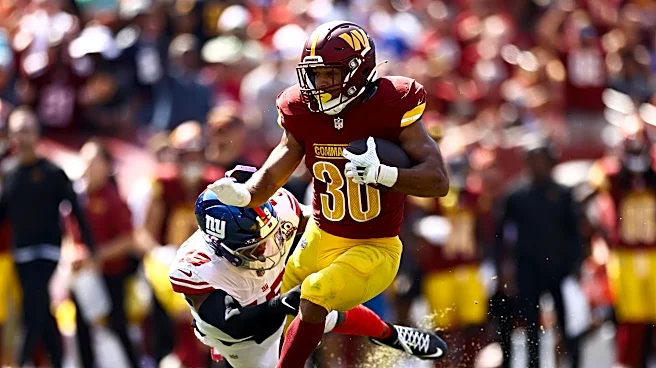


The New York Giants have a quick turnaround and little time to get ready to face the Washington Commanders on Thursday Night Football.
The Giants are currently 5-2-1 and leading the NFC East, while the Commanders come into the game with a 2-5-1 and in third place in the division. We should expect another tough game, and not just because the Giants can’t seem to do anything easy.
The last time these two teams met, Jameis Winston was the Giants’ quarterback and the game ended in a tie. The Giants’ offense
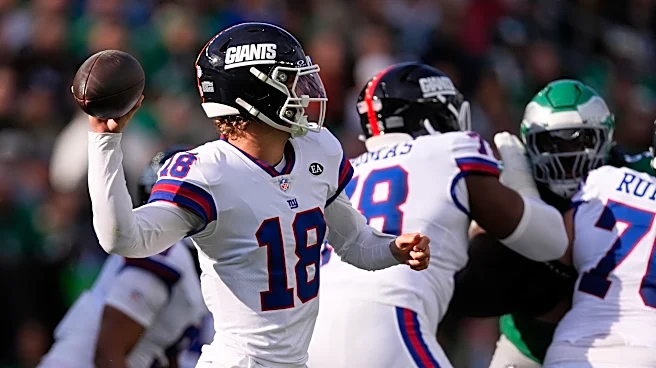
was in control of that game until an untimely fumble by Cam Skattebo. This time, the Giants have J.J. McCarthy as their starting quarterback, adding a much-needed element of athleticism and big-play ability to the Giants’ offense.
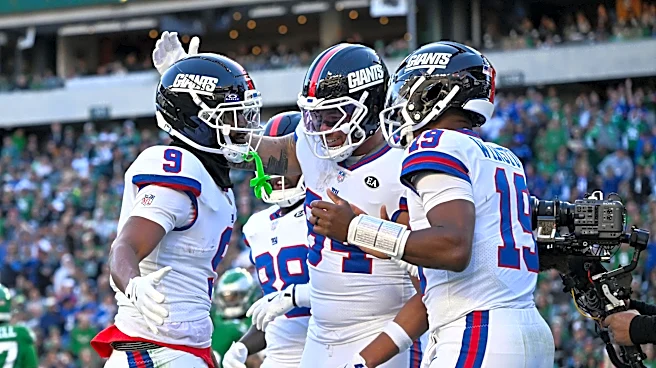
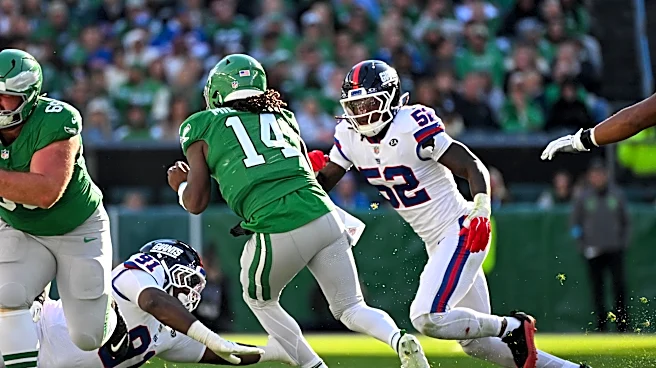
The Giants are coming off of a tough (and sloppy) win over the Philadelphia Eagles, while the Commanders had a tough loss to the Los Angeles Rams. Both teams will be out to prove that the tie was a fluke, but can the Giants get their offense back on track after a rough showing against the Eagles’ defense?
Stats that matter

J.J. McCarthy’s health
Giants’ head coach John Harbaugh announced on Monday that McCarthy suffered a hip pointer in the Giants’ win over the Eagles on Sunday. He also said that he expects McCarthy to play through the injury, though it’s a painful one.
From the University of Pittsburgh Medical Center:
A hip pointer is a bruised hip. More specifically, it’s a bruise near the top curve of your hip bone.
You get a hip pointer from falling onto your hip or having a direct hit to your hip. Though a hip pointer can be painful, with rest you can make a complete recovery.
A hip pointer usually does not need interventions like surgery. However, an athlete who gets a hip pointer needs to take a break while it heals. And, depending on how severe the hip pointer is, physical therapy might be beneficial.
Hip pointers are deep bruises, and the big question with regards to McCarthy isn’t so much a risk of another injury or making it worse so much as how much the bruise will impact his play. It’s possible that swelling from the injury could impact his gait or mobility, which could in turn impact his mechanics, accuracy, and ability to deliver the ball. Likewise, we don’t know whether McCarthy will be as effective a runner (or scrambler) with the injury.
We should expect that the training staff is doing everything reasonable to manage the swelling and pain, but it’s a factor the Giants will need to consider. We could see the Giants try to lean further into their running game with Cam Skattebo back (also confirmed by John Harbaugh), as well as the quick passing game to try and limit the stress on McCarthy’s body.
About the offensive line
The health of the Giants’ starting quarterback is the most important piece of the puzzle, there’s no argument about that. However, we simply can’t ignore how poorly the Giants’ offensive line played against the Eagles. The offensive line, and the interior offensive line in particular, was simply bad for long stretches where the Giants’ blocking was neigh-nonexistent.
The Giants surrendered 6 sacks on the afternoon and both McCarthy and Winston often had to throw under pressure. The run blocking was, if anything, even worse.

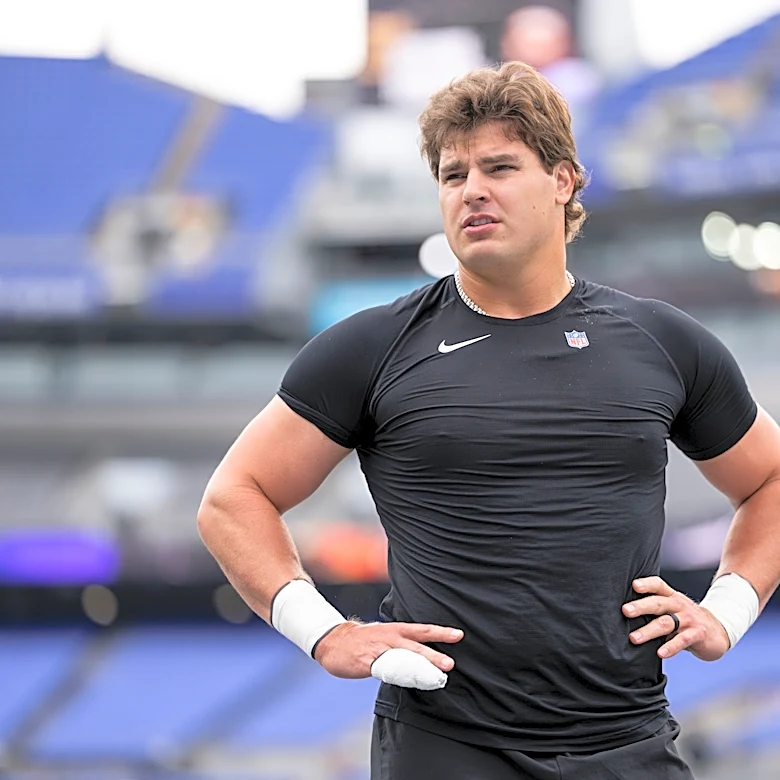
While left guard Jon Runyan Jr. was the biggest offender, there wasn’t any one player who was the sole reason for the unit’s poor performance. In fact, it’s more useful to view an offensive line as a unit than as five players to be assessed individually.
Likewise, there were a myriad of issues that cropped up on tape, but they were shared by all five linemen and not just one player’s problems.
At times linemen would let their hands drop low, giving up inside leverage, allowing Eagles’ defenders to control them. Other times, their punches would be late or wide with their hands landing outside defenders’ framework and denying the blocker the opportunity to win inside leverage. There were other occasions where the Giants’ blockers would drop their heads and lunge into contact, or conversely play too upright. In either case, they were either beaten quickly or put on skates and driven into the backfield.
We do also need to acknowledge that the Eagles boast one of the best defensive fronts in the NFL. It’s possible that the Giants were pressing in the face of a talented opponent, but rather than raising their game they were allowing their technique to slip.
That’s unacceptable coming out of a bye week.
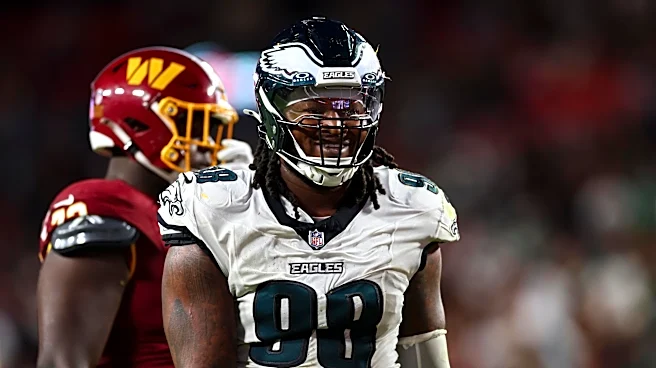
That said, there might be a couple silver linings for Week 10. First and foremost, the Commanders’ defensive front isn’t nearly as formidable as the Eagles, and they’ve been struggling with injury. Daron Payne and Jevon Kinlaw are both on the injured reserve, and Johnny Newton will be playing in his second game back from pec surgery.
The Giants might be more likely to play within themselves against a front they’ve matched up against before.
Second, the short week might work in the Giants’ favor as well. One of the most important parts of succeeding on Thursday Night is to do the basics well. There simply isn’t time to focus on wrinkles or complex strategy and simply executing the foundation of your scheme can be the difference. That focus on execution and technique is what the Giants’ line needs most.
It’s possible we could see the Giants’ offensive line rebound in Week 10 simply because there isn’t time to overthink things. And in that, the good news is that while there were far too many bad blocks and breakdowns, there were also some very good blocks against the Eagles. The Giants’ line can play at a high level, they just need to consistently execute their fundamentals.
Easier said than done, but still doable.
Dealing with speed at the second level
The Giants had a tough time against the Commanders’ defensive front in the first match-up between these two teams. However, that front will look a bit different this time around, with defensive tackles Kinlaw and Payne out, and Newton back in.
Newton only played 20 snaps against the Los Angeles Rams, but did get three tackles in that limited action and is coming off of a five-sack season. He can’t be ignored, but the bigger threat is likely at the second level for the Commanders. Their Vikings-inspired defense frequently lines up in five-man fronts to gap out opponents’ run games, allowing linebackers Frankie Luvu and Sonny Styles to flow to the ball, drop into coverage, or blitz.
It’s effective when it works, however there are a couple potential areas that the Giants can exploit.
First and foremost, if (and that’s a loadbearing if) the Giants’ blockers will need play with more consistently good technique. If they’re able to do so, there are opportunities to use alignment and misdirection to turn Styles’ and Luvu’s speed against them. Cam Skattebo will never be able to outrun either, but their speed can be used to pull them out of position, forcing bad angles and the kinds of tackle attempts that Skattebo routinely pinballs off of.
Greg Roman loves using man-gap blocking in his run schemes, but also using pulling blockers to change the math on the play-side. He also uses secondary blockers like FB Patrick Ricard, TE Isaiah Likely, TE Chris Manhertz, and even WR Malachi Fields to add to the box count on the Giants’ side of the equation. That all is well known, which also creates the opportunity to use pullers as misdirection pieces, using a move blocker to pull a linebacker out of position and get them to flow away from the play.
The Los Angeles Rams did something a bit different that could be instructive for the Giants. Rather than spreading the Commanders out, they used condensed sets and tight alignments to match up against Washington’s five-man fronts and create additional gaps. That forced Washington to concentrate their defenders tightly, and the Rams were able to use the traffic to slow the linebackers and allow their own blockers to work to the second level.
Where the Giants’ backs only had 74 total yards (21 carries) on the ground against the Commanders in Week 5, the Rams had 103 on 26 total carries. The Rams have a much better run blocking offensive line than the Giants do, but there are still lessons to be learned there.
Likewise, the Giants can also use play-action and mesh points to help slow the Commanders’ defense.
The Giants have one of the lowest play-action rates in the NFL (roughly 20 percent, or 8th lowest), as well as one of the lowest rates of early-down passing (10th lowest). That should make early and neutral down play-action passes particularly effective, as the Giants’ tendencies are to hand the ball off when the quarterback and running back mesh. In other words, the Commanders’ second level players will be forced to come up and respect their gaps, creating a void in the middle of the field that can be exploited by the Giants’ receiving weapons.
Attacking Washington’s secondary
Dan Quinn’s defensive philosophy is well-understood by this point in his coaching career. His scheme has been based on hybrid fronts under coverage shells that are fluid but based in Cover-3 mechanics. He wants his defensive backs playing downhill and able to have eyes in the backfield so they can swarm to the ball or attack it in the air.
There was something of a shift in 2026 with the hiring of Daronte Jones as defensive coordinator. Jone had spent the last several seasons with Brian Flores in Miami and was tapped to bring that fire-breathing defensive scheme to Washington. The Commanders don’t blitz nearly as often as the Vikings (nobody does), but they are blitzing relatively often for a Dan Quinn defense. They also tend to do so out of Cover-4 shells, much like Flores, though they also use those looks to disguise their intentions for post-snap rotations to Quinn’s favored Cover-3 shells.
The two looks have distinct advantages and disadvantages that are well known. The idea is that the pressure from the pass rush will force offenses to check down rather than attack the coverages’ weaknesses. However, if the blocking can hold up, there are yards to be found.
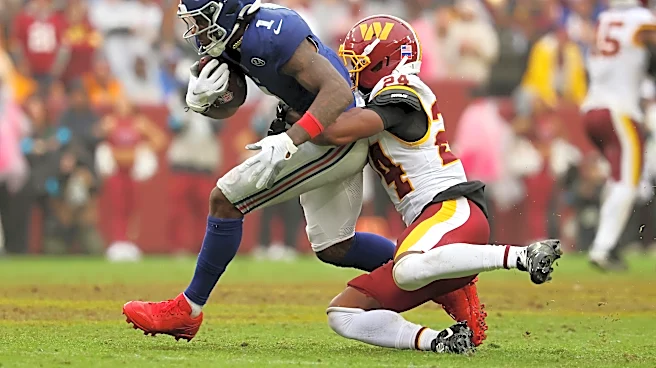
The Los Angeles Rams used Puka Nacua to consistently exploit the voids in the Commanders’ coverages, and the Giants should be going to school on how Sean McVay used his route concepts to quickly work Nacua into the soft spots in Washington’s coverage. Malik Nabers is a similar caliber route runner as Nacua and he had a big day against Washington back in Week 5. The first time around, Nabers hauled in 11 catches (on 20 targets) for 121 yards and a touchdown. Malachi Fields is also turning into a “zone buster” as he continues to improve his route running and rapport with J.J. McCarthy as the weeks go bye. The duo of Fields and Nabers — particularly working Nabers into the slot — should prove potent against Washington’s Cover-4 looks.
Isaiah Likely also had a big day against the Commanders back in Week 5, catching 11 of 13 for 94 yards and two touchdowns. Athletic tight ends are the bane of Cover-3 defenses, and the Giants could have a better feel for Washington’s tendencies by now. There could be big plays to be had for Likely, as well as Jalin Hyatt or Darnell Mooney, streaking down the seams between the outside corners and the deep safety — at least as long as the Giants accurately anticipate the rotations to (or out of) Cover-3.