

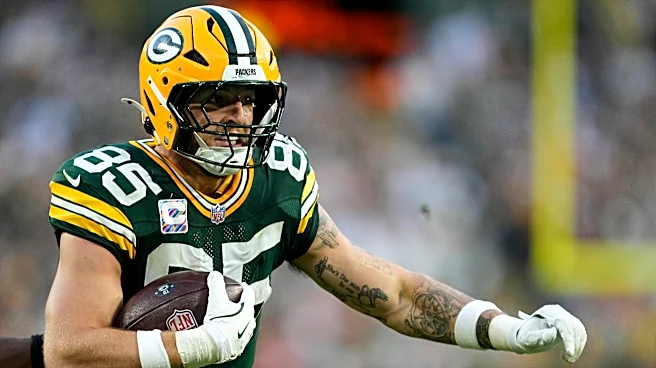


Opportunity cost is a real problem for football teams, especially ones built like the Packers.
In the Jordan Love era, the Packers have never really been short of offensive talent. Sure, it’s often been a challenge to have all of that talent on the field together, but in the aggregate, it’s never been an issue.
But that’s its own kind of problem. The Packers have frequently had so many decent options that they’ve lacked overall coherence; they’ve bordered on having too many cooks in the kitchen.
The
Packers themselves have tacitly admitted this was an issue this offseason, trimming their wide receiver room by allowing Romeo Doubs to leave in free agency and shipping Dontayvion Wicks off via trade. Gone are the days of a fleet of would-be number one wide receivers. Now it’s a more focused, and hopefully more successful group.
But that’s where the opportunity cost arises, at least potentially. Because over the past few years, the Packers have been one of the more run-focused teams in the NFL.
According to rbsdm.com, the Packers have been more reliant on runs in neutral situations than almost any team in the league over the past few years. In those analytically neutral situations (in short, when the game is close and neither team is running or passing more heavily for tactical reasons, like being way behind or far ahead), the Packers have increasingly leaned on the run. In the past three years, they’ve ranked 20th, 32nd, and 22nd in early down, neutral situation pass calls.
As much as the Matt LaFleur offense is supposed to be run-oriented, I still find this odd for a few reasons. First, Jordan Love is good. This is analytically well-supported and well-documented, and running the ball is a huge opportunity cost because it deprives Jordan Love of chances to do the good things he is good at doing.
But second, it seems odd because of how the Packers have built their own team. Dating back to 2022, the Packers have spent tons of resources on pass catchers, burning seven top 100 picks on wide receivers or tight ends (counting the two they spent in the trade up for Christian Watson), in addition to drafting four other receivers in the fourth round or later. Yet they regularly park those players in the metaphorical garage, leaving the offense to grind out gains on the ground rather than attacking through the air. And it’s not because they think these players are bad; they just offered contract extensions to two of them this offseason.
Why do it this way? Only Matt LaFleur knows the answer, but it seems to be because in addition to spending resources on wide receivers, the Packers have also spent fairly lavishly on running backs of late. Well, one back in particular.
The Packers signed Josh Jacobs to a rich free agent contract in the spring of 2024, seemingly just as Aaron Jones was headed out the door. (What a fun few minutes it was when we could picture Jones and Jacobs in the backfield together, but it was not to be). And they seem to have signed Jacobs because he fit two simultaneous visions: Brian Gutekunst’s vision of what a running back should be, and Matt LaFleur’s vision of what he wants his offense to be.
Gutekunst has a type at running back. He inherited Aaron Jones, probably the best non-Ahman Green Packers back of the 21st century (and the comparison might be closer than some would like to admit), but has steadily tried to supplement and even replace Jones with a steady string of near-clones: stubby, explosive backs that are more muscly than wiry who make their living hammering away between the tackles rather than sprinting around them. Jacobs is the ultimate expression of that vision. Though his explosiveness is not what it once was, there is no stubbier hammer in the world of ground-and-pound football today.
Jacobs’ arrival coincided perfectly with an existing shift in the Packers’ offense. Matt LaFleur has been trending away from his wide zone roots for several years and now runs a more power-focused, gap-heavy run scheme than his Shanahan-tree contemporaries in San Francisco or Los Angeles. Whether or not pivoting away from Aaron Jones was a good idea can only be decided by history, but I think it’s fair to say that Jones would have struggled in the current version of LaFleur’s offense.
But by committing hard to Jacobs and the version of the offense he represents, the Packers seem to have gone a bit too far. You can have a power-oriented, between-the-tackles run game, but you don’t need to make the whole plane out of it. But that’s what the Packers have done.
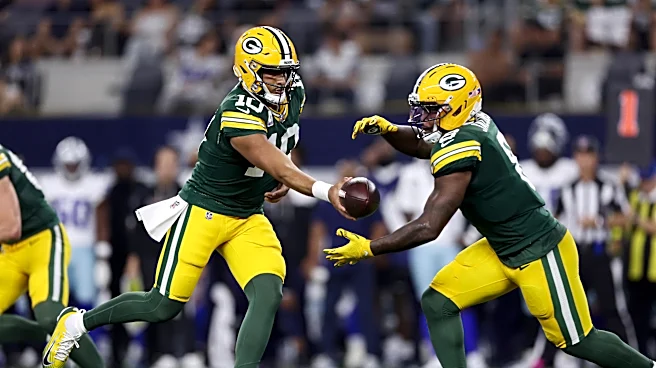
Jacobs touches the ball more frequently than any other offensive player whenever he’s on the field. He is the engine of the Packers’ offense. The ball is in his hands, and as goes Jacobs (or any other running back), so goes the offensive attack.
This is a mistake. This is a self-induced opportunity cost conundrum, powered by two different aspects of the offense built simultaneous but competing with one another. There’s the pass-heavy, Jordan Love-and-his-band-of-merry-men version, and there’s the version where Josh Jacobs pounds away for 93 yards on 26 carries every Sunday. They can exist together, but the Packers haven’t allowed them to.
So it’s time for the opportunity cost to reverse. If the Packers’ offense is going to change, someone is going to have to pay for it in a reduction of touches, and it should be Jacobs and the rest of the Packers’ ground attack. Let Love be the focus. Let him orchestrate an aerial attack with this curated selection of receivers, now battle tested and healthy. Reverse the trends of run-heaviness that have defined the Packers for the last three years.
Because if not now, when? I don’t know the answer to that, but I do know that if Matt LaFleur can’t be flexible in his approach on offense, he might not be the one that gets to envision a new version of the Packers’ offense in the future.