
#1 – Queta generated 19 points through screens
Neemias Queta might be the best screener in the NBA at the moment. At least, looking at this chart, he is the player with the most points via screen assists relative to his playing time.

Last night, he
helped the Celtics score 19 points with his screens, starting with the first bucket: an off-ball stagger for Derrick White, then a re-screen from Queta and, here you go, an open shot.
I also really like this play, where he sets a first ghost screen on the ball that freezes his matchup for a second, then runs toward Sam Hauser for a pindown screen. And because Jakob Pöltl is late due to Queta’s speed and that ghost screen, Hauser is wide open.
He also runs the same type of step-up screen that Luke Kornet was doing, in which he hands off the ball while setting a strong screen that surprises and traps the defender.
He played more than usual last night because, on top of his screening, he created extra possessions and was key in the Celtics’ defensive scheme against Toronto’s strong isolation scorers. With him on the court, the Celtics had an alternative to break the Raptors’ defensive shell. The other way was with the stunt beaters.
#2 – Stunt beaters
The Raptors have an aggressive defensive approach on drives, as they try to close space as much as possible with the closest defender stunting as soon as the ball-handler attacks the rim. They believe in their guys to stay connected to the shooter they leave and then make a hard contest to avoid open looks… the problem for the Raptors is that the Celtics are full of “stunt beaters.”
Derrick White, Payton Pritchard and Sam Hauser are among the best players to beat a stunt, especially the first two because they can do multiple things off the catch. The Celtics make sure that one of these players is one pass away from the ball so that, in any situation, if the Raptors are too greedy on the closeout, they can punish.
What is amazing with these guys is that they can do it from very far out. Therefore, the closeout becomes even more complicated for the defense and the Celtics get either better spacing or an open shot from 28 feet.
#3 – Tough shot maker duel
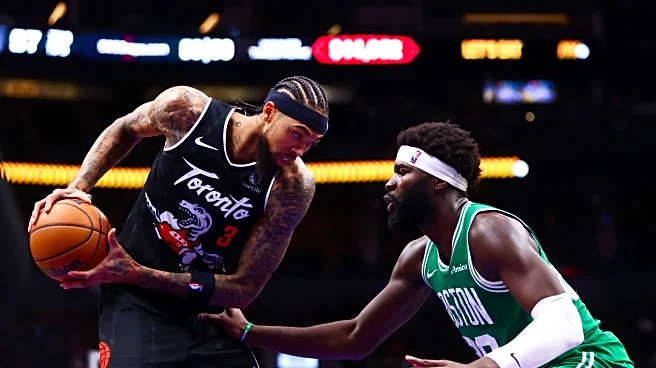
With Brandon Ingram and Jaylen Brown, we knew a shot-making battle was about to take place in Toronto. They both lead their team’s offense and are the two players with the biggest mid-range volume after the very unique DeMar DeRozan.
The Celtics’ go-to guy took seven long mid-ranges but made only one, while the former Pelican went six-for-ten from that zone. But overall, they both scored 30 points on 65% true shooting efficiency.
They had some one-on-one possessions to spice things up and delivered great highlights for the old-school fans who enjoy these types of duels.
#4 – Derrick White leading the way
Alongside JB, D-White had a lot of responsibility offensively with a 30.4% usage rate, one of his highest marks of the season. Against a defense that tries to take away the paint, White was able to remain efficient thanks to his jump shots.
After a rough first part of the season, White can finally trust his shot, and that makes a big difference for the team, especially against such a defense. Late in the game, it was his shooting that helped give the Celtics the win.
#5 – Dealing with Scottie Barnes post-up
When the Celtics went small in the first half, the Raptors got back into the game offensively by using Barnes as a creator. His strong frame was impossible to deal with for the Celtics one-on-one. Both Josh Minott and Jordan Walsh got bullied by the former Rookie of the Year.
The Celtics then went with Hugo Gonzalez on him, and they started sending more help, opening passing opportunities at the rim or above the three-point line.
This is where Neemias Queta’s rim protection came into play. He was used a lot as the safety when Barnes was attacking the Celtics’ wings. In the second half, the Celtics did a better job of overloading the side of the floor where Scottie had the ball to force him to make a difficult pass or retreat.
In the second half, he was limited to only two free throws and seven points, and committed two turnovers in almost 20 minutes.
#6 – Limited the Raptors to 15 points in the last 10
After capitalizing on a strong run, the Raptors were back in the game with 10 minutes to go. The Celtics changed their approach to better protect the paint and decided to live with the shooting variance from beyond the arc.
They forced the Raptors to kick the ball out and trust their shooters, with eight three-pointers attempted over the final 10 minutes, but only one went in. By forcing the shots the Raptors didn’t want and securing rebounds, the Celtics were able to play off misses and eventually take control of the game.
As Walsh fouled out, Sam Hauser came back into the game and the Raptors found a gap in the defense again, but it was too late.
#7 – Sam Hauser was targeted all night
The Raptors, similarly to the Celtics, like to hunt mismatches. With Ingram or Barnes, they went after his lack of size. With Jamal Shead or Immanuel Quickley, they targeted his lateral speed.
As Hauser often plays with the small-ball bench units, the Celtics have more difficulty hiding him because they switch frequently and lack size behind him to protect the rim.
At the same time, Hauser is key to the small-ball lineup because he provides the spacing that is required alongside Josh Minott, Anfernee Simons, Hugo Gonzalez and Baylor Scheierman. Finding the right balance is hard, but it might be best to pair him more often with Queta so the Portuguese big man can cover for him defensively.
#8 – Bench struggles
Hauser wasn’t the only one who struggled during the bench minutes last night. Against a strong and aggressive Raptors second unit, both Josh Minott and Anfernee Simons struggled to impact the game positively.
Minott couldn’t hold his ground defensively as he usually does, and Simons scored 12 points with a problematic 0.85 points-per-shot efficiency.
Hugo brought a small spark with two made shots in two minutes, along with some defensive activity against Scottie Barnes.
#9 – The Celtics starting five dominating the glass
With the current starting lineup, the Celtics seem to have found a formula to dominate the boards on both ends of the floor. When they share the court, Pritchard, White, Brown and Walsh grab offensive rebounds on 35.3% of opportunities, while holding opponents to 25.4%.
After a start to the season in which defensive rebounding was a major weakness, the Celtics appear to have found a solution.
#10 – Third in the east
The Celtics have the third-best net rating in the Eastern Conference and rank sixth in the NBA. What if, after a few trades (Myles Turner for Anfernee Simons?) and Jayson Tatum’s return (after the All-Star break?), the Celtics actually had a chance to compete for a spot in the NBA Finals?