

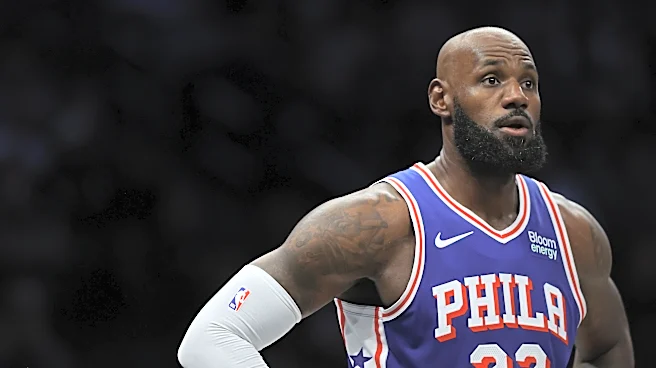

LeBron James is already all over the NBA’s record books. Heading into the 2026-27 season, he’s first in league history in regular-season points (43,440 and counting), games played (1,622), minutes played (61,030), made field goals (15,961), field-goal attempts (31,502), win shares (276.8) and value over replacement player (159.4).
LeBron is widely considered no worse than the second-best player in NBA history, depending on how old you are/how you feel about Michael Jordan. While LeBron has the leg
up on Jordan in most counting stats, Jordan has the edge in championship rings (six to four) and Finals record (6-0 vs. 4-6).
To some, that’s where the story starts and ends. There’s nothing LeBron can do to jump over Jordan given his deficit in the ringzzzzz department and his sub-.500 Finals record. (Whether it makes sense to punish LeBron for helping guide more teams to the Finals is another matter entirely.)
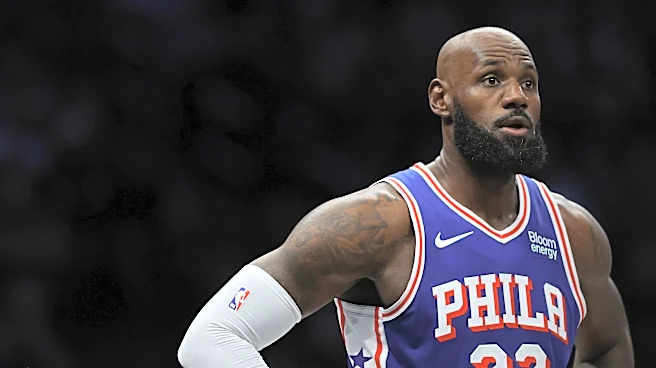
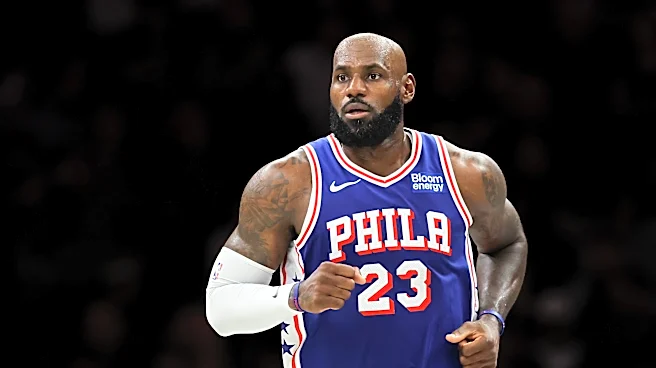
LeBron signed with the Sixers this offseason because he thought they gave him his best chance at winning a fifth championship. Even if he does win a title with the Sixers, it still might not be enough to vault him over Jordan as the NBA’s consensus GOAT. But it would put him in even more unique historical company.
How a Sixers ring would impact LeBron’s legacy
LeBron is already one of only four players in NBA history to win a championship with three different teams. John Salley, Robert Horry and Sixers legend Danny Green are the other three, and none of them were the focal point of their respective teams like LeBron was.
But if LeBron wins a championship with the Sixers, he’ll become the first player in league history ever to win with four different teams.
Again, that might not be enough for him to supplant MJ in all-time rankings. But that feat would be the perfect encapsulation of LeBron’s career.
After spending the first seven years of his career with his hometown Cleveland Cavaliers, LeBron ushered in the so-called Player Empowerment Era with “The Decision” in 2010. Rather than stick it out with the Cavaliers for his entire career, a la Kobe Bryant on the Los Angeles Lakers or Tim Duncan on the San Antonio Spurs, he took his fate into his own hands and sought greener pastures that might put him closer to a championship. Four years later, he had two rings and two Finals MVPs to show for it.
In 2014, LeBron exercised his early termination option to opt out of the final two years of his contract with the Miami Heat and head back home to the Cavaliers. In his absence, they landed the No. 1 pick in 2011 (Kyrie Irving), 2013 (Anthony Bennett) and 2014 (Andrew Wiggins), the latter of whom they’d eventually trade to the Minnesota Timberwolves for Kevin Love. Two years later, LeBron and the Cavs overcame a historic 3-1 series deficit to topple the 73-win Golden State Warriors in the 2016 NBA Finals.
And two years later, LeBron once again left Cleveland to sign with the Los Angeles Lakers. That also resulted in a ring—one with a Disney bubble-sized asterisk, depending on who you ask—in 2019-20.
Perhaps more than any modern star, LeBron understands the typical life cycle of NBA team-building. Once you get a star, you begin cashing in whatever chips you have (draft picks, young prospects, etc.) to maximize your win-now window. But at a certain point, you’re out of chips to play.
At that point, the star has two choices: tough it out through some rebuilding years and hope his team strikes gold with some under-the-radar moves, or head elsewhere. As Damian Lillard and Giannis Antetokounmpo have proved in recent years, unyielding loyalty to a team often devolves into frustration. LeBron never allowed himself to get to that point throughout any of his career stops.
Other stars have taken LeBron’s lead over the past 15 years and have exerted more control over their own careers. Players who spend their entire careers with one team are a nearly extinct species, although Stephen Curry may wind up being a rare exception. It’s now far more common for stars to force their way off teams via trade—see: Kevin Durant and James Harden—since free agency for superstars is largely dead as well.
Durant might have been directly responsible for the creation of the “supermax” contract, but James’ decision to leave Cleveland in 2010 was a wake-up call to owners who expected player loyalty to outweigh their desire to compete for championships. LeBron exerted win-now pressure on every team that he ever played for, and deservedly so.
Beyond his laundry list of NBA records, that’s going to be a major part of his legacy. Becoming the first player in league history to win a title with four different teams would therefore be a fitting culmination for that aspect of his career resume.
Unless otherwise noted, all stats via NBA.com, PBPStats, Cleaning the Glass or Basketball Reference. All salary information via Spotrac and salary-cap information via RealGM.
Follow Bryan on Bluesky.