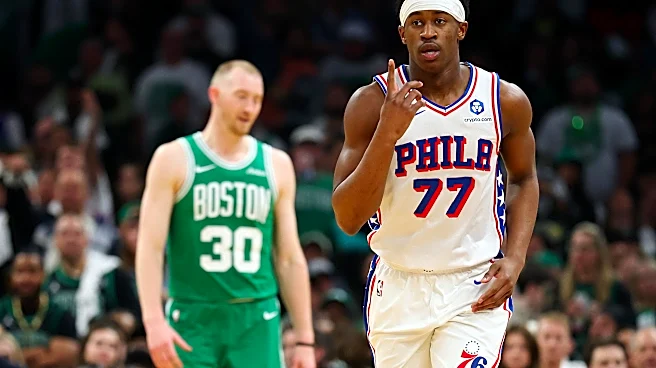



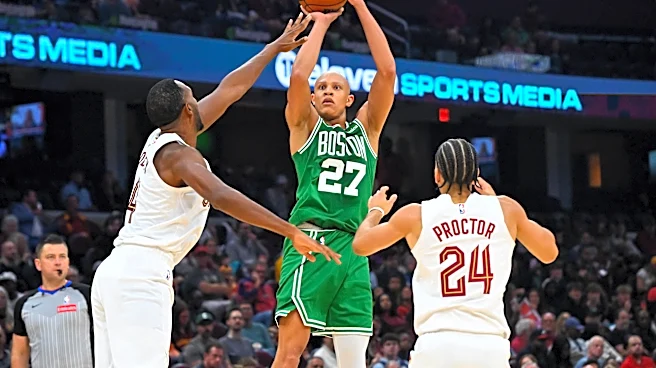
The Celtics finally unveiled something resembling their actual team Saturday night.
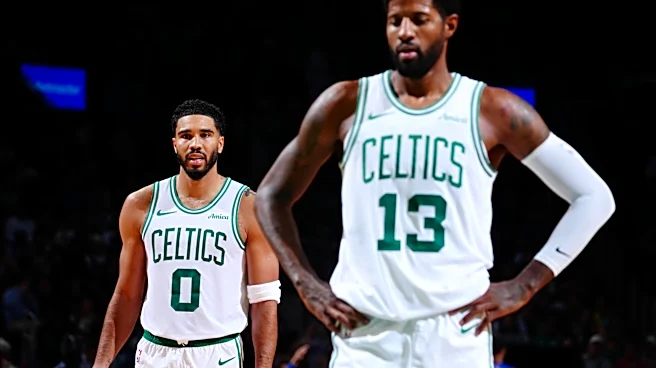
Joe Mazzulla started Jayson Tatum, Paul George, Jordan Walsh, Derrick White and Mitchell Robinson against Philadelphia. Payton Pritchard and Neemias Queta, two of Boston’s most frequent starters last season, came off the bench.
For a few minutes, we had something to study.
Boston fell behind 8-0. The new starting group looked like five players who had, in fact, never started a basketball game together before. Then, the Celtics
settled in.
Tatum started creating cleaner looks. Queta and Sam Hauser gave the first unit some life off the bench. Pritchard started raining threes. George spent his debut materializing in passing lanes like a green-clad Nightcrawler. By halftime Boston led 63-42, and by the end of the third quarter it was 104-69.
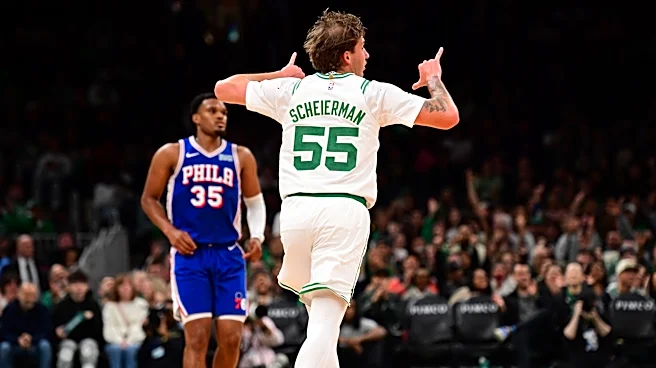
The fourth quarter technically still required five Celtics to play basketball. It just didn’t require anything resembling a closing lineup. Boston opened it with Pritchard, Hauser, Baylor Scheierman, Hugo González and Luka Garza while Tatum & Co. watched the rest of a 144-106 demolition from the bench.
An interesting question survived the night untouched.
We can spend October debating who starts. There are real implications there. But the five names announced before tipoff tell us something different from the five Mazzulla wants on the floor with 2:14 left and Boston protecting a three-point lead or trying to erase one.
Last season gave us plenty of reason to care about the distinction. The Celtics went 56-26 with a plus-8.1 net rating, but finished 16-17 in clutch games, where their net rating fell to plus-1.9. The best version of this year’s team needs to be more dependable there.
I don’t think the answer is finding one magical lineup that Mazzulla can laminate and keep in his pocket all season like a prized Pokémon card. Boston has too many different kinds of players for that. The opponent gets a vote. So do the score, foul trouble, whether the Celtics need a bucket or a stop, and whichever Celtic has decided that particular night belongs to him.
Somehow, this exercise won’t even include Luka Garza, Mike Conley, Ron Harper Jr. or the other guys who will inevitably save Boston on some otherwise forgettable Tuesday, which already feels a little disrespectful. Alas, the exercise continues.
Without further ado, here are Grant’s Four Tests for Building a Quality Closing Lineup™. Joe Mazzulla has not yet asked to see them.
1. Who can create something when the first idea fails?
Everybody has watched the late-game possession.
The first action gets switched. Tatum gives it up and never gets it back. With four seconds left, someone who was supposed to stand in the corner is suddenly dribbling sideways into a shot he has never practiced. Or Tatum does get it back, three feet beyond the line, with two defenders arriving and no choice but to launch.
Boston had too many of those possessions last year.
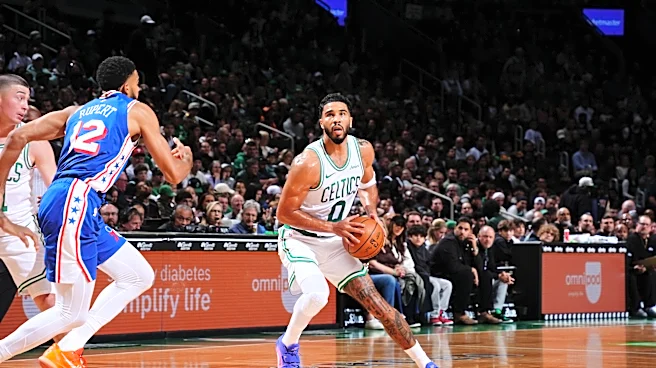
Tatum is obviously the person you want solving most of them. His 16-game regular-season return produced some uneven shooting, but he still averaged 21.8 points, 10 rebounds and 5.3 assists. Saturday was a useful reminder that when Tatum forces the defense to make two decisions at once, everybody else suddenly looks smarter. He found a cutting Queta early, hit Hauser on another cut and later slipped an underhanded pass to Pritchard for a deep three. He finished with 23 points and four assists against only one turnover.
White is probably the least interesting name to debate because he belongs in almost every version of the lineup.
His shooting numbers dipped last year, but he still averaged 5.4 assists against only 1.7 turnovers. He can bring the ball up, start an action, attack a rotating defense or simply make the next decision without hijacking the possession. You know, Derrick White things.
Even the advanced models have caught up to the strange challenge of quantifying Derrick White. LEBRON, which estimates a player’s impact using box-score and on/off data, rated him ninth in the league last season at plus-4.59. DARKO, a projection model built to estimate a player’s underlying value over time, currently has him around plus-2.0.
For a player whose appeal has always included dozens of things that barely register in a box score, the computers seem to be figuring him out.
George gives Boston another escape hatch.
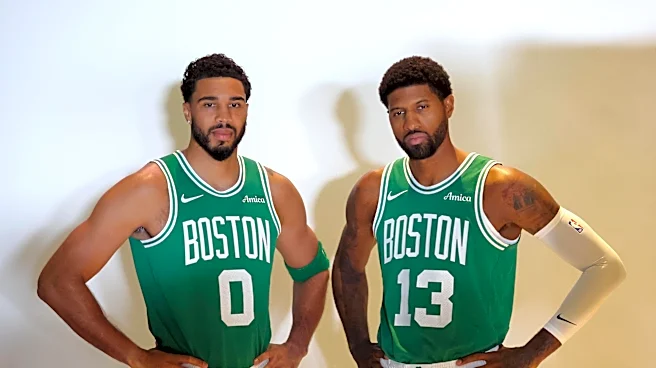
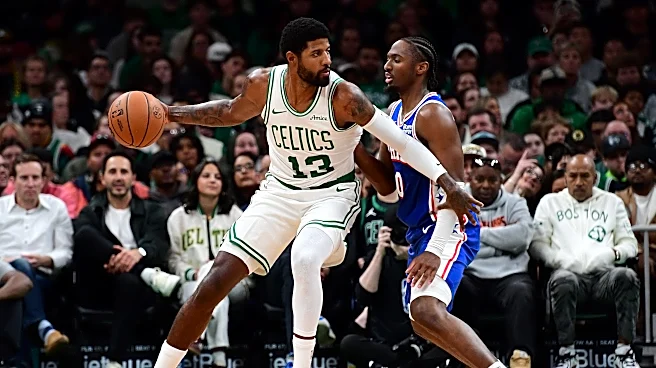
To be clear, he doesn’t need to be 2019 Paul George. The version Boston saw from the other side during last year’s playoffs would do just fine. At his best, George will punish the wrong switch, knock down a pull-up when a possession gets stuck and occasionally create something when Tatum has already forced the defense to move. Saturday’s five steals got most of the attention, but even an uneven offensive debut for George showed why another large wing who can dribble, pass and shoot changes Boston’s options.
Then there’s Pritchard.
Pritchard averaged 17 points and 5.2 assists last year while turning it over only 1.4 times per game. Against Philadelphia, he scored 25 with seven assists and hit five threes. Put him next to Tatum, White and George, and it becomes very difficult for a defense to completely kill a possession. Boston would have four players comfortable doing something with the ball after Plan A disappears.
That is a compelling case for Pritchard as the fourth member of most offensive closing groups.
It also comes with a price.
2. Who can make Tatum’s life easier without needing the ball?
The closer you get to the end of a tight game, the more valuable it becomes to have players who can affect a possession without asking for control of it. That’s where this roster gets much more interesting than simply sorting everyone by scoring average.
Pritchard provides obvious gravity. He shot 37.7 percent from three last season on more than seven attempts per game, and defenses know exactly what happens if they lose him 28 feet from the basket.
Hauser offers a similar threat with more size. You can imagine a five-out lineup with Tatum, George and White attacking while every potential help defender is attached to a shooter.
But I’m much more interested in the younger wings here than I was a year ago.
Scheierman, in particular, feels almost purpose-built for the way Mazzulla talks about basketball. “Give the game what it needs” has become one of Joe’s favorite ideas, and Baylor increasingly looks like the human embodiment of it.
He doesn’t need to decide before every possession that it’s his turn to score. Instead, he’ll make the extra pass. He’ll cut. He’ll rebound. He’ll move into the open space instead of standing around waiting for somebody to notice him. Against Philadelphia, he found González for a basket and then immediately created another possession with a steal. Later, he was part of the young group that kept piling on long after the starters were finished.
None of that is especially sexy, which is probably why it matters so much in the final two minutes.
Sometimes the right closer is the player least likely to interrupt what your best players are already doing.
González can enter this conversation for a different reason. He went 4-for-4 from three Saturday, but his appeal isn’t dependent on suddenly becoming a 100 percent three-point shooter, which seems like an unreasonable development goal. He brings size, activity and a willingness to make himself useful inside the flow of a possession. He drew an offensive foul against Philadelphia, moved the ball and kept finding places to impact the game.
Walsh is trying to earn his way into the same neighborhood.
His path is pretty straightforward. Defend. Cut. Run. Make the fast read. He doesn’t need Boston to design anything for him. If his decision-making catches up to his physical tools, there will be nights when his size and defense make considerably more sense next to the stars than another scorer would.
The centers solve another problem entirely.
Queta can screen, dive, clean up misses and give Tatum an obvious target around the rim. Robinson can turn a bad possession into a good one after the shot has already missed, which we saw come to life on Saturday. Boston outrebounded Philadelphia 63-34 and grabbed 19 offensive boards. That kind of possession extension has real late-game value when every extra shot feels stolen.
Of course, playing either center changes the geometry for everyone else.
3. Who can survive the hunt?
Late-game NBA offense can get hilariously unsophisticated. For most teams, it goes something like this.
Find the defender you respect the least. Bring his man into the action. Repeat relentlessly until somebody does something about it.
Boston has three players who should feel pretty comfortable on the other side of that exercise.
Tatum’s size makes him switchable across the entire floor. White was First Team All-Defense last season and posted a plus-2.32 defensive LEBRON. George is 36, but Saturday was a nice reminder that his length and anticipation haven’t disappeared.
Pritchard competes like hell and is stronger than most guards his size. Still, opponents aren’t going to admire his effort and politely attack somebody else. That doesn’t disqualify him. His offense might be worth the bargain. But there will be nights when the opponent makes the bargain considerably less appealing.
One of Boston’s younger wings could take those minutes from him. Walsh has the cleanest defensive tools. González brings more size, while Scheierman keeps turning his anticipation into deflections, steals and possessions going the other way.
None of them has to become a better overall player than Pritchard to make more sense for one particular final three minutes. Against a team with several large creators, another 6-foot-6 or 6-foot-7 defender who can switch without immediately forcing Boston into emergency help might be more valuable than another ballhandler.
The same choice exists at center. Queta and Robinson both give Boston real rim protection and rebounding, but neither is automatically the answer against every lineup.
Need a stop after a timeout? Robinson might be the guy I trust most to erase something around the rim or beyond.
Need to finish the final four minutes without handing the opponent an obvious late-game pressure point? Queta’s familiarity with Mazzulla’s system and better free-throw shooting might make him easier to leave out there.
Need to switch everything against five shooters?
Maybe neither is closing.
4. Who can keep making the right decision when the game speeds up?
This is the test I care about most, and it’s also the one no advanced metric can cleanly hand us.
The final few minutes punish hesitation.
A player has half a second to decide whether to shoot, drive or move it. Somebody misses a rotation and has to recover without compounding the mistake. The crowd gets loud, a whistle goes against you, somebody turns it over, and the next possession still needs five people making sound basketball decisions.
The veterans have already lived through most versions of the final two minutes, including several they would probably prefer not to revisit.
Tatum, White and George have played 342 combined playoff games. Pritchard has been through a championship run and years of Mazzulla learning exactly what he can and cannot trust him to do. But experience isn’t the only route to trust.
Scheierman is the young player I keep coming back to here.
Some guys look calm because they aren’t doing much. Baylor looks calm until the possession gives him something useful to chase, at which point he has the energy of a dog hearing the cheese drawer open from the other side of the house. There’s a difference.
González has a chance to force the same conversation with his defense and physicality.
Walsh probably has the widest gap between the player he can look like for two possessions and the player Mazzulla can trust for ten consecutive ones. Saturday showed some of both his appeal and the simplicity of his path. He blocked a shot that became a White three, then knocked down a three himself while Robinson occupied the defense inside. Those are the kinds of possessions that earn minutes because Walsh didn’t need to become the center of either one.
Speaking of centers, the big man decision gets particularly uncomfortable here.
Robinson might be Boston’s best rebounder and most imposing interior presence. He also shot 40.8 percent from the free-throw line last season and missed all three attempts Saturday. If an opponent decides to foul him intentionally, Mazzulla suddenly has to weigh everything Robinson gives him against the possibility that every offensive possession ends with a free-throw adventure.
Meanwhile, Queta shot 70.3 percent from the line last season and has considerably more experience in Boston’s system.
Some nights, that stability will win. Other nights, Robinson might grab four offensive rebounds in six minutes and make removing him feel insane.
There shouldn’t be a universal answer.
So, who actually closes?
If I had to choose the three names I expect to see most often, those are easy.
Tatum. White. George.
After that, I want Mazzulla to resist the temptation to decide until it’s time to decide.
Pritchard probably has the strongest claim to a fourth spot because shooting and secondary creation become incredibly valuable when defenses load up on Tatum. There will be plenty of nights when he belongs there.
The fifth spot is where the opponent should start dictating the lineup for Boston.
Against teams that force Boston to defend size for 48 minutes, like Denver, Orlando or Miami, give me Queta or Robinson. If Boston needs to spread the floor completely, Hauser can pull another defender out of Tatum’s driving lanes. If the opposing lineup has enough size to hunt Pritchard, maybe González, Walsh or Scheierman becomes the better answer.
And if one of those young guys spends the first 45 minutes making every correct decision, I don’t particularly care where he sat in the pecking order two weeks earlier. Leave him out there.
Saturday showed why there are so many plausible answers. Almost everybody auditioning for those final two spots gave Mazzulla something different.
The problem, if we can call it one, was that Boston played too well to learn anything about the question we’re trying to answer.
Nobody had to protect a two-point lead with 90 seconds left. Nobody had to choose between offense and defense. Mazzulla never had to decide whether he trusted Pritchard’s shotmaking more than an opponent could punish his size, or whether Robinson’s rebounding was worth the free-throw risk, or whether one of his young wings had earned the right to stay on the floor.
Eventually, somebody will keep a game close enough to make him choose.
I just don’t think he should make the same choice every time.