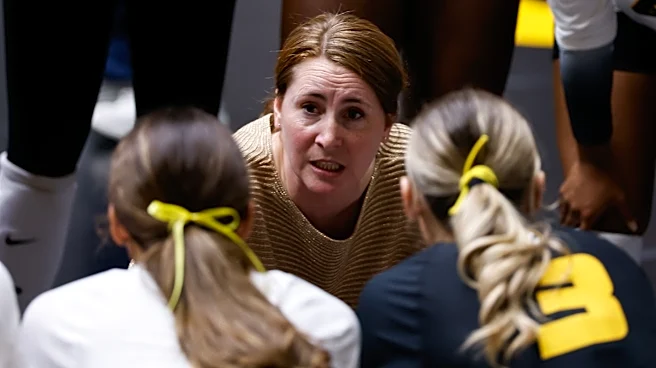







The lights dim, the music swells and another crowd files into the Hearnes Center. Long before the first serve, anticipation fills the arena. In just a few seasons, Missouri volleyball transformed from a program searching for consistency into one that expected meaningful matches every weekend.
That transformation did not happen overnight, but it happened quickly.
When Dawn Sullivan arrived in Columbia before the 2023 season, she inherited a program looking for direction in one of the nation’s toughest
volleyball conferences. Expectations were modest. Competing in the Southeastern Conference meant every weekend brought another ranked opponent and another opportunity to measure where the Tigers stood.
Instead of slowly rebuilding, Sullivan accelerated the process.
Her first teams played with confidence and aggressiveness that immediately changed the conversation surrounding Missouri volleyball. The Tigers became one of the SEC’s rising programs, earned NCAA Tournament appearances and consistently challenged some of the country’s best teams. National rankings followed. So did increased attention from recruits and fans.
Success quickly became the expectation rather than the surprise.
That is what made last season feel so different.
For the first time in Sullivan’s tenure, Missouri never found the rhythm that had defined its rise. The Tigers battled through stretches of inconsistency, struggled to string together momentum against a relentless SEC schedule and finished with a season that felt underwhelming compared to the lofty standards established during the previous three years.
The disappointment was not rooted solely in wins and losses.
It came from expectations that had fundamentally changed.
Programs do not experience frustration after average seasons unless they have first experienced excellence. Missouri volleyball had reached that point. A season that once might have been considered respectable instead left questions about what had gone wrong and how quickly the Tigers could respond.
That shift says as much about Sullivan’s impact as the victories themselves.
She elevated the standard.
Recruiting classes became stronger. The roster became deeper. Missouri developed into a destination capable of attracting talent from across the country and internationally. Players no longer arrived hoping to help rebuild the program. They arrived expecting to compete for postseason opportunities.
That cultural change is often harder to create than a winning season.
It requires convincing athletes that success is sustainable rather than temporary. It requires establishing habits that remain even when results do not. Most importantly, it requires building belief that one difficult year does not erase everything that came before it.
The Tigers now enter a season unlike any they have faced under Sullivan.
Instead of chasing validation, they are chasing a response.
Every successful program eventually encounters adversity. Championship contenders lose experienced players. Young athletes are forced into larger roles. Opponents adjust. Expectations grow heavier with every victory that came before.
How a team responds often defines a program more than how it first rose to prominence.
Missouri has already shown what it looks like when everything clicks. The Tigers have celebrated NCAA Tournament appearances, climbed the rankings and established themselves as one of the SEC’s consistent contenders. The next chapter will determine whether those accomplishments represent the foundation of sustained success or the high point of an early surge.
There are reasons for optimism.
Sullivan has continued to invest heavily in recruiting while adding experienced talent capable of helping the Tigers compete immediately. The foundation that produced those successful early seasons has not disappeared. Neither has the competitive culture that helped Missouri accelerate its climb through the conference.
The challenge now is turning potential back into results.
That journey begins well before the first serve of the season.
It starts in offseason workouts, summer practices and preseason training sessions where veterans set expectations and newcomers learn what Missouri volleyball has become. Every repetition is another opportunity to reclaim the identity that made the Tigers one of the SEC’s most intriguing programs.
That is where this series begins as well.
First Serve will follow Missouri volleyball leading up to the season, and throughout the year, documenting the victories, setbacks and defining moments that shape the Tigers’ pursuit of a return to national relevance. There will be breakout performances, difficult road trips, dramatic finishes and lessons learned along the way.
Because after the first disappointing season of the Dawn Sullivan era, the story is no longer about how Missouri became a contender.
It is about whether the Tigers can prove that one difficult year was simply the pause before the next climb.